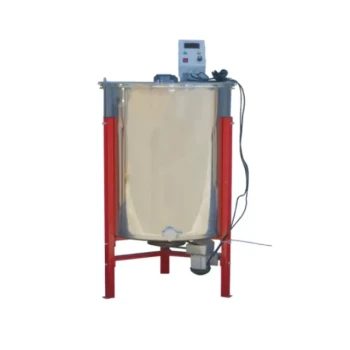
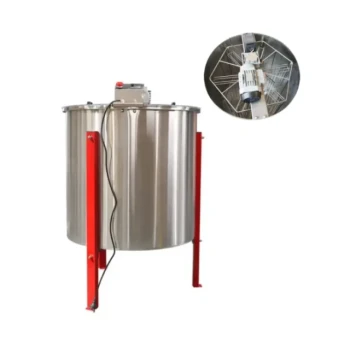
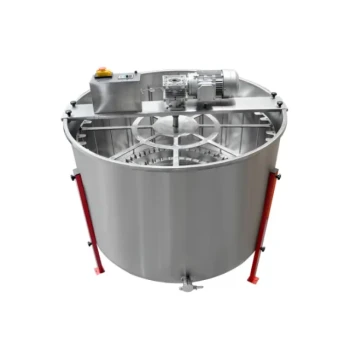
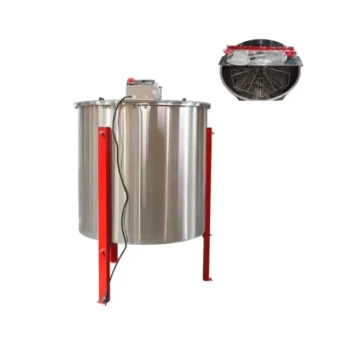
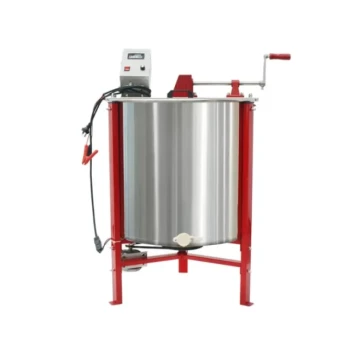
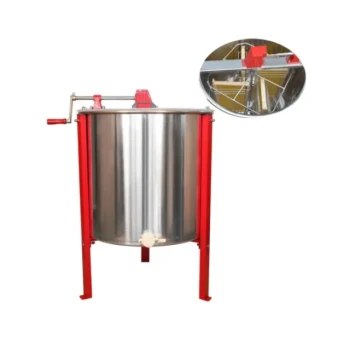
Industrial centrifuges serve as the cornerstone of efficiency in large-scale honey production. By utilizing high-speed rotation, these machines generate controlled centrifugal force to physically separate liquid honey from the comb. This process allows for the rapid extraction of honey while ensuring the wax foundation remains structurally intact, distinct from traditional pressing methods that crush the comb.
The definitive advantage of the industrial centrifuge is its ability to extract honey without destroying the beeswax infrastructure. This enables the immediate reuse of combs, shifting the colony’s biological resources from rebuilding wax to maximizing honey production.
The Mechanics of Non-Destructive Extraction
Preserving Structural Integrity
Traditional harvesting often involves pressing or crushing the honeycomb, which destroys the wax cells. Industrial centrifuges avoid this by spinning the frames, using physical force to pull the honey out while leaving the delicate wax foundation undamaged.
Processing High-Viscosity Varietals
Certain honey types, such as heather or honeydew, possess high viscosity that makes gravity draining inefficient. High-efficiency centrifuges apply controlled force to extract these thicker liquids rapidly. This capability ensures that even difficult varietals can be harvested without resorting to heat or destructive methods.
Economic and Biological Impact
Eliminating the "Wax Tax" on Bees
Producing beeswax is metabolically expensive for a honeybee colony; bees must consume significant amounts of nectar and energy to secrete wax. When a centrifuge allows you to return intact empty combs to the hive, the bees are spared this energy expenditure.
Accelerating the Production Cycle
Because the bees do not need to rebuild the comb structure, they can immediately begin refilling the cells with nectar. This drastically shortens the turnaround time between harvests. During a limited flowering season, this efficiency directly translates to higher overall yield per hive.
Quality Control and Hygiene
Enhancing Purity Standards
The physical separation method used by centrifuges minimizes the risk of contamination. Unlike pressing, which may mix pollen, wax particles, or environmental impurities into the final product, centrifugation isolates the honey cleanly.
Reducing Processing Time
Commercial apiaries deal with large volumes that must be processed quickly to maintain quality. Industrial centrifuges significantly increase the extraction rate compared to manual methods. This speed reduces the honey's exposure time to the processing environment, further safeguarding its sensory qualities.
Understanding the Trade-offs
The Necessity of Controlled Force
While the primary goal is speed, the force must be carefully modulated. If the centrifugal force is uncontrolled, it risks damaging the very comb structure you intend to save. The equipment must be calibrated to balance extraction speed with the physical limits of the wax foundation.
Dependence on Maturity
Centrifuges are designed specifically to extract from mature, capped honeycomb cells. Attempting to process uncapped or immature frames may lead to inconsistent extraction or moisture issues. The efficiency of the machine relies on the beekeeper's ability to supply properly ripened frames.
Making the Right Choice for Your Operation
For commercial operators, the centrifuge is not just an extraction tool; it is a colony management asset.
- If your primary focus is maximizing yield: Prioritize returning spun, intact combs to the hive immediately to eliminate the biological downtime required for wax reconstruction.
- If your primary focus is product quality: Leverage the centrifuge's ability to separate honey without crushing to produce a cleaner product free from the debris common in pressed honey.
- If your primary focus is efficiency: Utilize the high-speed throughput to process heavy, viscous flows like heather honey that would bottleneck manual extraction lines.
By preserving the comb, you effectively treat the wax infrastructure as a permanent capital asset rather than a disposable resource.
Summary Table:
| Feature | Benefit | Impact on Production |
|---|---|---|
| Centrifugal Force | Non-destructive extraction | Allows immediate comb reuse; saves bee energy |
| High-Speed Rotation | Rapid processing | Shortens turnaround time during peak flow |
| Precision Separation | Enhanced honey purity | Reduces debris and contamination vs. pressing |
| Viscosity Handling | Process thick varietals | Efficiently extracts heather or honeydew honey |
Optimize Your Harvest with HONESTBEE
Ready to elevate your commercial honey production? HONESTBEE provides the full spectrum of professional beekeeping tools, machinery, and consumables tailored for large-scale operations and distributors. From advanced honey-filling machines to durable industrial centrifuges, our wholesale solutions are designed to maximize your yield and protect your beeswax assets. Contact us today to explore our catalog and see how we can support your business growth.
References
- Elizabete Satsuki Sekine, Vagner de Alencar Arnaut de Toledo. Floral Origin and Physical and Chemical Characteristics of Honey from Africanized Bees in Apiaries of Ubiratã and Nova Aurora, State of Paraná. DOI: 10.13102/sociobiology.v66i1.3385
This article is also based on technical information from HonestBee Knowledge Base .
Related Products
- Manual Hand Crank 4 Frame Honey Extractor Centrifuge for Beekeeping
- electric honey extractor honey centrifuge 3 frame honey extractor stainless steel honey frame extractor
- Professional 4 Frame Self Reversing Electric Honey Extractor for Beekeeping
- HONESTBEE 72 Frame Industrial Electric Honey Extractor for Beekeeping
- Honey Concentrating and Filtering Dehumidifier Machine 2T Capacity for Honey
People Also Ask
- What are some tips for achieving efficient honey extraction with a centrifuge extractor? Maximize Your Yield & Efficiency
- What is the proper procedure for maintaining a centrifuge honey extractor? Expert Tips for Longevity and Hygiene
- What are the advantages of using a centrifuge honey extractor? Maximize Yields and Protect Your Honeycombs
- Which type of honey extractor is generally more durable? Focus on Material & Build Quality for Longevity
- What is a manual honey extractor? The Essential Guide to Cost-Effective Beekeeping for Beginners