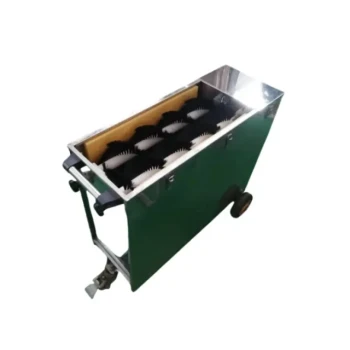
Industrial-grade migratory beekeeping equipment serves as the logistical backbone of commercial pollination. It provides the necessary physical stability to transport honeybee populations over long distances using standardized hive structures and reinforced brackets. By mechanizing the management of biological assets, these tools allow apiarists to fulfill large-scale agricultural contracts while ensuring colonies remain healthy enough to perform efficiently upon arrival.
The core value of industrial beekeeping equipment lies in converting fragile biological colonies into standardized, transportable units. It mitigates the physical stress of migration, ensuring that high-density pollinator populations can be deployed precisely when and where crops require them.
Ensuring Stability During Transport
Mitigating Physical Stress
The primary function of migratory equipment is to protect the colony during high-intensity relocation. Reinforced transport brackets and specialized structural components stabilize the hive, preventing collapse or shifting during transit.
By reducing vibration and physical shock, this equipment minimizes the stress placed on the bees. This preservation of energy is critical, as it ensures the population is active and ready to pollinate immediately upon reaching high-value crop areas.
Standardization for Logistics
Large-scale operations function like freight logistics; they require uniform units for efficiency. Standardized beehive structures allow for the secure stacking and palletizing of thousands of colonies.
This uniformity ensures compatibility across different transport vehicles and handling machinery. It transforms the complex biological management of individual hives into a streamlined, scalable industrial operation.
Optimizing Hive Health and Manufacturing
Precision Engineering for Biosecurity
Industrial-grade manufacturing machinery produces components with exceptional precision. This ensures that all parts of the hive fit together tightly, eliminating gaps that often appear in hand-crafted or lower-quality equipment.
These tight tolerances are crucial for disease and pest control. By reducing structural gaps, the equipment physically blocks the entry of pathogens and pests, such as the Greater Wax Moth, safeguarding the colony's internal environment.
Enhancing Assembly Efficiency
For operations managing thousands of hives, assembly time is a major cost factor. High-precision manufacturing ensures that standardized components are interchangeable and easy to assemble.
This "plug-and-play" capability reduces the labor required for hive maintenance and expansion. It allows operations to scale up rapidly without being bottlenecked by equipment preparation.
Strategic Mobility and Spatial Scheduling
Reacting to Pulse Flowering Events
Commercial pollination is a time-sensitive service. Mobile beehives and specialized carrying equipment allow beekeepers to rapidly relocate colonies to match specific blooming periods, such as those of oilseed rape or sunflowers.
This rapid mobility enables "spatial scheduling," where pollinators are moved across regions to chase peak bloom. This capability is essential for maximizing the fruit set rate in crops with short, intense flowering windows.
Compensating for Landscape Uniformity
Modern agriculture often results in simplified landscapes with few wild pollinators. Industrial equipment facilitates the introduction of Managed Introduced Multiple Species (MIMS) into these areas.
By strategically deploying hives into monocultures like apple orchards or oil palm plantations, managers can supplement natural deficits. This intervention directly increases yield per unit area and ensures economic returns for growers.
Understanding the Trade-offs
The Cost of Specialization
Adopting industrial-grade migratory equipment requires significant upfront capital investment compared to traditional stationary beekeeping. The machinery for precision manufacturing and the specialized transport fleets represent high entry barriers.
However, for commercial pollination, this is an operational necessity rather than a luxury. Attempting large-scale migration without this specialized gear often leads to higher colony mortality and breached contracts.
Biological Limits vs. Mechanical Efficiency
While equipment can optimize transport, it does not eliminate biological limits. Even with the best brackets and stabilization, migration is stressful for bees.
Operators must balance the efficiency provided by the tools with the biological recovery time bees need. Over-reliance on the durability of the equipment without accounting for colony fatigue can lead to population collapse despite technical precision.
Making the Right Choice for Your Goal
To maximize the effectiveness of your pollination services, select your equipment strategy based on your specific operational targets:
- If your primary focus is Logistics and Scalability: Prioritize high-precision manufacturing machinery to ensure every hive component is uniform, allowing for seamless stacking and transport of thousands of units.
- If your primary focus is Crop Yield and Timing: Invest in mobile carrying equipment and reinforced transport brackets to enable rapid, safe relocation during short "pulse flowering" windows.
- If your primary focus is Biosecurity and Colony Health: Focus on industrial-grade precision components that offer tight structural fits to physically exclude pests and reduce pathogen entry points.
Ultimately, industrial beekeeping tools are not just about housing bees; they are about engineering the reliability required to secure the global food supply chain.
Summary Table:
| Feature | Role in Commercial Pollination | Key Benefit |
|---|---|---|
| Reinforced Brackets | Stabilizes hives during long-distance transit | Reduces bee stress and colony mortality |
| Standardized Structures | Enables palletizing and mechanical handling | Streamlines logistics for thousands of units |
| Precision Engineering | Ensures tight-fitting components and gaps | Enhances biosecurity against pests like Wax Moths |
| Mobile Carrying Gear | Facilitates rapid relocation to blooming crops | Maximizes fruit set during pulse flowering events |
| Industrial Machinery | Automates hive and component manufacturing | Reduces labor costs and supports rapid scaling |
Scaling Your Apiary Operations with HONESTBEE
Transitioning from traditional beekeeping to a commercial-scale pollination service requires more than just bees—it requires industrial-grade reliability. HONESTBEE empowers commercial apiaries and distributors with the specialized infrastructure needed to dominate the market.
Our comprehensive wholesale portfolio includes:
- Precision Machinery: Hive-making and honey-filling machines for high-volume production.
- Durable Hardware: Standardized beekeeping tools and reinforced equipment built for the rigors of migration.
- Industry Consumables: A full spectrum of essentials to keep your colonies productive.
Whether you are expanding your fleet or supplying the next generation of industrial beekeepers, HONESTBEE delivers the precision and durability your business demands.
Ready to optimize your production and logistics? Contact us today to explore our wholesale solutions!
References
- Gabriela Byskov Petersen. 317 Applications for molecular breeding tools in honeybee populations.. DOI: 10.1093/jas/sky404.265
This article is also based on technical information from HonestBee Knowledge Base .
Related Products
- Queen Bee Artificial Insemination Instrument Equipment for Instrumental Insemination
- Stainless Steel J Hook Hive Tool for Beekeeping
- Stainless Steel Queen Grafting Tool for Beekeeping and Bee Queen Grafting
- Double Head Beekeeping Grafting Tools for Beekeepers
- Durable Galvanized Steel Frame Grip
People Also Ask
- Why is maintaining sanitary conditions important during artificial insemination? Protect Your Queen from Fatal Infections
- Why are artificial insemination instruments critical in bee hybridization? Master Genetic Control & Pure Breeding
- What is the core value of bee artificial insemination instruments in breed improvement? Achieve Precise Genetic Control
- Why is professional bee artificial insemination equipment considered a core tool for genetic control in honeybee breeding? Ensure 100% Purity
- Why is high-purity CO2 used for queen bee artificial insemination? Unlock Precision Breeding & Faster Egg-Laying