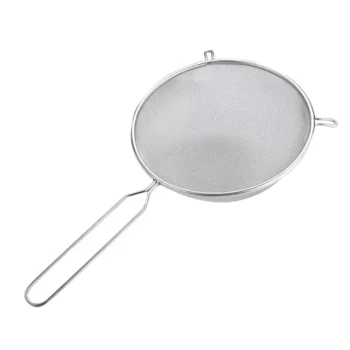
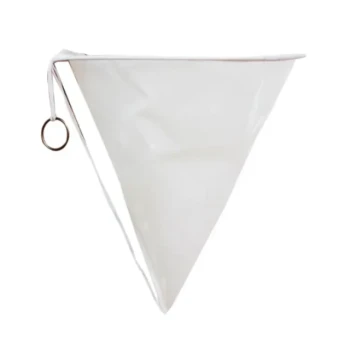
A fine sieve acts as the critical primary filtration mechanism during the pre-treatment of honey samples. Its specific function is to mechanically separate macroscopic impurities—such as wax particles, bee debris, and honeycomb fragments—while ensuring that microscopic pollen grains remain in the sample for analysis.
The sieve serves as a selective barrier that balances purity with analytical necessity. By removing physical contaminants without stripping away essential pollen, it creates a clean, homogenized substrate required for accurate microscopic classification and counting.
The Mechanics of Purification
Removal of Macroscopic Debris
The raw state of honey often contains various solid impurities introduced during the extraction or hive-crushing process.
A fine-mesh sieve acts as a physical barrier to intercept these larger contaminants. This effectively removes residual wax, bee parts, plant tissues, and honeycomb fragments that would otherwise contaminate the sample.
Preservation of Microscopic Targets
While the sieve removes debris, it plays a vital role in selective retention.
The mesh size is specifically chosen to allow microscopic pollen grains to pass through unhindered. This distinction is crucial; the goal is to clean the liquid matrix, not to sterilize it of the biological markers (pollen) needed for botanical origin analysis.
Impact on Analytical Accuracy
Reducing Background Noise
The clarity of the final microscope slide is directly dependent on this pre-treatment step.
By filtering out suspended impurities, the sieve prevents large contaminants from ending up in the pollen sediment. This significantly reduces background noise on the slide, ensuring that debris does not obscure the view of the pollen grains.
Ensuring Sample Homogeneity
Proper sieving ensures the honey sample is uniform before it undergoes further processing, such as microscope slide preparation.
This homogenization creates a consistent liquid substrate. A uniform sample ensures that subsequent physicochemical detection results and pollen counts are representative of the entire batch, rather than skewed by random particulate matter.
Understanding the Trade-offs
The Balance of Mesh Size
Selecting the correct sieve acts as a critical control point in the workflow.
If the sieve is too coarse, it will fail to remove sufficient debris, leading to a "dirty" slide that makes accurate counting impossible. Conversely, if the mesh is too fine, you risk filtering out larger pollen species, which would scientifically invalidate the sample by altering its botanical profile.
Making the Right Choice for Your Goal
To maximize the effectiveness of the pre-treatment stage, align your filtration approach with your specific analytical objective:
- If your primary focus is Pollen Analysis (Melissopalynology): Ensure the sieve allows for the free passage of all pollen sizes to guarantee a representative population for classification and counting.
- If your primary focus is Physicochemical Testing: Prioritize thorough removal of all solid particulate matter (wax and debris) to prevent interference with chemical property detection.
Effective pre-treatment is not just about cleaning the honey; it is about protecting the integrity of the data you intend to extract.
Summary Table:
| Feature | Function in Pre-treatment | Impact on Honey Analysis |
|---|---|---|
| Macroscopic Filtration | Removes wax, bee debris, and honeycomb fragments | Reduces background noise and slide contamination |
| Selective Retention | Allows microscopic pollen grains to pass through | Preserves biological markers for botanical origin profiling |
| Mesh Size Control | Balances debris removal with pollen preservation | Prevents scientific invalidation of the sample profile |
| Homogenization | Creates a uniform liquid substrate | Ensures consistent and representative physicochemical results |
Elevate Your Honey Processing and Analysis Standards with HONESTBEE
At HONESTBEE, we understand that the integrity of your honey products starts with precision equipment. Whether you are a commercial apiary or a specialized distributor, we provide the tools you need to maintain the highest analytical standards and production efficiency.
Our comprehensive wholesale offering includes:
- Advanced Machinery: From hive-making to high-precision honey-filling machines.
- Quality Tools: Professional-grade sieves and filtration equipment designed for accuracy.
- Essential Consumables: A full spectrum of supplies to keep your operations running smoothly.
- Cultural Merchandise: Unique honey-themed products to expand your market reach.
Ready to optimize your beekeeping operations? Contact us today to discover how HONESTBEE's industry-leading hardware and expertise can deliver superior value to your business.
References
- Cláudia Marques Gonçalves Simeão, Esther Margarida Alves Ferreira Bastos. Pollen analysis of honey and pollen collected by Apis mellifera linnaeus, 1758 (Hymenoptera, Apidae), in a mixed environment of Eucalyptus plantation and native cerrado in Southeastern Brazil. DOI: 10.1590/1519-6984.23513
This article is also based on technical information from HonestBee Knowledge Base .
Related Products
- Stainless Steel Double Layer Honey Strainer Sieve Filters
- Professional Stainless Steel Honey Filter with Support Handle
- Stainless Steel Triangle Support Honey Strainer and Filters
- Honey Concentrating and Filtering Dehumidifier Machine 2T Capacity for Honey
- Electric Double Wall Honey Filtering Machine Purifier Equipment for Honey Processing Plant
People Also Ask
- What are some typical mesh size combinations found in double sieve honey strainers? Expert Guide to Honey Filtration
- How is a double-layer honey filter used for monitoring Varroa mite infestation? Achieve Precise Pest Control Data
- How do double-layer honey filters and white blotting paper function together in Varroa mite detection? Expert Guide
- What is the function of honey sieves, strainers, and filters in processing? Master the 3 Stages of Honey Purity
- What mesh sizes are commonly used in double sieve honey strainers? Achieve Clean, Raw Honey Efficiently