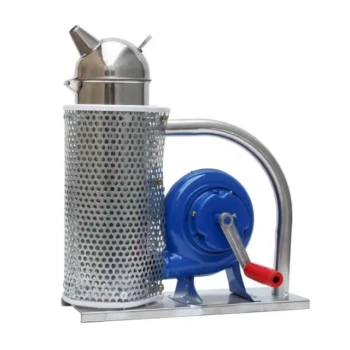
In the context of wax moth control, a professional bee smoker functions as a precise hardware delivery system rather than a simple calming tool. It is responsible for converting specific solid treatments, such as dried tobacco leaves, into a chemically active smoke and injecting it directly into the hive environment to target the infestation.
The smoker serves as a thermodynamic engine that transforms solid treatment materials into a pervasive fumigant. This allows active ingredients to penetrate the complex internal structure of the hive, reaching infested frames that topical applications cannot access.
Transforming the Smoker into an Applicator
While most beekeepers associate the smoker with calming bees during inspections, its role changes significantly during pest control fumigation. Here, it becomes a device for chemical delivery.
Thermal Conversion of Active Ingredients
For wax moth control, standard fuel is replaced with treatment-specific materials, such as dried tobacco leaves.
The smoker utilizes combustion to thermally convert these solids. This process releases the chemical properties of the material into a volatile smoke state, making the active agents airborne and mobile.
Targeted Injection Strategy
Unlike the general "puffing" used during inspections, fumigation requires a directed approach.
The smoker is used to forcibly inject this medicated smoke through the hive entrance. This ensures the treatment enters the primary airflow of the colony rather than dissipating into the surrounding atmosphere.
The Physics of Smoke Fumigation
The effectiveness of using a smoker for wax moth control relies on how smoke behaves physically within an enclosed space.
Comprehensive Internal Coverage
Once injected, the smoke acts as a gas, expanding to fill the volume of the hive boxes.
It permeates tight gaps, corners, and the spaces between frames. This physical property ensures that the fumigant makes contact with the wax moths and larvae hiding deep within the comb structure.
Localized Application
Using a smoker allows for a localized treatment.
Because the smoke is directed internally, the concentration of the treatment remains high within the infested area. This maximizes the impact on the pest population while reducing waste.
Understanding the Trade-offs
While using a smoker for fumigation is effective, it presents specific challenges that differ from standard usage.
Heat Management
A smoker acts as a furnace. If the combustion is too intense, the smoke effectively becomes a heat gun.
Injecting superheated smoke into a hive can melt beeswax combs and physically harm the colony. You must maintain a balance where the fuel smolders to produce cool, white smoke rather than hot, clear exhaust.
Dosage Control
Standard chemical treatments often have precise dosages, but a smoker relies on the burn rate of leaves or herbs.
This introduces a variable in how much active ingredient is actually delivered. Inconsistent bellows operation or fuel packing can lead to under-treatment (survival of the moths) or over-treatment (toxicity to the bees).
Making the Right Choice for Your Goal
The smoker is a versatile tool, but its application must change based on your immediate objective.
- If your primary focus is Wax Moth Eradication: Use the smoker as an injector to force chemically active smoke (from materials like tobacco) deep into the hive entrance to permeate infested frames.
- If your primary focus is Routine Inspection: Use standard fuels to produce light, cool smoke solely to disrupt the bees' defensive pheromones and mask alarm signals.
The professional bee smoker is not just a safety device; when loaded with the correct materials, it becomes a sophisticated instrument for internal hive fumigation.
Summary Table:
| Fumigation Element | Function of the Bee Smoker |
|---|---|
| Mechanism | Thermal conversion of solid fuel (e.g., tobacco) into active gas |
| Delivery | Targeted injection of medicated smoke through the hive entrance |
| Coverage | Permeates tight gaps and internal frames unreachable by topical sprays |
| Control Factor | Requires careful heat management to prevent comb melting or bee harm |
Scale Your Beekeeping Success with HONESTBEE
At HONESTBEE, we empower commercial apiaries and distributors with the high-performance hardware needed for professional-grade pest management. Whether you require robust, precision-engineered bee smokers for wax moth control or advanced honey-filling and hive-making machinery, our comprehensive wholesale catalog is designed to optimize your operations.
Partner with us to access a full spectrum of beekeeping tools, industry consumables, and unique honey-themed cultural merchandise tailored to your business needs.
Ready to elevate your productivity? Contact us today to discuss our wholesale solutions and secure the equipment your apiary deserves!
References
- Ademe Mihiretu, Agazhe Tsegaye. Efficiency of some common treatments on infestation level with wax moths, colony strength and honey yield in Northeast Ethiopia: Participatory and comparative analysis. DOI: 10.1080/23311932.2020.1783172
This article is also based on technical information from HonestBee Knowledge Base .
Related Products
- Professional Bee Smoker with Elongated Spout and Durable Bellows for Beekeeping
- Professional Replacement Bee Smoker Bellows for Beekeeping Equipment
- Heavy-Duty Bee Smoker with Durable Plastic Bellows for Beekeeping
- Premium Traditional Copper Bee Smoker with Bellows
- Stainless Steel Honey Bee Smoker Hive and Honeycomb Smoker for Beekeeping
People Also Ask
- What roles do bee smokers and precision tools play in honey harvesting? Master Safety and Quality Control
- Why is a professional bee smoker considered an essential tool for hive management and safety? Master Colony Control.
- Why is the use of professional bee smokers and specialized fuel essential? Protect Honey Purity & Colony Safety
- Why is a professional Smoker essential during routine apiary inspections? Enhance Safety and Operational Efficiency
- Why is a professional bee smoker essential for hive maintenance? Master Colony Control & Safety