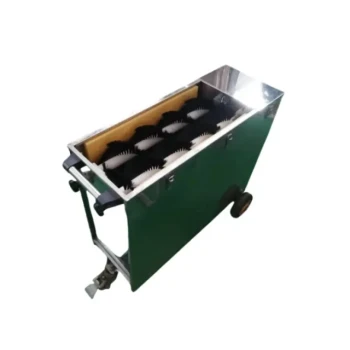
Mechanical crushing serves as the fundamental physical mechanism for liberating bee bread from honeycombs in industrial settings. By applying targeted physical impact to dried honeycombs, this equipment shatters the wax structure to detach the valuable bee bread granules, setting the stage for effective purification.
The core function of mechanical crushing is selective destruction: it obliterates the wax honeycomb structure while preserving the integrity of the bee bread granules, a balance that is essential for large-scale production.
The Mechanics of Separation
Utilizing Physical Impact
The equipment operates by delivering a controlled physical impact to the raw material. This force is directed specifically at breaking down the structural integrity of the honeycomb.
The Requirement for Dried Input
The process relies on the feedstock being dried honeycombs. The drying process renders the wax brittle enough to shatter upon impact, facilitating the release of the bee bread.
Enabling Large-Scale Production
Mechanical crushing provides the consistency and speed required for high-volume processing. It transforms a labor-intensive manual task into an automated workflow, acting as the foundation for large-scale production.
Precision and Granule Integrity
Controlled Destruction
The equipment does not simply pulverize the material; it separates components through precise force control. The goal is to destroy the housing (the wax) without damaging the resident material (the bee bread).
Maintaining Granule Structure
A critical success metric is the integrity of the bee bread granules. Proper crushing ensures these granules remain intact rather than being crushed into powder.
Pre-Purification Conditioning
This mechanical step creates the necessary physical conditions for subsequent purification. By freeing the granules from the comb, it prepares the material for the final cleaning stages.
Understanding the Challenges
The Sensitivity of Force Application
The effectiveness of this method hinges entirely on precisely controlling the crushing force. If the force is too aggressive, the bee bread granules will be destroyed along with the wax.
Dependency on Material State
The process assumes the honeycombs are adequately dried. If the moisture content is incorrect, the physical impact may fail to fracture the wax cleanly, leading to poor separation.
Making the Right Choice for Your Goal
To maximize the efficiency of bee bread extraction, consider how mechanical crushing aligns with your production targets:
- If your primary focus is volume: Prioritize equipment that offers consistent, high-speed physical impact to handle large-scale batches of dried honeycomb.
- If your primary focus is quality: Ensure your machinery allows for fine-tuned force adjustments to maximize the yield of whole, intact bee bread granules.
Success lies in balancing the destructive force required to break the comb with the precision needed to protect the nutrient-rich granules.
Summary Table:
| Process Aspect | Role of Mechanical Crushing | Key Requirement |
|---|---|---|
| Physical Action | Shatters wax honeycomb structure while freeing granules | Brittle, dried honeycomb feedstock |
| Production Scale | Automates manual tasks for high-volume industrial output | Consistent, high-speed impact force |
| Quality Control | Preserves granule integrity through selective destruction | Fine-tuned force adjustments |
| Pre-Purification | Prepares material for final cleaning and sorting stages | Accurate moisture levels in wax |
Maximize Your Bee Bread Yield with HONESTBEE Professional Equipment
Efficiency in commercial beekeeping requires the right balance of power and precision. At HONESTBEE, we specialize in providing commercial apiaries and distributors with high-performance machinery designed to optimize every stage of production. From specialized hive-making and honey-filling machines to industrial-grade honey extraction tools and consumables, our comprehensive wholesale offering ensures your operations remain competitive and productive.
Ready to upgrade your processing line with equipment that protects your harvest while maximizing throughput? Contact HONESTBEE today to discover how our tailored beekeeping solutions can drive your business forward.
References
- Oksana Vradii. INTENSITY OF ACCUMULATION OF HEAVY METALS IN THE POLLEN PRODUCED FROM THE FLOWER POLLEN OF THE FOREST PARK NECTAROPOLINES IN THE CONDITIONS OF THE FOREST STEPPE OF THE RIGHT BANK. DOI: 10.46913/beekeepingjournal.2023.11.02
This article is also based on technical information from HonestBee Knowledge Base .
Related Products
- Frame Punching Hole Puncher Machine for Bee Frame Producing Line
- HONESTBEE Top Bar & Bottom Bar Forming Machine | Bee Frame Machine
- Professional Bee Frame Machine for Side Bar Shaping
- Stainless Steel 3 Frame Manual Honey Extractor Spinner for Bee Honey Extraction
- High Performance Cordless Electric Bee Shaker for Beekeeping
People Also Ask
- How does a bee frame making machine work? A Guide to Automated Metal Frame Production
- Why is professional beehive frame-making machinery required for large-scale apiary operations? Scale with Precision
- How do professional beehive and frame manufacturing machines contribute to commercial apiary management? Boost Efficiency
- What are the qualities of the bee frame forming machine? Durable, Efficient, and Built to Last
- How does the Beehive Frame Making Machine improve operational efficiency? Scale Your Output with Automated Precision