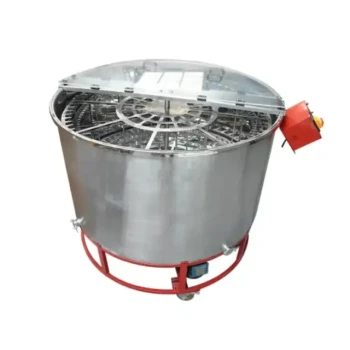
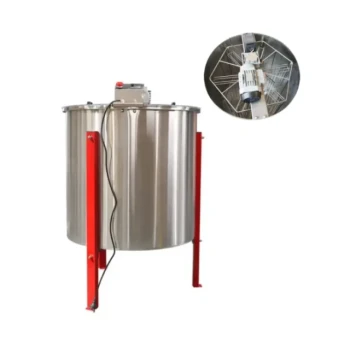
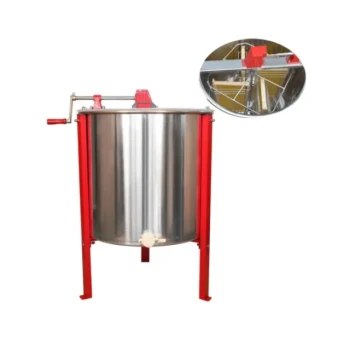
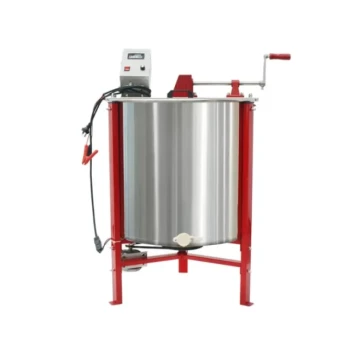
The fundamental technical challenge is that traditional radial or self-turning extractors rely on fluid dynamics, whereas larch honeydew honey behaves as a solid. Due to rapid crystallization and extremely low water content, this "cement honey" solidifies within the cells, rendering the centrifugal force of standard extractors completely ineffective.
Larch honeydew honey creates a unique processing crisis because it crystallizes into a hard structure inside the hive frames. Standard extraction machinery cannot liquify or dislodge this solid mass, often resulting in the mechanical destruction of frames rather than the successful harvest of honey.
The Physics of the Failure
The Crystallization Barrier
The core issue stems from the chemical composition of larch honeydew honey. Unlike standard floral nectars, this variety crystallizes rapidly while still inside the hive.
It creates a hard, solid structure beneath the wax cappings. Because traditional extractors are designed to move viscous liquids, they cannot manipulate this solidified material.
Incompatibility with Centrifugal Force
Radial and self-turning extractors operate on the principle of centrifugal force. They spin frames to throw liquid honey out of the cells and onto the extractor walls.
"Cement honey" defies this mechanism. The honey possesses such low water content and high structural integrity that the centrifugal force generated by standard rotation is insufficient to break its bond with the comb.
Equipment and Yield Consequences
Catastrophic Frame Damage
When beekeepers attempt to extract cement honey using traditional gear, they often resort to increasing the rotation speed. This is a critical error.
The weight of the solid honey, combined with high-speed rotation, exerts immense pressure on the wooden or plastic frames. Instead of the honey releasing, the frames themselves physically disintegrate or shatter under the stress.
Zero-Yield Extraction
Even when frames are spun at dangerous speeds, the honey rarely leaves the cells. The solid mass remains stuck within the comb structure.
The result is a worst-case scenario: the equipment (frames) is destroyed, and the harvest yield remains near zero.
The Risks of Forcing the Process
The Velocity Trap
A common pitfall is assuming that higher RPMs (Revolutions Per Minute) will eventually force the honey out.
In reality, increasing velocity only increases the kinetic energy acting on the frame structure, not the flow of the honey. There is no "safe" speed for extracting cement honey in a standard radial unit.
The Thermal Misunderstanding
Standard extractors lack the integrated heating mechanisms required to alter the honey's state.
Without temperature-controlled softening applied directly during the process, the honey remains a solid block. Relying on ambient room temperature or standard spinning friction provides no benefit.
Strategic Implications for Processing
To successfully manage larch honeydew honey, you must recognize that standard mechanical separation is not a viable option.
- If your primary focus is equipment preservation: Do not attempt to process cement honey in a radial extractor, as frame destruction is the likely outcome.
- If your primary focus is successful harvest: You must bypass standard centrifugal units in favor of specialized machinery that utilizes thermal softening or non-centrifugal extraction technologies.
Effective processing of cement honey requires changing the state of the substance, not just increasing the force applied to it.
Summary Table:
| Challenge | Traditional Extractor Impact | Physical Cause |
|---|---|---|
| Material State | Solid mass remains in cells | Rapid crystallization of melezitose |
| Mechanism | Centrifugal force is ineffective | Zero fluid dynamics in solid honey |
| Equipment Integrity | High RPMs shatter/destroy frames | Excessive weight & kinetic stress |
| Yield Outcome | Near-zero harvest | Honey bonds permanently to the comb |
| Thermal Control | No integrated heating | Honey remains solid at ambient temps |
Maximize Your Harvest with HONESTBEE Professional Solutions
Processing difficult varieties like larch honeydew honey requires more than just force—it requires the right technology. HONESTBEE specializes in supporting commercial apiaries and distributors with high-performance beekeeping machinery and tools designed to handle the toughest industry challenges.
From advanced honey-filling machines to durable hive-making hardware and essential consumables, we provide the full spectrum of equipment needed to scale your operations and protect your yields. Don't let "cement honey" destroy your frames or your profits.
Ready to upgrade your extraction workflow?
Contact HONESTBEE Today for Wholesale Solutions
References
- Monika Kucharczyk, Daniel Borowiak. PROBLEMS OF BEEKEEPING IN POLAND. DOI: 10.15611/pn.2017.494.11
This article is also based on technical information from HonestBee Knowledge Base .
Related Products
- HONESTBEE 72 Frame Industrial Electric Honey Extractor for Beekeeping
- Commercial Electric 12 Frame Honey Extractor Spinner Motorized Honey Extractor
- HONESTBEE 3-Frame Manual Acrylic Honey Extractor
- electric honey extractor honey centrifuge 3 frame honey extractor stainless steel honey frame extractor
- HONESTBEE 6 Frame Self Reversing Electric Honey Extractor for Beekeeping
People Also Ask
- What is the importance of balancing honeycomb frames within a honey extractor? Ensure Stability and Protect Machinery
- How is honey separated from the frames after they are uncapped? Efficient Extraction Methods for High Yields
- What are the main benefits of using a honey extractor? Maximize Yields and Protect Your Honeycomb
- What are the recommended methods for removing honey from the honeycomb? Top Extraction Techniques for Maximum Efficiency
- How do manual honey extractors compare to electric honey extractors? Choosing the Right Tool for Your Apiary Growth