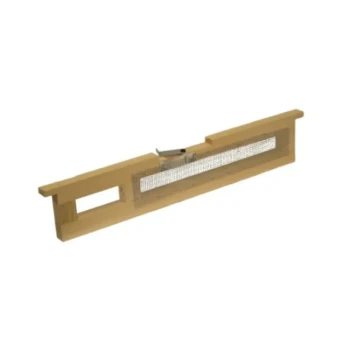
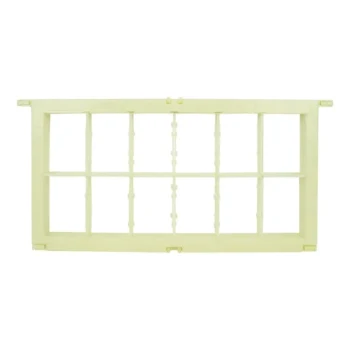
The design for the reversible frame relied on a complex mechanical modification to the standard side-bar to allow for inversion. It featured a long central slot cut into the side-bars which housed a rotating half-height bar, enabling the frame's suspension lugs to be repositioned physically.
The core concept was to eliminate the gap between the comb and the bottom bar by allowing the frame to be flipped. By utilizing a central pin hinge and double-sided lugs, the internal mechanism could swing outwards and upwards to reverse the frame's orientation, though this complex design failed to achieve popularity.
Anatomy of the Reversible Mechanism
To understand how this design attempted to solve the gap problem, we must look at the three distinct mechanical components integrated into the frame.
The Slotted Side-Bar
Unlike a standard solid side-bar, this design required a long central slot running through the side component of the frame.
This slot was not merely structural; it acted as a housing unit for the moving parts of the frame.
The Central Pin Hinge
Inside the central slot sat a half-height bar.
This bar was anchored by a pin hinge located exactly at the center of the slot. This hinge was the pivot point that allowed the internal bar to move.
The Rotating Action
The mechanism allowed the half-height bar to be swung outwards and upwards.
By rotating on the central pin, the bar could be moved from one end of the slot to the other, effectively reversing the vertical orientation of the frame components.
Double-Sided Lugs
Fixed to the outer end of the rotating bar were double-sided frame lugs.
When the bar was swung into position, these lugs were presented at the top of the frame, allowing it to hang in the hive regardless of which side was currently facing up.
Understanding the Trade-offs
While the engineering intent was to solve a specific spatial problem within the hive, the design introduced significant practical barriers.
Mechanical Complexity vs. Utility
The primary trade-off of this design was the introduction of moving parts into a frame construction.
Standard frames are static and rigid. This proposal replaced simplicity with a multi-part system involving slots, hinges, and rotating bars.
Lack of Adoption
Despite the ingenuity of the mechanism, the primary reference notes that this design never gained popularity.
The complexity required to manufacture and operate these frames likely outweighed the benefits gained by solving the comb-to-bottom-bar gap issue.
Evaluating Historical Design Choices
When analyzing this specific piece of beekeeping engineering, consider your specific interest in the topic.
- If your primary focus is historical evolution: Note that this represents a mechanical approach to space management, prioritizing adjustable hardware over static precision.
- If your primary focus is equipment design: Recognize that adding moving parts (hinges and slots) to equipment that gets propolized often leads to failure, which likely contributed to its obscurity.
The most effective designs usually balance problem-solving with mechanical simplicity.
Summary Table:
| Component | Mechanical Feature | Functional Purpose |
|---|---|---|
| Side-Bar | Long Central Slot | Acts as a housing unit for the internal moving parts. |
| Internal Bar | Half-Height Rotating Bar | Pivot point anchored by a pin hinge for orientation reversal. |
| Hinge System | Central Pin Hinge | Allows the internal mechanism to swing outwards and upwards. |
| Suspension | Double-Sided Lugs | Enables the frame to hang securely regardless of vertical orientation. |
Upgrade Your Apiary with HONESTBEE Precision Engineering
While historical designs like the reversible frame were clever but complex, modern commercial beekeeping demands reliability and efficiency. HONESTBEE provides commercial apiaries and distributors with high-performance, durable beekeeping solutions that avoid the pitfalls of over-engineering.
Why partner with us?
- Comprehensive Wholesale Range: From specialized hive-making and honey-filling machinery to a full spectrum of manual tools.
- Essential Consumables: We supply the high-volume industry consumables your business relies on daily.
- Expert Manufacturing: Our products balance problem-solving innovation with the mechanical simplicity needed for long-term use.
Whether you are scaling a commercial operation or stocking a distribution network, our team is ready to support your growth. Contact HONESTBEE today to discuss your wholesale needs!
Related Products
- Professional Wooden Requeening Frame for Beekeeping
- Professional Sectional Comb Honey Frame with 250g Cassette System for Beekeeping
- Wooden Bee Hive Frames for Beekeeping and Wholesale
- JZBZ Langstroth Queen Rearing Frame for Beekeeping
- Plastic Bee Frame Beekeeping Hive Frames for Wholesale
People Also Ask
- What are the primary functions of beekeeping frames? Boost Efficiency with Professional Hive Management
- What are the best practices for assembling beekeeping frames? Pro Tips for Maximum Durability & Efficiency
- How are deep, medium, and shallow frames typically used in beekeeping? Optimize Your Hive Setup
- What are the characteristics of wooden frames in beekeeping? Unlock Natural Flexibility & Cost-Effectiveness
- What are the common specifications for wooden beekeeping frames used in colony expansion? Your Complete Guide