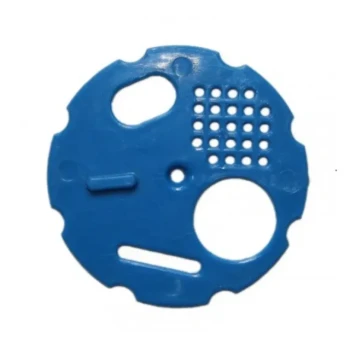
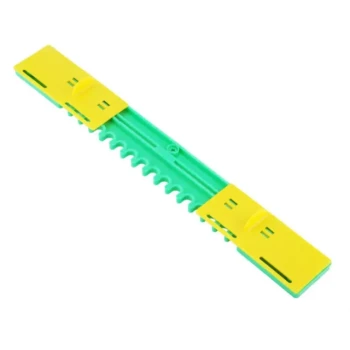
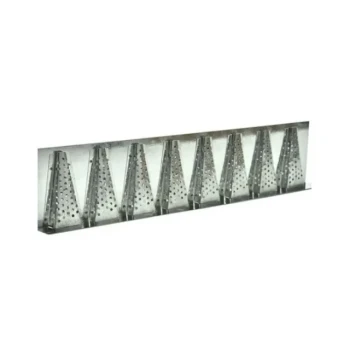
Entrance reducers act as a critical physical interface between biological chaos and digital precision. They are necessary in electronic monitoring because they channel bee traffic directly into the camera’s effective field of view. By narrowing the entry and exit points, they prevent bees from bypassing the sensors, ensuring the electronic monitoring system can capture data with the required fidelity.
Core Insight: Electronic monitoring systems rely on predictable subject placement. Entrance reducers bridge the gap between bee behavior and technological limitations, ensuring every bee passes through the sensor's focal point for accurate, zero-omission detection.
Aligning Physical Movement with Digital Sensors
To capture accurate data, you must control the environment where the data is generated.
Constraining the Traffic Flow
In a natural setting, bees utilize the full width of a hive entrance. This random movement creates a chaotic data set that is difficult to monitor comprehensively.
Entrance reducers act as a funnel, narrowing the path for entering and exiting bees. This forces the colony's activity into a specific, predictable lane.
Maximizing the Effective Field of View
Camera sensors and monitoring devices have a limited effective field of view.
If a bee moves outside this visual cone, the data point is lost. The reducer ensures that the physical space accessible to the bees matches the digital space visible to the camera.
Driving Data Precision
The ultimate goal of electronic monitoring is the reliability of the dataset.
Improving Image Recognition
Computer vision algorithms perform best when the subject is clearly presented. By standardizing where the bees appear, reducers significantly improve the success rate of image recognition.
This allows the system to identify features with higher confidence, as the variables of distance and angle are tightly controlled.
Eliminating Omission Errors
The primary risk in data collection is "false negatives"—marked bees returning to the hive without being counted.
Reducers facilitate the precision of individual bee detection by removing the "blind spots" at the edges of the hive entrance. This flow control guarantees that the monitoring system captures all incoming marked bees without omission.
Understanding the System Dependencies
While reducers are effective, they introduce specific dependencies into your project.
Reliance on Physical Installation
Your data integrity becomes entirely dependent on the mechanical stability of the reducer.
If the reducer is dislodged or positioned incorrectly, the software cannot compensate for the widened path. The system is not fully autonomous; it requires the physical barrier to function correctly.
The Bottleneck Effect
By design, you are creating a bottleneck.
While this is necessary for the camera, it artificially alters the flow of traffic. You must ensure the restriction does not impede the colony's vital functions while serving the monitoring equipment.
Making the Right Choice for Your Goal
Using an entrance reducer is about prioritizing data completeness over natural entrance width.
- If your primary focus is Zero-Omission Tracking: You must use a reducer to force 100% of the traffic through the sensor's detection zone.
- If your primary focus is Algorithm Efficiency: Use a reducer to standardize the images, allowing your software to focus on recognition rather than searching a wide frame.
Control the flow to trust the data.
Summary Table:
| Feature | Impact on Electronic Monitoring | Benefit for Data Collection |
|---|---|---|
| Traffic Channeling | Forces bees into a predictable lane | Eliminates blind spots and "false negative" counts |
| Field of View Alignment | Matches bee movement to the camera's sensor cone | Ensures every subject is captured within the focal point |
| Standardized Imaging | Tightly controls distance and angle of bees | Significantly improves computer vision & recognition rates |
| Flow Control | Creates a managed bottleneck at the entrance | Guarantees 100% detection for zero-omission tracking |
Elevate Your Commercial Apiary with HONESTBEE Precision
For commercial apiaries and distributors, data accuracy is the foundation of modern colony management. HONESTBEE provides the comprehensive wholesale solutions you need to bridge the gap between biological activity and digital insights.
From specialized beekeeping tools and hive-making machinery to essential industry consumables, we supply everything required to build a high-performance monitoring infrastructure. Our portfolio is designed to help you streamline operations and maximize data fidelity across your entire apiary network.
Ready to scale your beekeeping operations with professional-grade equipment?
Contact HONESTBEE Today to explore our full spectrum of wholesale machinery and tools.
References
- Kelly Kulhanek, Dennis vanEngelsdorp. Accelerated Varroa destructor population growth in honey bee (Apis mellifera) colonies is associated with visitation from non-natal bees. DOI: 10.1038/s41598-021-86558-8
This article is also based on technical information from HonestBee Knowledge Base .
Related Products
- Steel Round Disc Entrance Reducer for Flexzion Bee Hive Nuc Box Gate
- Beehive Entrance Reducer Guardian Metal Hive Entrance for Bees
- White Plastic 0.5L Beekeeping Entrance Feeder for Bees
- Professional Hive Front Entrance Bee Feeder
- Beehive Entrance Discs Plastic Bee Entrance Disc for Bee Hives
People Also Ask
- What is the purpose of an entrance reducer for a beehive? Strengthen Colony Defense and Prevent Robbery
- Why are entrance reducers used to counter hornet infestations? Protect Your Hive with Strategic Choke Points
- Why is it critical to maintain a smaller entrance for a newly established bee hive? Boost Colony Growth and Security
- Under what conditions should a beekeeper adjust the size of a beehive entrance? Seasonal & Defense Management Tips
- What is the function of an entrance reducer on a beehive? Strengthen Colony Defense and Climate Control