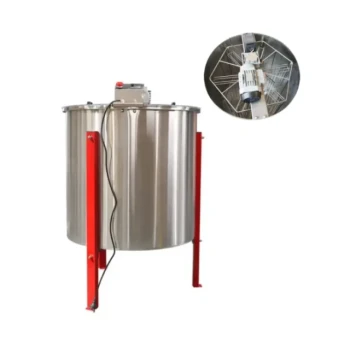
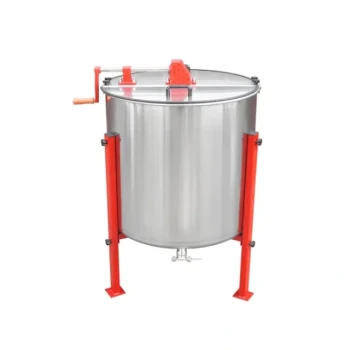
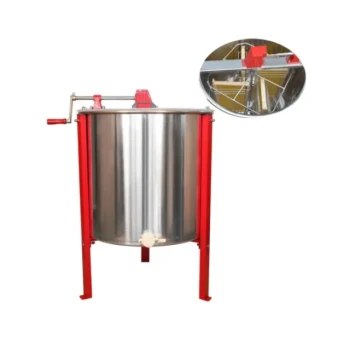
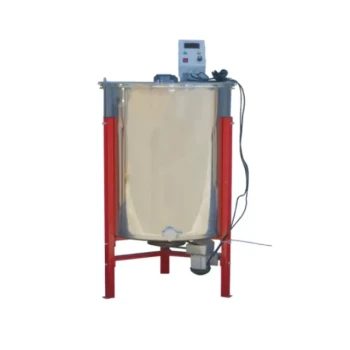
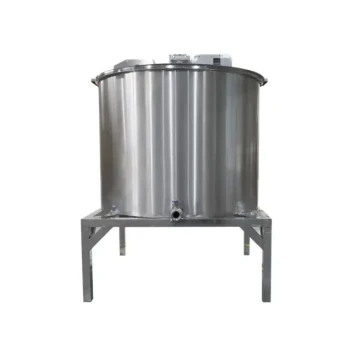
The use of two distinct bearing types in a honey extractor is a strategic engineering decision designed to balance mechanical efficiency with strict food safety standards. The system utilizes ball bearings at the top to ensure smooth, low-friction rotation, while employing specialized bush bearings at the bottom to provide structural support without risking contamination of the honey.
The design separates functions: the top assembly handles the mechanical load and speed, while the bottom assembly acts as a hygienic seal to prevent grease and metal particles from entering the product.
Optimizing the Top for Mechanical Efficiency
Reducing Rotational Resistance
The primary goal of the top-mounted bearing is to facilitate movement. Ball bearings are installed at the top of the basket frame because they excel at minimizing friction.
Ensuring Smooth Operation
Honey extractors require consistent, smooth spinning to extract honey effectively without damaging the comb. The top ball bearings allow the basket to rotate freely, reducing the physical effort required (in manual models) or the motor load (in electric models).
Prioritizing Hygiene at the Bottom
The Contamination Challenge
The bottom of the main shaft is located directly within or near the honey collection zone. A standard bearing in this location presents a significant risk of leaking lubricants or shedding metal shavings into the food product.
The Role of Bush Bearings
To mitigate this risk, bush bearings are fixed at the bottom of the container. Their primary mechanical function is to provide radial support to keeping the spinning shaft centered and stable.
Specialized Seals for Safety
Crucially, these bottom bush bearings are engineered for hygiene. They are equipped with seals and steel balls specifically designed to prevent grease or worn metal particles from escaping the bearing assembly. This ensures the extraction process remains sanitary and meets food-grade safety standards.
Understanding the Engineering Trade-offs
Friction vs. Containment
The design accepts a trade-off: ball bearings offer lower friction but are harder to seal perfectly against leakage. Bush bearings generally have higher friction but offer superior containment capabilities for submerged or food-contact applications.
Location-Based Specialization
By splitting the system, engineers avoid the "worst of both worlds." Using ball bearings at the bottom would risk food safety; using bush bearings at the top might create unnecessary drag and make the extractor harder to spin.
Assessing Your Equipment Needs
When evaluating or maintaining a honey extractor, understanding this split design helps you identify potential failure points.
- If your primary focus is Operational Smoothness: Inspect the top ball bearings for rust or stiffness, as these are responsible for the ease of rotation.
- If your primary focus is Food Safety: Regularly check the bottom bush bearing seals for damage, ensuring no debris or lubricant is compromising the honey.
The hybrid bearing system provides the most effective compromise, delivering a machine that spins easily while keeping your harvest pure.
Summary Table:
| Bearing Type | Location | Primary Function | Key Benefit |
|---|---|---|---|
| Ball Bearing | Top of Shaft | Reduces rotational friction | Smooth spinning & lower motor load |
| Bush Bearing | Bottom of Shaft | Provides radial support | Prevents grease & metal contamination |
Upgrade Your Apiary with HONESTBEE Professional Equipment
At HONESTBEE, we understand that the perfect honey harvest requires a balance of mechanical precision and uncompromising hygiene. As a leading partner for commercial apiaries and distributors, we provide a comprehensive wholesale range of beekeeping tools, from honey-filling machines to high-efficiency extractors engineered with food-grade safety in mind.
Whether you are scaling your production with advanced machinery or stocking essential consumables, our expertise ensures your operations remain smooth and sanitary. Contact us today to discover how our professional-grade hardware and industry-leading solutions can grow your business!
References
- M. A. Al-Rajhi, A. El-Sheikha. DEVELOPMENT AND EVALUATION OF A TANGENTIAL HONEY - EXTRACTOR. DOI: 10.21608/mjae.2014.98404
This article is also based on technical information from HonestBee Knowledge Base .
Related Products
- Stainless Steel Beekeeping Honey Extractor Lid
- electric honey extractor honey centrifuge 3 frame honey extractor stainless steel honey frame extractor
- 24 Frame Honey Extractor Commercial Radial Honey Frame Extraction Machine
- Electric 8 Frame Honey Spinner Extractor Equipment for Beekeeping
- Manual Hand Crank 4 Frame Honey Extractor Centrifuge for Beekeeping
People Also Ask
- How do specialized organic beekeeping tools impact production efficiency? Maximize honey yields and ensure compliance.
- What are the advantages of selecting a stainless steel honey extractor over a plastic one? Pro Beekeeping Guide
- What is a stainless steel honey extractor? Boost Your Apiary's Efficiency with Professional Extraction
- What are the key features of a stainless steel honey extractor? Ensure Purity & Longevity for Your Honey
- What are the key features and benefits of a stainless steel honey extractor? Upgrade to Professional Purity