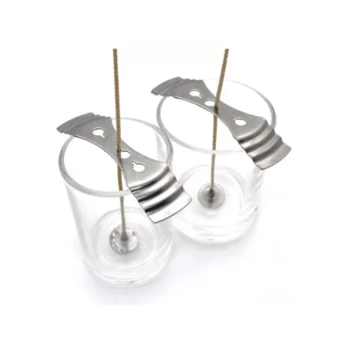
Fastening devices act as the structural anchor for the wick throughout the candle-making process. Specifically, tools like metal rods or wooden supports are engineered to maintain the vertical alignment and necessary tension of cloth wicks while they are subjected to the repeated dipping or pouring of molten beeswax.
The fundamental purpose of these devices is to counteract the movement of liquid wax, ensuring the wick remains perfectly centered to guarantee structural symmetry and a stable, even burn.
The Mechanics of Wick Alignment
Maintaining Vertical Tension
Cloth wicks are naturally pliable and prone to bending. Fastening devices apply the necessary tension to keep the wick taut.
This tension is critical because molten beeswax creates drag and resistance. Without a fastening device to hold the wick rigid, the force of the liquid wax would push the wick out of alignment during dipping or pouring.
Ensuring Uniform Wax Accumulation
For the candle to form correctly, beeswax layers must build up evenly on all sides of the wick.
By locking the wick in a fixed vertical position, fastening devices allow the wax to adhere uniformly. This prevents "lopsided" candles where one side is significantly thicker than the other, which is a common defect in hand-dipped production.
Impact on Final Product Quality
Guaranteeing Burn Stability
The position of the wick directly dictates the quality of the flame. A wick that was allowed to drift during manufacturing will not burn straight.
Fastening devices ensure the fuel source (the wick) remains central. This prevents the flame from extinguishing itself by drowning in the wax pool or burning too close to the edge of the candle.
Preserving Structural Symmetry
A centered wick supports the physical integrity of the candle.
If the wick is misaligned, the heat distribution becomes uneven. This can lead to the structural collapse of the candle wall or uneven melting, compromising both the aesthetic and the function of the beeswax candle.
Common Pitfalls and Considerations
The Risk of Improper Tensioning
While tension is necessary, there is a nuance to how it is applied. If a fastening device is too loose, the wick will float; if it is too tight or misaligned, the wick may sit off-center in the final mold.
Improvised vs. Specialized Tools
Supplementary data suggests that hobbyists often use improvised fasteners like pencils or clothespins to bridge the top of a container.
However, for professional applications—particularly with dipped tapers—specialized metal rods are superior. They offer the rigidity required to handle multiple candles simultaneously without bending under the weight of the accumulating wax.
Making the Right Choice for Your Goal
To ensure your beeswax candles perform as intended, select your fastening method based on your production style:
- If your primary focus is commercial production or dipped tapers: Prioritize rigid metal rods or specialized racks to maintain high tension and uniform alignment across multiple dips.
- If your primary focus is small-batch container candles: Utilize simple centering tools like clothespins or wick bars to keep the wick vertical while the poured wax cools.
Ultimately, the fastening device is not just a holder; it is the primary control mechanism for the candle's future performance.
Summary Table:
| Feature | Purpose in Candle Making | Benefit to Final Product |
|---|---|---|
| Vertical Tension | Keeps cloth wick taut against molten wax drag | Prevents wick bending and lopsided shapes |
| Centering Control | Locks the wick in the exact middle of the mold | Ensures even heat distribution and stable flame |
| Structural Anchor | Supports wick during repeated dipping or pouring | Maintains symmetry and prevents wall collapse |
| Alignment Rigidity | Counteracts movement of liquid beeswax | Guarantees a clean, centered, and efficient burn |
Elevate Your Beekeeping Business with HONESTBEE
At HONESTBEE, we understand that professional-grade results require professional-grade tools. Whether you are a commercial apiary or a specialist distributor, we provide the comprehensive wholesale solutions you need to succeed. Our portfolio ranges from specialized hive-making and honey-filling machinery to the essential beekeeping tools and consumables required for premium beeswax product manufacturing.
Why partner with HONESTBEE?
- Complete Wholesale Offering: Access a full spectrum of hardware and industry-standard consumables.
- Industrial Precision: From specialized racks to advanced machinery, we support large-scale production efficiency.
- Industry Expertise: We cater specifically to the needs of professional beekeeping enterprises and global distributors.
Ready to scale your production and enhance your product quality? Contact us today to discuss your wholesale requirements and discover how our equipment can streamline your operations.
References
- Fabio Fernando Flores, Liliana C. Lupo. Melliferous insects and the uses assigned to their products in the northern Yungas of Salta, Argentina. DOI: 10.1186/s13002-018-0222-y
This article is also based on technical information from HonestBee Knowledge Base .
Related Products
- Metal Wick Holder Centering Devices for DIY Candle Making Candle Wick Holder
- 3D Square Honeycomb Pillar Silicone Candle Molds for Making Beeswax Candles
- Beeswax Melter for Candle Making Honey Bee Wax Melter
- Silver Metal Candle Wick Tabs Sustainer Base for Candle Making
- 3D Beehive Silicone Skep Wax Candle Molds for Candles
People Also Ask
- Why is a ball-shaped whisk attachment used at high speeds during the rapid preparation of cream honey? Expert Guide.
- What are the common wick sizes for beeswax candles? A Guide to a Perfect Burn
- What is the mechanism of using industrial blowtorches for beehive sterilization? Eradicate American Foulbrood Spores
- How are industrial blowtorches utilized in beekeeping biosecurity? Mastering Deep Thermal Disinfection
- How can a propane torch be used to clean a bee smoker? Reclaim Your Equipment with High-Heat Cleaning Techniques