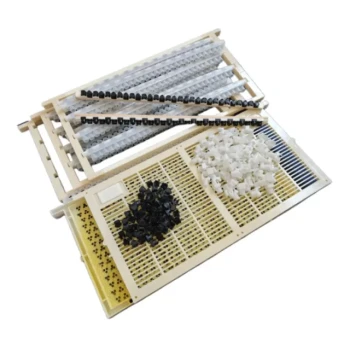
High-performance colony-splitting tools and queen bee supplies are the critical infrastructure for rapid population recovery. When apiaries face high mortality rates, these assets allow beekeepers to proactively split surviving colonies or introduce new ones to immediately replace losses. This capacity for quick turnover is the only way to maintain the operational scale necessary for economic viability and fulfilling commercial pollination contracts.
The ability to rapidly replace lost colonies is a prerequisite for survival in high-mortality regions. Specialized tools and quality queens convert a passive operation into a proactive one, ensuring the apiary can rebound quickly enough to meet contract obligations.
The Mechanics of Rapid Recovery
Transitioning to Proactive Management
Reliance on passive methods, such as catching natural swarms, is insufficient for offsetting modern colony losses. Professional splitting tools and queen rearing supplies enable a shift toward proactive breeding and management. By scientifically splitting colonies, you gain control over hive occupancy rates rather than leaving production scales to chance.
Maintaining Commercial Viability
Commercial beekeeping relies heavily on the ability to fulfill crop pollination contracts. High annual mortality threatens the minimum colony counts required for these agreements. Having a stockpile of biological assets (queens) and the tools to deploy them ensures you can restore hive numbers fast enough to honor your commitments.
Establishing Economies of Scale
To be profitable, operations must maximize yield per unit area. Specialized tools facilitate the consistent expansion of the apiary, spreading fixed costs across more units. This efficiency is the foundation for achieving economies of scale, allowing operations to remain profitable even when facing biological headwinds.
Technical Advantages of Specialized Equipment
Minimizing Risk During Splits
Professional colony splitting tools allow for the precise segmentation and reorganization of the hive structure. This precision drastically reduces the risk of injury to the queen or excessive loss of worker bees during the splitting process.
Accelerating Colony Establishment
Standardized artificial hives and splitting tools provide adequate preset space and optimized entrance designs. This encourages the split colony to quickly establish a defense system and resume brood rearing. Faster establishment leads to higher survival rates for the new splits.
Preserving Genetic Vigor
Using specialized equipment for queen rearing helps maintain the genetic purity and vigor of the colonies. High-quality queens ensure high foraging activity, often exceeding ranges of 1500 meters. This vigor is essential for maximizing honey production and ensuring the colony is robust enough to survive future stressors.
Understanding the Trade-offs
The Burden of Standardization
To utilize high-performance tools effectively, your operation must commit to strict equipment standardization. Mismatched gear in a large-scale operation increases mortality rates and operational friction. You cannot mix industrial-grade tools with ad-hoc equipment without risking stability.
Maintenance Requirements
Expanding an apiary through splitting increases the density of biological assets, which raises the stakes for biosecurity. You must pair high-performance tools with rigorous maintenance using durable, rust-proof materials. Failing to repair damaged hives promptly can turn a high-density operation into a breeding ground for larval infections and other diseases.
Ensuring Sustainability Through Strategic Investment
To counter high mortality rates effectively, align your resource allocation with your operational goals:
- If your primary focus is Contract Fulfillment: Prioritize a steady supply of high-quality queens to immediately replace dead-outs and maintain the minimum hive counts required by your clients.
- If your primary focus is Apiary Expansion: Invest heavily in standardized splitting tools and nucleus hives to maximize the safety and speed of dividing your surviving colonies.
True sustainability in modern beekeeping is defined not just by preventing loss, but by your capacity to efficiently rebuild using superior tools and genetics.
Summary Table:
| Key Focus Area | Critical Benefit | Impact on Sustainability |
|---|---|---|
| Colony Splitting | Rapid population recovery | Restores hive counts for pollination contracts |
| Queen Supplies | Preserving genetic vigor | Increases honey production and stress resilience |
| Specialized Gear | Precision & safety | Minimizes worker bee loss and queen injury |
| Standardization | Operational efficiency | Reduces mortality caused by mismatched equipment |
| Scale Management | Economies of scale | Maintains profitability despite biological losses |
Secure Your Apiary’s Future with HONESTBEE
Facing high colony mortality? HONESTBEE empowers commercial apiaries and distributors with the industrial-grade tools and machinery needed for rapid recovery and long-term sustainability. From specialized hive-making and honey-filling machines to a complete spectrum of beekeeping consumables, our wholesale offerings are designed for large-scale efficiency.
Don't let losses compromise your pollination contracts. Leverage our expertise in high-performance hardware and honey-themed cultural merchandise to scale your operation and maximize your yield.
Connect with HONESTBEE Experts Today to optimize your commercial beekeeping infrastructure.
References
- Fabrice Réquier, Karina Antúnez. First large-scale study reveals important losses of managed honey bee and stingless bee colonies in Latin America. DOI: 10.1038/s41598-024-59513-6
This article is also based on technical information from HonestBee Knowledge Base .
Related Products
- Stainless Steel Beekeeping Queen Grafting Tool for Honey Bee Rearing
- Plastic Chinese Queen Grafting Tool for Bee Queen Rearing
- Stainless Steel Queen Grafting Tool for Beekeeping and Bee Queen Grafting
- Black 2 Pack Beekeeper Queen Grafting Tool for Bee Queen Larva Transferring Needle
- Queen Bee Artificial Insemination Instrument Equipment for Instrumental Insemination
People Also Ask
- What is the process of grafting in honey bee queen rearing? A Master Guide for Commercial Success
- Why is it necessary for migratory beekeeping enterprises to utilize professional queen bee rearing tools? Boost Resilience
- What is the step-by-step process for using a queen grafting tool? Master Larva Transfer for Better Queen Rearing
- What is the primary function of a queen grafting tool? Master Precise Larval Transfer for High Queen Acceptance
- What specialized tools and frame configurations are needed for larval grafting during queen rearing, and how are queen cells properly spaced? Master the essentials for efficient queen production