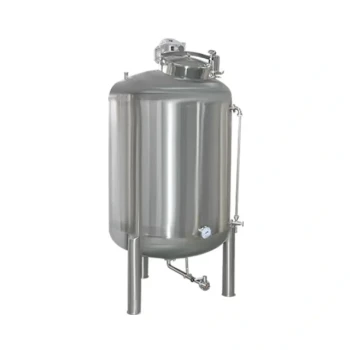
High-precision refrigeration is the architectural foundation of creamed honey production. It serves to maintain a strict, stable environment—typically 5±1°C—during the crucial resting phases between stirring cycles. This specific thermal control is the only way to guide the formation of dense micro-crystal nuclei, which allows the honey to thicken rapidly while locking in a stable, emulsified structure that resists separation.
Temperature precision is the active ingredient in creamed honey; it dictates the difference between a smooth, spreadable delicacy and a separated, gritty product.
The Science of Controlled Crystallization
Guiding Crystal Formation
Honey naturally wants to crystallize, but often does so in large, jagged structures that feel gritty on the tongue.
High-precision refrigeration interrupts this natural tendency. By holding the product at a steady 5±1°C, the system forces the sugars to organize into dense micro-crystal nuclei.
This controlled nucleation is what creates the signature "creamy" mouthfeel rather than a crunch.
Accelerating the Thickening Process
Time is a critical factor in production efficiency.
The use of a dedicated cold room accelerates the thickening process.
By rapidly cooling the honey during resting phases, you reduce the overall time required for the product to reach its desired consistency.
Stability and Shelf Life
Locking in the Emulsion
Creamed honey is essentially a stabilized emulsion of crystals and liquid syrup.
Without precise cooling, this structure is prone to collapse. The cold environment stabilizes the emulsified structure, ensuring the crystals remain suspended evenly throughout the jar.
Preventing Separation and Spoilage
A major risk in honey production is phase separation, where liquid rises to the top and crystals sink to the bottom.
High-precision cooling prevents this by "setting" the structure before separation can occur.
Furthermore, maintaining this low temperature protects the product's flavor profile, preventing the development of off-flavors during long-term storage.
Understanding the Risks of Temperature Fluctuation
The Danger of Inconsistency
The "high-precision" aspect is as important as the cold itself.
If the temperature fluctuates significantly outside the 5±1°C range, the crystal growth becomes unpredictable.
Even minor warm spikes can cause crystals to dissolve or grow too large, ruining the smooth texture you worked to create.
Equipment vs. Quality
Standard refrigeration often lacks the tight variance control of high-precision systems.
While standard units keep things cold, they may cycle through temperature ranges that are too wide for optimal crystallization.
Investing in precision is an investment in consistent batch-to-batch texture.
Making the Right Choice for Your Goal
If your primary focus is Texture Quality:
- Ensure your system can hold a strict 5±1°C variance to guarantee the formation of smooth micro-crystals.
If your primary focus is Shelf Stability:
- Prioritize a cooling system that maintains temperature during the resting phase to lock in the emulsion and prevent liquid separation.
If your primary focus is Production Speed:
- Utilize the cold room to accelerate the thickening process, reducing the time from stirring to packaging.
Control the temperature, and you control the quality of the final product.
Summary Table:
| Feature | Precision Refrigeration (5±1°C) | Standard Refrigeration | Impact on Creamed Honey |
|---|---|---|---|
| Crystal Size | Dense micro-crystal nuclei | Large, jagged crystals | Creates smooth vs. gritty texture |
| Structural Integrity | Locked, stable emulsion | Prone to collapse/separation | Ensures shelf stability and uniformity |
| Process Speed | Accelerated thickening | Slow, inconsistent cooling | Increases production efficiency |
| Temperature Variance | Minimal (±1°C) | High fluctuations | Prevents batch-to-batch inconsistency |
Elevate Your Honey Production with HONESTBEE Precision Solutions
At HONESTBEE, we understand that the secret to premium creamed honey lies in absolute temperature control. We cater to commercial apiaries and distributors by providing a comprehensive range of professional beekeeping tools, machinery, and industrial consumables. From high-performance honey-filling machines to specialized hardware designed for large-scale operations, our wholesale offerings empower you to maintain the highest quality standards from hive to jar.
Ready to optimize your consistency and scale your business? Contact HONESTBEE today to discover how our specialized equipment can transform your production cycle.
References
- Hanna Lysenko, K. D. Buchkovska. The production cremated honey from natural honey of different botanical origin. DOI: 10.31890/vttp.2019.03.04
This article is also based on technical information from HonestBee Knowledge Base .
Related Products
- Professional Honey Storage Tank with Agitation System
- 0.5T Capacity Honey Dehumidifier Dryer with Vacuum Heating and Thickening Filtering Machine
- Heavy Duty Stainless Steel Honey Processing Machine Decrystallizing Tank
- Honey Concentrating and Filtering Dehumidifier Machine 2T Capacity for Honey
- Stainless Steel Honey Storage Tank with Lid for Honey
People Also Ask
- What economic role do honey storage tanks play? Boost Your Revenue Through Strategic Inventory Management
- What roles do industrial honey storage tanks and filtration meshes play in processing? Ensure Purity & Consistency
- What is the purpose of a honey storage tank? Streamline Your Honey Processing for Quality & Efficiency
- What are honey storage tanks used for? Essential Features for Quality Preservation and Profit
- How do large honey storage tanks and gravity fall filling systems improve honey packaging efficiency and safety?