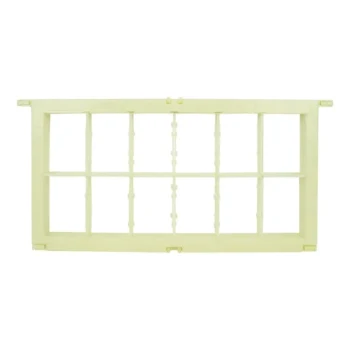
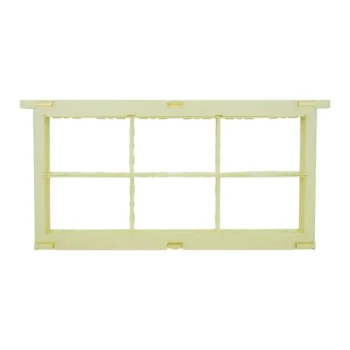
Honey bee frames serve as the skeletal architecture of a modern hive. They provide the essential structural support that guides bees to build wax honeycombs in straight, manageable lines, allowing beekeepers to remove and replace mature combs for extraction without destroying the colony's home.
The Core Takeaway By converting the natural, irregular structure of a wild hive into a modular system, frames allow for non-destructive harvesting. This modularity enables mechanized extraction, rapid inspection, and the vertical expansion of the hive, directly correlating to higher yields and lower labor costs.
Transforming Biology into a Manageable System
Structural Guidance and Modularity
In a natural setting, bees build comb in irregular patterns. Frames impose order on this chaos. They act as guides, ensuring bees build straight, uniform combs.
This precision engineering allows for the movable frame principle. Beekeepers can manage the internal hive space modularly, vertically stacking "supers" (honey chambers) to accommodate seasonal nectar flows and increasing colony size.
Non-Destructive Harvesting
The primary efficiency gain is the ability to harvest without destruction. Without frames, harvesting honey often requires cutting out and destroying the wax comb.
With frames, the structure is removed, the honey is extracted, and the empty comb is returned to the hive. This preserves the colony’s energy, allowing bees to focus on refilling cells with honey rather than rebuilding wax infrastructure.
The Role of Standardization in Efficiency
Compatibility with Automation
Efficiency in commercial operations relies on machinery. Standardized frames are the "input keys" for this machinery.
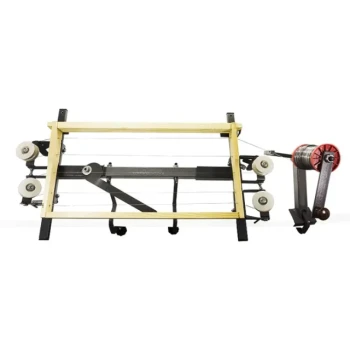
Uniform specifications ensure compatibility with automated honey production lines, which integrate extraction, filtration, and bottling. This standardization supports the use of mechanical uncappers and radial extractors, significantly reducing manual labor intensity.
Scalability and Migratory Beekeeping
Frames provide the stability required for migratory beekeeping. The rugged construction holds the comb related to the hive box, preventing collapse during transport.
This structural integrity allows commercial apiaries to move thousands of hives to different pollination sites or nectar sources. Furthermore, uniform equipment reduces the cost of expansion, as parts are interchangeable across the entire operation.
Understanding the Trade-offs
Maintenance and Durability
While frames provide structure, they are not maintenance-free. High-quality wooden frames offer thermal insulation and stability, but they are exposed to harsh outdoor conditions.
Beekeepers must monitor for rot or structural failure. Regular equipment replacement is necessary to maintain the "sterile environment" required for hygiene standards, incurring long-term operational costs.
Disease Management Risks
The re-use of frames drives efficiency, but it also creates a vector for disease. Pathogens and chemical residues can accumulate in the wax over time.
However, the movable nature of the frame allows for easier inspection. Beekeepers can identify issues like Varroa mites or viral diseases early and apply specialized veterinary consumables to inhibit pathogen spread, preventing large-scale colony collapse.
Making the Right Choice for Your Goal
- If your primary focus is Commercial Yield: Prioritize standardization and durability. Use frames that are strictly compatible with automated extraction lines to lower unit production costs.
- If your primary focus is Colony Health: Focus on the movability of the frame. Ensure the design facilitates frequent, non-invasive inspections to monitor biological rhythms and manage pest risks effectively.
The frame is not merely a wooden support; it is the critical interface that bridges the biological needs of the colony with the industrial requirements of modern production.
Summary Table:
| Feature | Benefit to Efficiency | Impact on Production |
|---|---|---|
| Movable Design | Allows non-destructive harvesting | Preserves bee energy for honey collection |
| Standardization | Compatibility with automated machinery | Reduces labor costs and speeds up extraction |
| Structural Support | Enables migratory beekeeping | Facilitates transport to diverse nectar sources |
| Modularity | Vertical hive expansion (Supers) | Increases storage capacity during peak flows |
| Ease of Inspection | Rapid disease and pest monitoring | Prevents colony loss and maintains hive health |
Scaling Your Apiary Operations? Partner with HONESTBEE
To compete in the modern honey market, commercial apiaries and distributors need more than just supplies—they need precision-engineered infrastructure. HONESTBEE provides the full spectrum of beekeeping tools, from high-durability frames and hive-making machinery to advanced honey-filling lines and essential consumables.
Whether you are expanding your commercial colonies or looking to supply the industry with top-tier equipment, we offer comprehensive wholesale solutions tailored to your scale. Maximize your production efficiency and ensure long-term hive health by contacting our expert team today. Let’s build a more productive future for your beekeeping business.
References
- Aniketa Horo, J.M. Singh. An Economic Analysis of Stationary Beekeeping in the Northern States of India. DOI: 10.55446/ije.2023.1136
This article is also based on technical information from HonestBee Knowledge Base .
Related Products
- Assembled Wooden Bee Frames with Plastic Foundation for Durability and Convenience by HONESTBEE
- Professional Sectional Comb Honey Frame with 250g Cassette System for Beekeeping
- HONESTBEE Wired and Assembled Wooden Bee Frames Foundation for a Thriving Hive
- Professional 500g Sectional Comb Honey Frame System for Beekeeping
- Assembled Wooden Bee Frames with Beeswax Foundation Ready to Use by HONESTBEE
People Also Ask
- When should frames with new foundation be given to colonies? Master Timing for a Thriving Hive
- What types of bee frames can be cleaned and returned to service? A Guide to Safe Apiary Refurbishment
- How do you re-wax bee frames? A Simple Guide to Faster Comb Building
- Can beekeepers switch between wooden and plastic frames? Optimize Your Hive's Performance
- Do you have to wire bee frames? Essential Guide to Frame Strength & Honey Harvesting