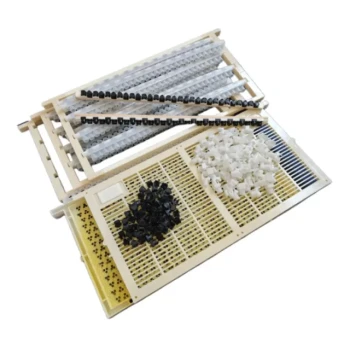
Managed queen management tools are the linchpin of modern agricultural stability in regions suffering from pollination deficits. These tools allow beekeeping technicians to scientifically monitor and control the queen's egg-laying activity, ensuring the colony's growth cycle aligns perfectly with crop blooming schedules. By synchronizing hive expansion with agricultural needs, producers can guarantee a massive workforce of foragers is available exactly when needed to compensate for the decline of wild pollinators.
Core Insight: In the absence of sufficient wild pollinators, nature’s timing can no longer be left to chance. Queen management tools shift beekeeping from a passive activity to a precise technical operation, allowing humans to engineer the "expansion rhythm" of a hive to match the immediate demands of the local ecosystem.
The Mechanics of Colony Synchronization
To understand why these tools are critical, one must look beyond simple hive maintenance and understand the biological engineering involved.
Maintaining Reproductive Continuity
The foundation of a strong colony is the queen's egg-laying capability. Management tools are primarily used to monitor and maintain high-quality reproductive output.
Without this monitoring, a colony’s population can fluctuate unpredictably. Consistent egg-laying is the only way to build the biological momentum required for large-scale pollination.
Controlling the Expansion Rhythm
The primary reference highlights the ability to "precisely control the expansion rhythm." This is the specific mechanism that solves the pollination deficit.
Technicians do not just let the hive grow; they manage the speed of growth. This ensures the colony reaches its peak population density at the exact moment crops enter their peak pollination demand.
Mitigating Environmental Deficits
The urgency for these tools is driven by the widening gap between agricultural demand and the availability of natural resources.
Compensating for Wild Decline
As wild pollinator populations decline, the "free" pollination services provided by nature are disappearing. Managed colonies must step in to fill this void.
Queen management tools turn managed hives into reliable biological assets that can be deployed to offset these severe regional shortages.
Guaranteeing Foraging Mass
One or two bees are not enough; effective pollination requires volume. The goal of these tools is to ensure a "massive foraging population" is available.
By timing the queen's output, technicians ensure the hive is dominated by mature foraging bees—rather than nurse bees or brood—during the critical pollination window.
Operational Trade-offs
While critical for food security, the use of these tools introduces specific operational shifts that must be acknowledged.
Reliance on Specialized Technicians
The source material specifically notes the role of "beekeeping technicians." This implies that queen management is not a passive task; it requires skilled labor to interpret data and intervene effectively.
The Risk of Precision
The system relies on "precise control." If the expansion rhythm is miscalculated, the colony might peak too early or too late, missing the pollination window entirely.
Strategic Application of Queen Management
When operating in regions with low natural pollinator counts, your strategy must focus on timing and volume.
- If your primary focus is Crop Yield Reliability: Prioritize tools that allow you to synchronize the peak foraging population with the specific blooming dates of your target crops.
- If your primary focus is Ecosystem Compensation: Use these management techniques to artificially boost colony density to substitute for the lack of wild biodiversity in the area.
True pollination security comes from converting the biological potential of a queen into a predictable, deliverable service.
Summary Table:
| Feature | Strategic Impact | Benefit for Pollination |
|---|---|---|
| Reproductive Monitoring | Ensures consistent egg-laying | Maintains biological momentum for hive strength |
| Expansion Control | Matches hive growth to bloom cycles | Guarantees peak foraging mass at the right time |
| Workforce Engineering | Optimizes ratio of foragers vs. nurse bees | Maximizes pollination efficiency per colony |
| Resource Deployment | Offsets decline of wild pollinators | Provides a reliable, deliverable biological asset |
Maximize Your Pollination Potential with HONESTBEE
For commercial apiaries and distributors, precision is the difference between a successful harvest and a missed opportunity. HONESTBEE empowers your operations with a comprehensive wholesale range of beekeeping tools, from professional queen management supplies to industrial-grade honey-filling and hive-making machinery.
We provide the essential hardware and consumables needed to turn biological potential into predictable agricultural success. Contact HONESTBEE today to discover how our specialized equipment can enhance your hive productivity and support large-scale pollination efforts.
References
- Mohammad Irshad, Elizabeth Stephen. Review: Pollination, Pollinated and Pollinators Interaction in Pakistan. DOI: 10.35691/jbm.4102.0003
This article is also based on technical information from HonestBee Knowledge Base .
Related Products
- Plastic Chinese Queen Grafting Tool for Bee Queen Rearing
- Stainless Steel Queen Grafting Tool for Beekeeping and Bee Queen Grafting
- Black 2 Pack Beekeeper Queen Grafting Tool for Bee Queen Larva Transferring Needle
- Stainless Steel Beekeeping Queen Grafting Tool for Honey Bee Rearing
- Stainless Steel Scraper for Metal Queen Bee Excluders
People Also Ask
- Why is it necessary for migratory beekeeping enterprises to utilize professional queen bee rearing tools? Boost Resilience
- What are the benefits of using a queen grafting tool for queen rearing? Master Precision for Superior Bee Genetics
- What is grafting in queen rearing? Take Control of Your Apiary's Genetics
- What are the steps involved in using a queen grafting tool? A Guide to Successful Queen Rearing
- What is the primary function of a queen grafting tool? Master Precise Larval Transfer for High Queen Acceptance