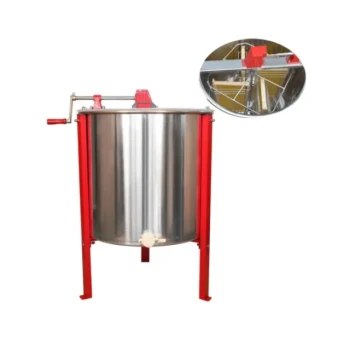
Microprocessor-based control platforms are the industry standard for modern honey extraction because they enable complex, adaptive automation that mechanical solutions cannot support. Unlike electromagnetic relays, which are limited to simple switching and suffer from physical wear, microprocessors execute sophisticated algorithms to optimize cycle times, increase extraction rates, and protect honeycomb frames.
By replacing mechanical switching with digital logic, operators gain the ability to execute adaptive algorithms. This shift optimizes the extraction process for speed and yield while simultaneously protecting honeycomb frames from damage and eliminating the maintenance overhead of relay contacts.
The Power of Adaptive Algorithms
The primary advantage of a microprocessor is its ability to process information and react to changing conditions in real-time.
Handling Rotational Inertia
Honey extraction is a dynamic process. As honey leaves the comb, the weight of the frames decreases, changing the rotational inertia of the basket.
Automatic Adjustments
A microprocessor detects these shifts in inertia. It automatically adjusts reversal timing and speed-interval durations to match the current weight load, ensuring the machine runs efficiently throughout the entire cycle.
Multi-Stage Programming
Electromagnetic relays generally offer rigid, fixed operations. Microprocessors allow for the precise setting of multi-stage extraction programs, allowing operators to customize the process for different honey viscosities or frame types.
Operational Outcomes
The implementation of digital control logic translates directly to measurable performance improvements.
Increased Extraction Rates
Because the system can optimize speed and direction based on real-time data, it extracts a higher percentage of honey from the comb compared to fixed-speed mechanical systems.
Shorter Processing Cycles
Adaptive algorithms eliminate wasted time. By adjusting intervals based on the actual physics of the load rather than a timer, the overall processing cycle is significantly shortened.
Frame Protection
One of the distinct risks in extraction is damaging the honeycomb due to excessive force. Microprocessors manage acceleration and deceleration precisely, providing better protection for honeycomb frames.
Understanding the Trade-offs: Reliability vs. Wear
When choosing between these technologies, you are fundamentally choosing between software reliability and mechanical liability.
The Lifespan of Electromagnetic Relays
Traditional relays rely on physical contacts that open and close to complete circuits. Over time, these contacts degrade due to arcing and mechanical fatigue.
The Maintenance Liability
Relay-based systems suffer from short lifespan issues associated with these contacts. This necessitates frequent maintenance and part replacement to keep the machine operational.
The Microprocessor Advantage
Microprocessor platforms eliminate these moving switching parts. By removing the physical point of failure, the control system becomes far more durable and reliable over the long term.
Making the Right Choice for Your Goal
While microprocessor systems are technically superior, understanding your specific operational goals helps clarify the value of the investment.
- If your primary focus is Maximizing Yield: The microprocessor is essential because it uses adaptive algorithms to extract more honey in shorter cycles.
- If your primary focus is Equipment Longevity: The microprocessor is the correct choice because it eliminates the maintenance burden and short lifespan issues of relay contacts.
- If your primary focus is Asset Protection: The microprocessor provides the necessary precision to protect delicate honeycomb frames from damage during high-speed spins.
Adopting microprocessor-based control is not just an upgrade in technology; it is a fundamental shift toward higher efficiency and reduced mechanical failure.
Summary Table:
| Feature | Microprocessor Control | Electromagnetic Relays |
|---|---|---|
| Operation Logic | Adaptive, programmable algorithms | Rigid, fixed mechanical switching |
| Inertia Handling | Real-time adjustment to load weight | Non-responsive to load changes |
| Maintenance | High durability, no moving parts | High (frequent contact wear/arcing) |
| Yield Optimization | Maximized via multi-stage cycles | Limited by fixed-speed settings |
| Frame Safety | Precise acceleration/deceleration | Abrupt starts/stops increase damage risk |
Scale Your Honey Production with HONESTBEE Precision Technology
Transitioning to microprocessor-controlled extraction is a game-changer for commercial apiaries and distributors seeking to maximize yield and minimize equipment downtime. At HONESTBEE, we specialize in providing professional-grade honey-filling machines, hive-making equipment, and high-efficiency extractors designed for the modern industry.
By choosing our advanced machinery, you benefit from:
- Increased ROI: Higher extraction rates and shorter cycle times.
- Reduced Costs: Eliminating the maintenance burden of traditional relay systems.
- Asset Longevity: Precision programming that protects your valuable honeycomb frames.
Ready to upgrade your apiary’s efficiency? Contact HONESTBEE today to explore our wholesale equipment and customized industrial solutions.
References
- О.М. Логунов. Aдаптивна система управління електроприводом самооборотної медогонки. DOI: 10.33216/1998-7927-2022-272-2-42-45
This article is also based on technical information from HonestBee Knowledge Base .
Related Products
- Stainless Steel 3 Frame Manual Honey Extractor Spinner for Bee Honey Extraction
- electric honey extractor honey centrifuge 3 frame honey extractor stainless steel honey frame extractor
- HONESTBEE 3-Frame Manual Acrylic Honey Extractor
- Stainless Steel Manual 8 Frame Radial Honey Extractor Machine for Beehives
- HONESTBEE 2 Frame Manual Acrylic Honey Extractor Beekeeping Equipment
People Also Ask
- Which type of honey extractor is generally more durable? Focus on Material & Build Quality for Longevity
- What are the disadvantages of a manual honey extractor? Overcome Efficiency Bottlenecks in Your Apiary
- What is a manual honey extractor? The Essential Guide to Cost-Effective Beekeeping for Beginners
- Why are manual extractors popular among beginner beekeepers? A Guide to Starting Simple & Saving Money
- What are the primary advantages of utilizing a manual honey extractor? Cost-Effective & Gentle Harvesting