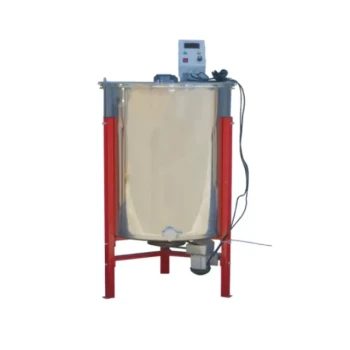
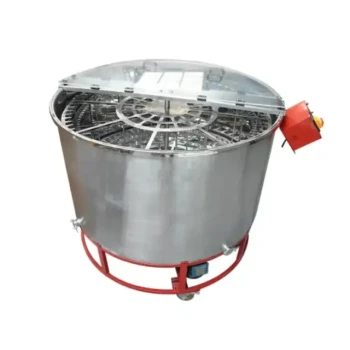
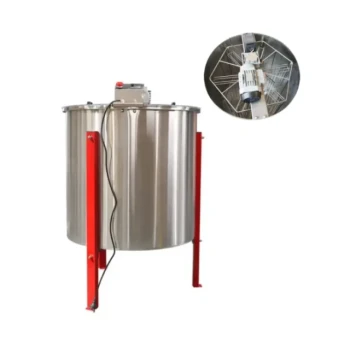
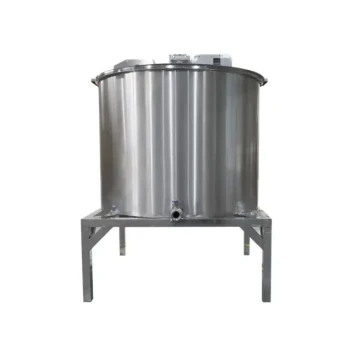
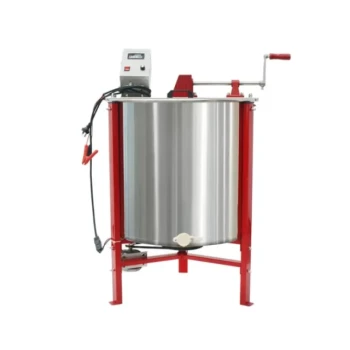
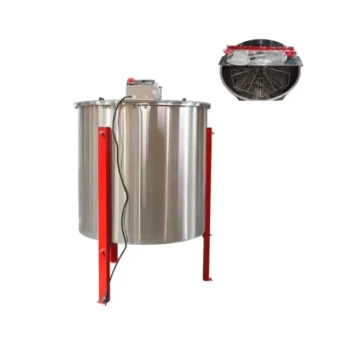
An industrial centrifuge is the definitively essential tool for isolating microscopic pollen grains from the dense, viscous sugar matrix of honey. It functions by applying high-velocity centrifugal force—typically roughly 2500 to 3500 rpm—to a diluted honey solution, forcing phase separation that drives trace pollen particles into a concentrated sediment pellet while stripping away interfering liquid sugars.
The separation of pollen from honey is a battle against viscosity. Because pollen content is extremely low and honey is physically dense, natural gravity is insufficient for separation. The centrifuge provides the necessary mechanical force to isolate these biological signatures for analysis without destroying them.
The Mechanics of Phase Separation
Overcoming the Sugar Matrix
Honey is a supersaturated sugar solution that naturally suspends microscopic particles. To extract pollen, you must first dilute the honey, but even then, the sugar matrix interferes with analysis.
An industrial centrifuge applies rapid rotational force to break the bond between the liquid sugar and the solid pollen. The primary reference notes that speeds around 2500 rpm are critical for this phase separation. This process effectively "washes" the pollen, removing the sticky glucose and fructose that would otherwise obscure microscopic observation.
Creating the Sediment Pellet
The ultimate goal of the extraction process is the recovery of a solid sample from a liquid medium. The centrifuge drives the solid material—the pollen—to the very bottom of the tube.
This results in a dense sediment pellet. By compacting the solids, the operator can easily decant (pour off) the liquid supernatant (the sugar water), leaving behind only the purified biological material needed for study.
Enabling Precise Analysis
Concentrating Trace Elements
Pollen in commercial honey is present in very low quantities. Attempting to analyze honey without concentration would be like looking for a needle in a haystack.
The centrifuge acts as an enrichment tool. By processing a larger volume of diluted honey and forcing all solid matter into a small area, it concentrates the sample. This ensures that the density of the pollen meets the requirements for statistical validity during microscopic examination.
Facilitating Palynological Classification
Once the pollen is isolated and concentrated, scientists perform palynological analysis to determine the honey's botanical origin.
The cleaning process allows for the identification of specific plant families, such as Brassicaceae or Asteraceae. As noted in the supplementary data, this step is fundamental for classifying the honey's commercial grade and verifying its floral source for labeling accuracy.
Understanding the Trade-offs
The Necessity of Parameter Control
While centrifugal force is effective, it must be precise. The process relies on specific specific gravity differences between the pollen and the fluid.
If the speed is too low, the phase separation will be incomplete, leaving pollen suspended in the sugar solution. If the speed is excessive or the duration uncontrolled, there is a risk of compacting the pellet so tightly that resuspension for slide preparation becomes difficult.
Complexity vs. Gravity Settling
Using an industrial centrifuge adds a layer of complexity compared to traditional gravity settling. It requires power, maintenance, and precise calibration of time (often up to 45 minutes) and speed.
However, this trade-off is unavoidable for professional applications. Gravity settling is simply too slow and inefficient to overcome the viscosity of honey for standardized, high-throughput industrial or laboratory operations.
Making the Right Choice for Your Goal
To ensure your pollen extraction yields useful data, you must align your processing parameters with your analytical objectives.
- If your primary focus is Botanical Origin (Purity): Prioritize multiple washing cycles within the centrifuge to ensure 100% removal of the sugar matrix, as sugar crystals can mimic pollen structures under a microscope.
- If your primary focus is Quantitative Analysis (Pollen Count): Adhere strictly to standardized speeds (e.g., 2500–3500 rpm) and durations to ensure all pollen is recovered in the pellet, preventing data skewing from suspended particles.
The industrial centrifuge transforms honey from a simple food product into a chemically analyzable dataset, unlocking the ability to verify quality and origin with scientific certainty.
Summary Table:
| Feature | Industrial Centrifuge Specification | Benefit to Honey Processing |
|---|---|---|
| Rotational Speed | 2500 - 3500 RPM | Overcomes viscosity to force phase separation |
| Sample Enrichment | High-density pellet formation | Concentrates trace pollen for statistical validity |
| Processing Time | Up to 45 minutes | Ensures complete extraction compared to slow gravity settling |
| Analytical Goal | Palynological classification | Enables precise identification of botanical and floral sources |
Elevate Your Honey Processing with HONESTBEE
Precision in pollen extraction is the key to verifying honey quality and origin. HONESTBEE provides commercial apiaries and distributors with the professional-grade tools needed to lead the market. From high-performance industrial centrifuges and honey-filling machines to a complete range of beekeeping equipment and consumables, we empower your business with industrial-scale efficiency.
Whether you are expanding your wholesale operations or optimizing your laboratory analysis, our specialized hardware and honey-themed merchandise are designed for your success.
Ready to scale your apiary operations?
Contact HONESTBEE today for a comprehensive wholesale quote!
References
- Mahani Majid, Mohd Fadzelly Abu Bakar. Melissopalynological Study, Phenolic Compounds, and Antioxidant Properties of <i>Heterotrigona itama</i> Honey from Johor, Malaysia. DOI: 10.1155/2020/2529592
This article is also based on technical information from HonestBee Knowledge Base .
Related Products
- electric honey extractor honey centrifuge 3 frame honey extractor stainless steel honey frame extractor
- Manual Hand Crank 4 Frame Honey Extractor Centrifuge for Beekeeping
- Professional 4 Frame Self Reversing Electric Honey Extractor for Beekeeping
- HONESTBEE 72 Frame Industrial Electric Honey Extractor for Beekeeping
- Honey Concentrating and Filtering Dehumidifier Machine 2T Capacity for Honey
People Also Ask
- What are the characteristics of electric honey extractors? Boost Your Apiary Efficiency with Automated Technology
- What are the disadvantages of using an electric honey extractor? Weighing Cost, Power, and Comb Safety
- What are the advantages of an electric honey extractor? Boost Efficiency and Scale Your Honey Production
- What are the technical advantages of electric honey extractors? Maximize Yield and Protect Your Bee Colony
- How does an electric honey extractor affect the quality of honey? Preserve Flavor & Purity with Precision Extraction