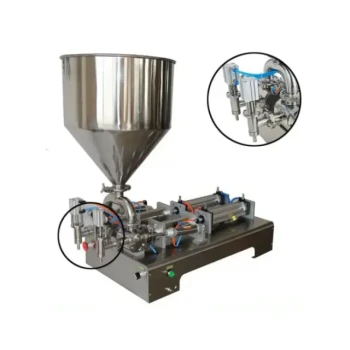
The transition to commercial honey production hinges on consistency and scalability. An industrial honey-filling machine is critical because it replaces variable manual labor with automated precision, ensuring every container meets the strict hygiene and volumetric standards required by professional supply chains. Without this technology, achieving the standardized packaging necessary for retail distribution or export markets is practically impossible.
Industrial filling machinery bridges the gap between artisanal beekeeping and mass market supply by guaranteeing production efficiency and product uniformity. It transforms honey processing from a labor-intensive chore into a standardized operation capable of meeting international food safety and export requirements.
Achieving Commercial Standardization
Precision and Quantitative Packaging
In a commercial setting, "approximately full" is not acceptable. Industrial machines utilize high-precision quantitative packaging technologies.
This ensures strict volume consistency across thousands of containers. This precision is vital for meeting legal labeling requirements and consumer expectations.
Meeting Strict Hygiene Standards
Manual filling introduces significant risks of contamination through human contact. Industrial machines utilize automated processes to minimize manual handling.
This automation creates a sterile environment during the bottling process. It ensures the final product complies with rigorous food safety standards required by health regulators.
Readiness for Export Markets
For producers aiming for international distribution, consistency is a prerequisite. Automated hardware provides the standardized output required for export.
Without the assurance of hygiene and uniformity provided by these machines, entering the global marketplace is virtually impossible.
Operational Efficiency and Scalability
High-Throughput for Growing Apiaries
As operations scale—specifically those managing over 100 hives—manual filling becomes a bottleneck. Industrial machines offer high-throughput output capabilities.
They allow producers to process large harvests quickly during peak seasons. This prevents production backlogs that can degrade honey quality over time.
Reducing Labor Reliance
Transitioning to an industrial model requires lowering the cost of goods sold. Specialized machinery significantly reduces reliance on manual labor.
By mechanizing the primary processing phases, beekeepers can reallocate workforce resources to hive management rather than bottling. This lowers overall labor intensity and operational costs.
Minimizing Material Loss
In high-intensity operations, manual pouring leads to spills and waste. Industrial fillers are designed to minimize material loss.
They ensure that valuable product ends up in the bottle, not on the floor. Over thousands of units, this efficiency directly impacts the bottom line.
Market Positioning and Brand Trust
Enhancing Market Recognition
Professional packaging is a key driver of consumer perception. High-performance equipment ensures a standardized and hygienic presentation.
This consistency signals professionalism to the consumer. It supports brand development by moving the product away from a "backyard" aesthetic to a retail-ready appearance.
Commanding Premium Pricing
Reliability allows for better margins. By demonstrating adherence to food safety and packaging quality standards, producers can achieve premium pricing.
Retailers and distributors are willing to pay more for products that guarantee shelf stability and uniform weight.
Understanding the Trade-offs
Capital Investment vs. Long-term Gain
While essential for growth, these machines represent a significant upfront capital expenditure.
Beekeepers must weigh the initial cost against the long-term savings in labor and the potential for increased revenue through wider distribution.
Maintenance and Technical Skill
Moving from manual to automated systems introduces technical complexity.
Operators must account for the maintenance required to keep high-precision equipment calibrated. A shift in skillset from pure beekeeping to machinery management is often required.
Making the Right Choice for Your Goal
To select the right equipment, you must align the machine's capabilities with your specific business objectives.
- If your primary focus is International Export: Prioritize machines with advanced hygiene automation and certification capabilities to meet strict border standards.
- If your primary focus is Local Retail Expansion: Focus on equipment that guarantees visual uniformity and precise volume control to build consumer trust and brand recognition.
- If your primary focus is Cost Reduction: Look for high-throughput machines that offer the highest ratio of bottles-per-hour to minimize labor hours and material waste.
Investing in industrial filling technology is not just about speeding up the process; it is the fundamental step that legitimizes a honey business in the commercial eye.
Summary Table:
| Key Factor | Manual Filling | Industrial Machine Filling | Business Impact |
|---|---|---|---|
| Volume Precision | High Variance | High-Precision Quantitative | Legal compliance & consumer trust |
| Hygiene Levels | Human-contact risk | Automated, sterile process | Meets international food safety standards |
| Production Speed | Low (Bottleneck) | High-Throughput | Enables scaling past 100+ hives |
| Labor Costs | High intensity | Significantly reduced | Lowered cost of goods sold (COGS) |
| Market Reach | Local/Artisanal | Export & Retail Ready | Access to premium global markets |
Scale Your Apiary with HONESTBEE Professional Solutions
Transitioning from artisanal beekeeping to a commercial powerhouse requires the right technical partner. HONESTBEE specializes in supporting commercial apiaries and distributors with a comprehensive range of wholesale beekeeping machinery and tools.
From high-precision honey-filling machines that guarantee export-quality hygiene to industrial hive-making equipment and essential consumables, we provide the infrastructure you need to eliminate production bottlenecks.
Our Value to You:
- Efficiency: Reduce labor reliance with high-throughput automation.
- Standardization: Achieve the uniformity required for international retail.
- Growth: Expert hardware solutions designed for large-scale operational success.
Ready to elevate your honey production? Contact us today to discuss your wholesale equipment needs and join the global market.
References
- Aleksandra Tymczak. Honey production in Alberta: Grassroots extension services. DOI: 10.56367/oag-048-11780
This article is also based on technical information from HonestBee Knowledge Base .
Related Products
- Commercial Rotary Honey Filling Machine for Production
- Precision Durable Efficient HONESTBEE Rotary Honey Filling Machine
- Fully Automatic Honey Filling Packaging Machine for Processing Line
- Economy Small Honey Filling Machine Honey Bottle Filler Packaging Machine
- Automatic Honey Filling and Filtering Machine for Beekeeping Bottle Filling
People Also Ask
- What role do commercial honey filling machines play in honey distribution? Scaling Efficiency and Quality Control
- What technical support do commercial-grade filling machines provide? Convert Honey NTFPs into Marketable Commodities
- What is the significance of specialized honey filling equipment? Scaling from Beekeeping to Commercial Success
- Why is professional honey filling machinery critical for honey production? Scale Your Apiary's Profit & Efficiency
- Why is high-capacity honey filling machinery necessary for Giant Honey Bees? Solve the Apis dorsata Volume Crisis