Emergency queen cells may save a colony, but they cannot reliably support commercial production. Worker bees create emergency cells from available worker larvae—typically larvae less than three days old—but they do not consistently select the best genetics or the most suitable larvae. Dedicated queen-rearing equipment lets commercial apiaries control larval selection, cell orientation, nutrition, protection, mating, and production volume.
Emergency queen rearing is a useful recovery mechanism; dedicated equipment is a production system. Commercial apiaries need repeatable control over queen quality, genetic selection, survival rates, biosecurity, and delivery schedules.
Why Emergency Queen Cells Are Insufficient at Commercial Scale
Worker selection is uncontrolled
When a colony loses its queen, workers rapidly convert suitable worker cells into emergency queen cells. Their priority is restoring queenright status—not selecting the best larva for long-term productivity.
This means the resulting queens may vary significantly in size, fertility, laying capacity, temperament, disease resistance, and winter performance.
Colony survival is not the same as queen quality
An emergency queen can prevent colony collapse, but that does not make her the best commercial queen. A replacement queen with weak laying performance can reduce brood production, worker population, honey yields, and overwintering strength.
For a commercial apiary, the relevant question is not simply whether a queen emerges. It is whether she consistently supports a productive colony.
Emergency timing is unpredictable
Emergency cells are created only after queen loss and may mature at different times. This makes it difficult to coordinate mating, colony strength, requeening schedules, and customer deliveries.
Commercial operations require predictable batches of queens rather than irregular production triggered by accidental queenlessness.
How Dedicated Equipment Improves Queen Quality
Precision grafting enables genetic selection
Grafting tools allow breeders to transfer selected larvae into artificial queen cups. The breeder can choose larvae from high-performing colonies rather than leaving the selection entirely to worker bees.
This supports deliberate propagation of traits such as high productivity, gentle behavior, disease resistance, cold tolerance, and winter resilience.
Cell cups create a controlled development environment
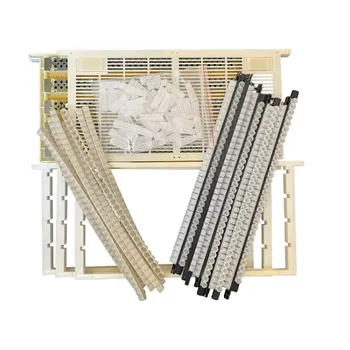
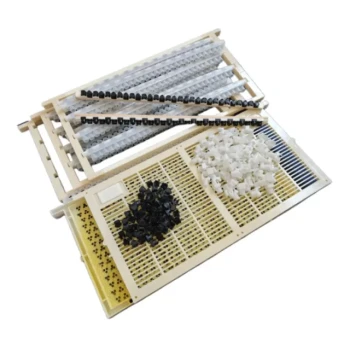
Artificial queen cups provide standardized locations for grafted larvae and help establish consistent queen-cell development. Proper cell orientation and sufficient space allow nurse bees to provide abundant royal jelly during the critical larval stage.
The result is a more repeatable process than relying on emergency cells formed in irregular worker-cell locations.
Queen frames increase production efficiency
Queen-rearing frames organize cell cups in a format that can be inspected, transferred, protected, and harvested efficiently. Standardized frames also make it easier to manage multiple batches and integrate queen production into an existing apiary workflow.
This is essential when an operation must produce dozens or hundreds of queens rather than a few emergency replacements.
Mating equipment completes the production process
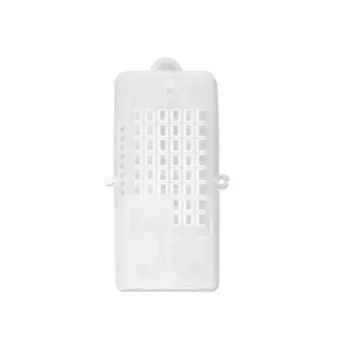
Grafting and cell production alone do not guarantee a usable queen. Mating nucs and related hive components provide controlled colonies in which virgin queens can emerge, mate, and begin laying.
A commercial system therefore needs to manage the entire sequence: larval selection, grafting, cell development, emergence, mating, evaluation, and distribution.
Equipment Supports Commercial Consistency
Standardization improves survival rates
Manual grafting is sensitive to handling, positioning, moisture, feeding, and timing. Dedicated grafting tools, cell cups, and queen frames create a controlled physical environment that reduces avoidable variation.
Standardized consumables also help operators repeat successful procedures across production cycles.
Cell protectors prevent preventable losses
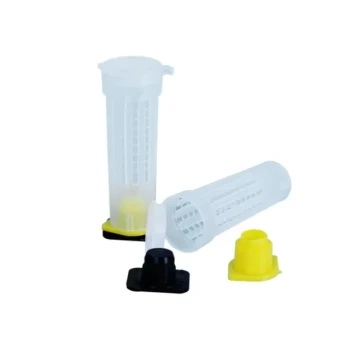
Before queens emerge, individual queen-cell protectors can be installed around developing cells. These protectors help prevent an emerging queen or worker bees from damaging neighboring queen cells.
For a commercial breeder, protecting each viable cell matters because losing a batch of cells directly reduces available inventory and increases production costs.
Production can be synchronized
Dedicated equipment allows breeders to plan larval age, grafting dates, cell transfer, mating-nuc preparation, and delivery windows. Synchronization is difficult when production depends on colonies independently raising emergency cells.
Predictability benefits both the apiary and its business customers, especially when replacement queens are needed for scheduled requeening or seasonal demand.
In-House Rearing Improves Genetic and Biosecurity Control
Local adaptation becomes possible
Commercial apiaries can select queens from resident colonies that already perform well under local conditions. This allows breeding programs to emphasize traits such as regional climate tolerance, disease resistance, productivity, and winter survival.
The goal is not merely to produce more queens, but to produce queens suited to the environments where their colonies will operate.
Imported queens carry additional risks
Purchasing queens from outside regions can introduce unwanted pathogens, pests, or poorly adapted genetics. Examples of potential biosecurity concerns include American foulbrood, small hive beetles, and invasive or undesirable bee genetics.
In-house production does not eliminate all disease risk, but it can reduce dependence on external biological material and strengthen control over colony health.
Self-sufficiency reduces supply dependence
A commercial apiary that can rear its own queens is less exposed to supplier shortages, transport delays, imported-queen costs, and seasonal availability constraints. This is particularly valuable for distributors and beekeeping businesses that must maintain reliable supply.
A dependable equipment and consumables program is therefore part of operational continuity, not merely a breeding convenience.
Understanding the Trade-offs
Emergency cells remain useful in specific situations
Emergency queen cells are valuable when a colony unexpectedly becomes queenless and the immediate priority is recovery. They require little specialized equipment and can provide a practical solution for small-scale or non-commercial beekeeping.
They are best understood as a contingency method, not as the foundation of a controlled queen-production program.
Equipment requires investment and expertise
Dedicated queen rearing involves costs for grafting tools, cell cups, frames, mating nucs, protectors, and other hive components. Staff must also develop skills in larval selection, grafting, colony preparation, timing, and quality assessment.
The investment is justified when consistent queen quality, volume, or self-sufficiency has meaningful commercial value.
Equipment does not replace biological management
Even precise tools cannot compensate for weak breeder colonies, poor nutrition, unsuitable mating conditions, or inadequate disease control. Successful queen production still depends on strong nurse colonies, proper timing, and disciplined apiary management.
The equipment provides control and repeatability; it does not remove the need for sound beekeeping judgment.
More equipment can create process complexity
Commercial queen rearing adds inspections, inventory requirements, scheduling, and quality-control steps. Operations should standardize procedures and maintain reliable access to compatible consumables to prevent interruptions between grafting and emergence.
For this reason, a responsive supplier with a broad product portfolio and efficient fulfillment can be operationally important, particularly during peak production periods.
Making the Right Choice for Your Goal
Dedicated queen-rearing equipment should be selected according to the level of control and production reliability your apiary requires.
- If your primary focus is emergency colony recovery: Emergency queen cells may be adequate for replacing a lost queen when genetic selection and production timing are not critical.
- If your primary focus is consistent queen quality: Use grafting tools, artificial cell cups, and queen frames to select superior larvae and standardize cell development.
- If your primary focus is commercial volume: Build a complete system incorporating cell-production equipment, protectors, mating nucs, and standardized consumables.
- If your primary focus is biosecurity and local adaptation: Rear queens from high-performing resident colonies to reduce dependence on imported queens and select traits suited to regional conditions.
- If your primary focus is reliable customer supply: Use synchronized production processes and maintain dependable access to equipment and consumables to support predictable fulfillment.
Dedicated equipment turns queen rearing from an unpredictable emergency response into a controllable commercial capability.
Summary Table:
| Aspect | Emergency Queen Cells | Dedicated Queen Rearing Equipment |
|---|---|---|
| Genetic Control | Uncontrolled worker selection | Precise grafting of selected larvae |
| Production Volume | Irregular, low | Scalable, predictable batches |
| Quality Consistency | Variable quality | Standardized development environment |
| Timing | Unpredictable emergence | Synchronized production schedules |
| Biosecurity | Risk of imported diseases | In-house rearing reduces external risks |
| Cost & Expertise | Low investment, minimal skills | Higher investment, requires trained staff |
Looking to elevate your queen rearing operation? HONESTBEE offers a complete range of commercial queen rearing equipment, from grafting tools to mating nucs, designed for apiaries and distributors. Our one-stop sourcing, rapid delivery, and expert support ensure you maintain high-quality queen production and meet supply commitments. Contact us today to discuss your requirements and boost your apiary's efficiency!
Related Products
- Retractable Chinese Queen Rearing Grafting Tools Equipment
- HONESTBEE Improved No Grafting Queen Rearing Kit For Queen Rearing and Royal Jelly Production
- No Grafting Queen Rearing Kit: System for Royal Jelly Production and Queen Rearing
- Premium Nicot Style Queen Rearing Kit with Hair Roller Bee Cages
- Stainless Steel Queen Grafting Tool for Beekeeping and Bee Queen Grafting
People Also Ask
- Which specialized tools are necessary for implementing standardized queen rearing? Scale Your High-Yield Apiary
- Why are specialized queen rearing tools necessary to mitigate winter hive losses? Boost Apiary Survival and Recovery
- What operational workflows and queen rearing tools are required for implementing instrumental insemination and isolated mating in commercial queen breeding programs?
- How do queen-rearing tools facilitate the sustainability and expansion of a commercial apiary? Drive Scalable Growth
- In what ways do modern queen rearing equipment and grafting tools improve competitiveness? Boost Breeding Success Rate