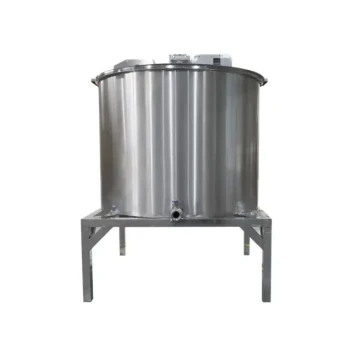
Industrial vacuum concentration is the definitive solution for reducing honey moisture content while protecting its commercial value. This equipment operates by lowering the atmospheric pressure surrounding the honey, allowing water to evaporate at significantly lower temperatures than open-air boiling. This process is essential for preventing the destruction of heat-sensitive nutrients while ensuring the product reaches the density levels required to prevent fermentation.
By decoupling moisture removal from high heat, vacuum concentration preserves the natural enzymes and vitamins that define honey's quality. It is the technical bridge between raw, high-moisture harvest and a stable, export-grade commodity.
Preserving Biological Integrity Through Physics
The Mechanism of Low-Temperature Evaporation
The primary function of vacuum concentration is to alter the physical environment of the honey. By creating a vacuum, the equipment reduces the boiling point of the water contained within the honey.
This allows moisture to be evaporated rapidly without subjecting the honey to scorching temperatures. This is physically impossible to achieve with standard heating methods at normal atmospheric pressure.
Protecting Heat-Sensitive Compounds
Honey is biologically active, containing delicate enzymes, vitamins, and nutrients. High heat is the enemy of these compounds; it denatures enzymes and degrades nutritional value.
Vacuum concentration avoids this thermal damage. It ensures that while the water is removed, the bio-active components remain intact, preserving the honey's natural profile.
Ensuring Commercial Viability and Safety
Preventing Fermentation
High moisture content is the leading cause of honey fermentation. Yeast naturally present in honey thrives in moist environments, leading to spoilage.
Vacuum concentration creates an artificial dehydration process that increases honey density. This stabilizes the product, making the environment inhospitable for yeast and effectively shelf-stable.
Meeting International Export Standards
Global markets enforce strict physicochemical indicators for honey. To enter trade systems like the European Union, products must meet specific concentration and density benchmarks.
This equipment transforms variable raw honey into a standardized product. It ensures the consistency required for long-term storage and international transportation.
Understanding the Trade-offs
The Balance of Processing vs. Natural State
While vacuum concentration is less damaging than direct heating, it is still a processing step. Operators must carefully monitor the duration and vacuum levels to avoid removing volatile aromatic compounds that give honey its unique flavor.
Complexity and Capital Investment
Unlike simple settling tanks, this is sophisticated machinery. It requires higher initial capital and skilled operation to integrate with filtration and filling lines.
The benefits of quality preservation must be weighed against the operational complexity of maintaining vacuum seals and pressure systems.
Making the Right Choice for Your Goal
To succeed in the global market, you must align your processing technology with your end-product goals.
- If your primary focus is Premium Quality Export: Prioritize vacuum concentration to maintain enzyme activity and nutrient levels, allowing you to market the product as high-grade and natural.
- If your primary focus is Shelf Stability: Use vacuum concentration to strictly control density, ensuring the product survives long logistics chains without fermenting.
Vacuum concentration is not just about drying; it is the essential safeguard that allows you to scale production without sacrificing the biological quality that the market demands.
Summary Table:
| Feature | Vacuum Concentration | Traditional Open Heating |
|---|---|---|
| Boiling Point | Low (protects nutrients) | High (risks scorching) |
| Enzyme Retention | High (biological integrity) | Low (thermal degradation) |
| Moisture Control | Precise & rapid dehydration | Inconsistent & slow |
| Shelf Life | Excellent (prevents yeast growth) | Variable (risk of fermentation) |
| Market Readiness | Meets international export standards | Often fails density benchmarks |
Elevate Your Honey Quality with HONESTBEE Professional Solutions
To compete in the global marketplace, your processing equipment must deliver both efficiency and biological integrity. HONESTBEE specializes in supporting commercial apiaries and distributors by providing the industry's most reliable industrial vacuum concentration machinery, honey-filling systems, and specialized beekeeping tools.
Whether you are a large-scale distributor looking to standardize export quality or a commercial apiary scaling up production, our comprehensive wholesale offerings ensure your honey remains nutrient-rich and shelf-stable. We provide the technical bridge from harvest to high-grade commodity with hardware designed for long-term performance.
Ready to upgrade your processing line? Contact our experts today for a tailored quote!
References
- Hua Yu, Cui Peng-bo. Research on the International Export Competitiveness of Honey – Taking Anhui Province as an example. DOI: 10.1051/shsconf/20151402015
This article is also based on technical information from HonestBee Knowledge Base .
Related Products
- Honey Concentrating Vacuum Heating Thickening Machine Dehumidifier for Honey
- Honey Concentrating and Filtering Dehumidifier Machine 2T Capacity for Honey
- 0.5T Capacity Honey Dehumidifier Dryer with Vacuum Heating and Thickening Filtering Machine
- Electric Double Wall Honey Filtering Machine Purifier Equipment for Honey Processing Plant
- Electric Honey Press Machine for Squeezing Honey Comb Press Equipment
People Also Ask
- What should be observed during the feeding process of the honey concentrator? Master Honey Processing Efficiency
- What are the advantages of using a honey concentrator machine in apiculture? Boost Quality & Shelf Life
- What are the benefits of a honey concentrator? Elevate Your Honey Quality and Market Value
- What electrical safety precaution is necessary when operating the honey concentrating equipment? Essential Grounding Tips
- What maintenance should be performed when the honey concentrating equipment is not in use? Key Safety & Care Tips