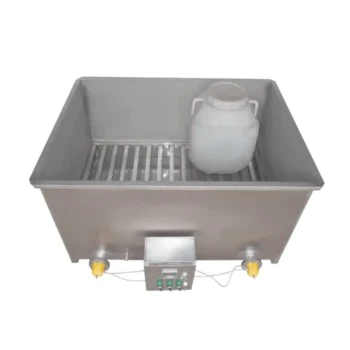
Shell freezing equipment transforms the efficiency of honey processing by rotating the product containers during the cooling phase. Instead of allowing the honey to settle into a thick, solid block, this rotation forces the liquid to freeze in a thin, uniform layer against the inner walls of the vessel.
By maximizing the surface-area-to-volume ratio, shell freezing accelerates heat transfer and creates a clear path for water vapor to escape. This significantly shortens the overall freeze-drying cycle compared to static freezing methods.
The Mechanics of Surface Maximization
Creating a Uniform Structure
Standard freezing methods often result in a dense core of product. Shell freezing equipment actively prevents this by rotating the flask or vessel.
This rotation spreads the honey while it is still liquid. As the temperature drops, the honey hardens into a thin, even shell coating the interior of the container.
Increasing the Surface-Area-to-Volume Ratio
The physical geometry of the frozen honey is the critical factor here. Shell freezing dramatically increases the surface-area-to-volume ratio.
You are processing the same amount of honey, but by spreading it out, you expose a much larger percentage of the product directly to the vacuum environment.
Why Geometry Drives Efficiency
Facilitating Heat Transfer
For freeze-drying to occur, heat energy must reach the ice crystals to trigger sublimation.
A thin shell allows this thermal energy to transfer through the honey much more efficiently. There is no thick, frozen core acting as an insulator to slow down the process.
Optimizing Water Vapor Escape
As ice turns to vapor (sublimation), that vapor must travel out of the product matrix.
In a thick block, vapor deep inside struggles to escape, slowing the process. The thin layer created by shell freezing provides a short, direct path for water vapor escape.
Reducing Cycle Time
These factors combine to produce a distinct operational advantage. Because heat enters faster and vapor leaves easier, the overall drying cycle is shortened.
Understanding the Trade-offs
Equipment Dependency
The primary "cost" of this method is hardware-related. You cannot achieve a shell freeze structure with a standard static freezer.
It requires specialized shell freezing equipment capable of consistent rotation during the cooling phase.
Volume Limitations
While efficient, shell freezing is generally restricted to the volume of the flasks or vessels used in the rotator.
It is highly effective for batch processing in vessels but differs mechanically from bulk tray drying.
Making the Right Choice for Your Goal
To determine if shell freezing is the right step for your honey processing, consider your production priorities:
- If your primary focus is processing speed: Utilize shell freezing to maximize heat transfer and minimize the duration of each drying cycle.
- If your primary focus is equipment simplicity: Recognize that static freezing avoids the need for rotating hardware, though it will result in longer drying times due to poor surface area exposure.
Shell freezing is the definitive choice for operators looking to optimize throughput by leveraging physics to speed up sublimation.
Summary Table:
| Feature | Shell Freezing Method | Static Freezing Method |
|---|---|---|
| Physical Form | Thin, uniform layer (shell) | Dense, solid block |
| Surface-to-Volume Ratio | Exceptionally high | Relatively low |
| Heat Transfer Speed | Fast (no insulated core) | Slow (thick core insulation) |
| Vapor Escape Path | Short and direct | Long and obstructed |
| Total Cycle Time | Significantly reduced | Extended |
| Equipment Required | Specialized rotating hardware | Standard static freezer |
Elevate Your Honey Production with HONESTBEE
Maximize your commercial efficiency with professional-grade honey processing solutions. At HONESTBEE, we specialize in empowering commercial apiaries and distributors with high-performance tools and machinery designed for scale.
Whether you need advanced honey-filling machines, hive-making equipment, or the latest beekeeping consumables, our comprehensive wholesale portfolio has you covered. Partner with us to streamline your workflow, reduce cycle times, and deliver superior honey products to your market.
Ready to optimize your apiary operations? Contact our expert team today to discover the perfect equipment for your business needs!
References
- Nebojša Nedić, Miloš Pajić. Study of vacuum and freeze drying of bee honey. DOI: 10.2298/tsci200317194n
This article is also based on technical information from HonestBee Knowledge Base .
Related Products
People Also Ask
- What are the features of the processing tanks offered? Engineered for Purity and Efficiency
- What types of stainless steel processing tanks are used for honey? Essential Equipment for Quality Honey Production
- What design options are available for honey processing tanks? Optimize Efficiency with Custom Geometries
- What types of stainless steel are used for honey processing? Ensure Food Safety with 304 & 316 Grade Equipment
- Why is industrial-grade stainless steel processing equipment required for honey harvesting? Ensure Purity & Compliance