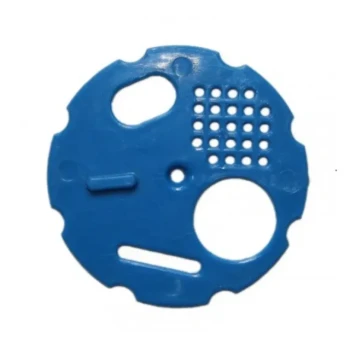
The application of distinctive visual cues to hive entrances is a fundamental bio-security measure, not merely an aesthetic choice. Honeybees rely heavily on visual landmarks for navigation. By adding distinct colors and geometric symbols, you increase the visual complexity of the apiary, providing foraging bees with unique identifiers to locate their specific colony and preventing them from accidentally entering a neighbor's hive.
By transforming a uniform row of hives into a landscape of unique landmarks, you significantly reduce drifting behavior. This is the single most effective passive method for preventing the cross-infection of pathogens and limiting the spread of parasites between colonies.
The Mechanics of Drift Reduction
Breaking Visual Uniformity
In a standard apiary, hives often appear identical to the human eye and the bee's eye. This uniformity causes confusion for returning foragers.
By applying specific colors and shapes, you create a unique visual address for each colony. This allows the bee to distinguish its native hive from the one next to it with high accuracy.
Increasing Visual Complexity
Bees navigate using a combination of sun position and terrestrial landmarks.
Adding geometric symbols enhances the visual complexity of the immediate environment. This provides the distinct "signposts" necessary for bees to correct their flight path before landing.
The Bio-Security Implications
Preventing Cross-Infection
Drifting is a primary vector for disease transmission. When a bee from an infected colony "drifts" into a healthy one, it carries pathogens with it.
Reducing navigation errors acts as a quarantine barrier. It ensures that an infection in one hive is less likely to jump to adjacent colonies through lost foragers.
Limiting Parasite Spread
Parasites, such as mites, hitch rides on foraging bees. Drifting bees act as inadvertent transport vessels for these pests.
By ensuring bees return only to their native hives, you contain parasite loads to specific colonies. This makes monitoring and treatment significantly more effective and prevents apiary-wide infestations.
Understanding the Implementation Trade-offs
Equipment Interchangeability
Standardizing equipment becomes more difficult when hive bodies are color-coded or marked.
If you rely on swapping components between hives for management, distinct markings can become a logistical hurdle. You must ensure that moving a marked box does not confuse the bees further.
Maintenance of Visual Cues
Colors fade and symbols weather over time.
To maintain the efficacy of the landmarks, these visual aids require periodic upkeep. A faded symbol may lose its distinctiveness, causing the drift rates to creep back up unnoticed.
Making the Right Choice for Your Goal
To implement this effectively, consider your primary management objectives:
- If your primary focus is Disease Control: Prioritize high-contrast geometric symbols to create the strongest possible visual barriers between colonies.
- If your primary focus is Apiary Efficiency: Use color coding on landing boards rather than main hive bodies to allow for equipment rotation while maintaining navigation cues.
Strategic visual differentiation is a low-cost investment that yields high returns in colony health and long-term apiary stability.
Summary Table:
| Feature | Impact on Navigation | Bio-Security Benefit |
|---|---|---|
| Geometric Symbols | Increases visual complexity for high-accuracy landing | Reduces cross-colony pathogen transmission |
| Distinct Colors | Creates a unique visual address for returning foragers | Limits the spread of parasites like Varroa mites |
| High-Contrast Marks | Breaks visual uniformity of identical hive rows | Acts as a passive quarantine barrier |
| Strategic Placement | Provides reliable landmarks for flight path correction | Simplifies colony-specific health monitoring |
Secure Your Apiary’s Health with HONESTBEE Professional Solutions
At HONESTBEE, we understand that reducing bee drift is critical for the productivity of commercial apiaries and the reputation of equipment distributors. Our comprehensive wholesale catalog offers more than just tools; we provide the foundation for healthy, high-yield beekeeping.
How we add value to your business:
- Precision Machinery: From hive-making to honey-filling machines, we empower your production efficiency.
- Essential Consumables: We supply a full spectrum of durable beekeeping equipment and hardware designed for long-term field use.
- Expert Support: Whether you are stocking a distribution center or scaling a commercial operation, our portfolio meets the highest industry standards.
Protect your colonies and optimize your operations today. Contact our expert team at HONESTBEE to discuss wholesale opportunities and customized equipment solutions!
References
- Travis L. Dynes, Jacobus C. de Roode. Reduced density and visually complex apiaries reduce parasite load and promote honey production and overwintering survival in honey bees. DOI: 10.1371/journal.pone.0216286
This article is also based on technical information from HonestBee Knowledge Base .
Related Products
- Multi-Functional Sliding Hive Entrance for Beekeeping
- Beehive Entrance Discs Plastic Bee Entrance Disc for Bee Hives
- Professional Hive Front Entrance Bee Feeder
- Professional Reversible Beehive Hive Entrance
- Steel Round Disc Entrance Reducer for Flexzion Bee Hive Nuc Box Gate
People Also Ask
- What roles does the hive entrance (piquera) play in beehive management and colony health? Essential Guide for Pro Apiaries
- Where is the hive entrance typically located? Optimize Your Hive's Health and Honey Production
- What role does the size of the entrance play in hive ventilation? Master Beehive Climate Control
- What is the best entrance for a bee hive? Maximize Colony Health & Honey Production
- What happens if you block the entrance to a bee hive? Avoid This Dangerous Mistake