The Search for the Perfect Winter Hive
Every autumn, beekeepers ask the same question: "What is the best hive for winter?"
It's a natural query, born from a desire to protect the colony. We look for a single piece of equipment, a silver bullet, that will guarantee survival. But this question is a psychological trap. It frames a complex environmental challenge as a simple hardware problem.
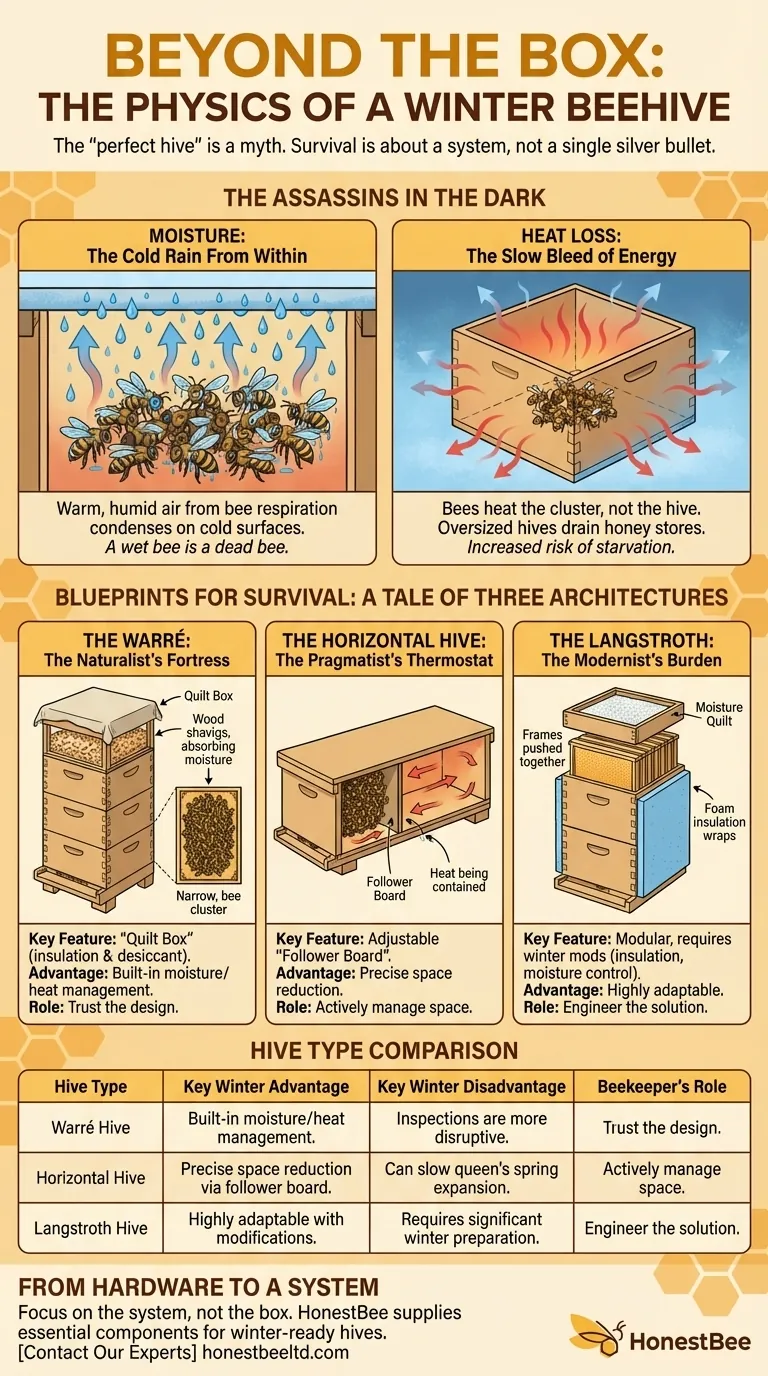
The truth is, the "best" winter hive isn't a specific brand or model. It's a system—an environment meticulously engineered to defeat the two silent assassins that threaten every colony in the cold: moisture and heat loss.
The Assassins in the Dark
To understand how to protect a colony, we must first understand its enemies. They aren't predators in the traditional sense; they are forces of physics that work from within the hive itself.
Moisture: The Cold Rain From Within
As bees huddle in their winter cluster, they consume honey and respire, releasing an incredible amount of warm, water-saturated air. This humid air rises, just like the steam from a kettle.
When it hits the cold inner surface of the hive lid, it condenses instantly, turning from a harmless vapor into drops of frigid water. This water then drips back down onto the very bees that produced it.
A wet bee is a dead bee. Cold water robs a bee of its body heat far more efficiently than cold air ever could, chilling the cluster and killing the colony from the inside out.
Heat Loss: The Slow Bleed of Energy
A common misconception is that bees heat the entire interior of their hive. They don't. They only heat their cluster, vibrating their flight muscles to generate warmth.
The hive box is merely a shelter, an insulated container meant to hold that precious heat. But if that container is too large, the cluster must burn through an immense amount of energy—their honey stores—to maintain its core temperature against the surrounding cold air.
It's a slow, invisible drain on their vital resources. An oversized, uninsulated space forces the colony into a state of high metabolic stress, increasing the risk of starvation long before the first spring flowers bloom.
Blueprints for Survival: A Tale of Three Architectures
Different hive designs are simply different philosophical approaches to solving the same engineering problems of moisture and heat.
The Warré: The Naturalist's Fortress
The Warré hive was designed to mimic a hollow tree, nature's own overwintering cavity. Its brilliance lies in two features.
- A "Quilt Box": A top box filled with wood shavings acts as both insulation and a desiccant. It absorbs the rising moisture, preventing condensation while keeping the heat in.
- A Smaller Footprint: Its narrow, square design encourages the bee cluster to form a more thermally efficient vertical oval, reducing the surface area exposed to the cold.
This hive is engineered for low-intervention survival, but that comes at the cost of management simplicity during inspections.
The Horizontal Hive: The Pragmatist's Adjustable Thermostat
The single greatest advantage of a horizontal hive—be it a Langstroth or Top Bar style—is its adjustability.
Using a solid divider called a "follower board," the beekeeper can shrink the colony's living space to the exact size of the cluster. This is the most direct and efficient solution to the problem of heat loss. By eliminating empty, cold air space, you create a perfectly tailored environment that conserves maximum energy.
The Langstroth: The Modernist's Burden of Proof
The Langstroth is the most popular hive in the world, a testament to its modularity and flexibility. However, its standard design is poorly suited for winter without help. Its large boxes and flat top are a recipe for heat loss and condensation.
Success in a Langstroth depends entirely on the beekeeper's intervention. It's a blank canvas that requires you to become the engineer, adding:
- Insulation: Foam boards on the exterior to reduce heat transfer.
- Moisture Control: A moisture quilt or spacer rim at the top to absorb condensation.
- Space Reduction: Pushing frames together and, if possible, consolidating the colony into fewer boxes.
The Langstroth offers the most control, but also bears the most responsibility.
From Hardware to a System
The choice of hive is less important than the beekeeper's understanding of the physics at play. A colony doesn't survive because of the box it's in; it survives because it is housed in a dry, well-insulated, and properly sized system.
| Hive Type | Key Winter Advantage | Key Winter Disadvantage | Beekeeper's Role |
|---|---|---|---|
| Warré Hive | Built-in moisture/heat management. | Inspections are more disruptive. | Trust the design. |
| Horizontal Hive | Precise space reduction via follower board. | Can slow the queen's spring expansion. | Actively manage space. |
| Langstroth Hive | Highly adaptable with modifications. | Requires significant winter preparation. | Engineer the solution. |
For commercial apiaries and distributors, ensuring every hive is winter-ready isn't just about protecting bees—it's about protecting your business. Adapting a fleet of hives requires reliable, high-quality components, from insulation wraps and moisture quilts to follower boards for horizontal setups. At HONESTBEE, we supply the essential equipment to transform any hive into a fortress of survival.
To ensure your colonies have the best possible chance this winter, shift your focus from the box to the system you build within it. Contact Our Experts
Visual Guide
Related Products
- Professional Insulated Winter Hive Wrap for Beekeeping
- Professional Insulated Plastic Bee Hives
- Inner Beehive Cover for Beekeeping Bee Hive Inner Cover
- Wholesales Dadant Size Wooden Bee Hives for Beekeeping
- Stainless Steel Round Beehive Air Vents for Ventilation
Related Articles
- The Cold Deception: Why Beehive Wintering is About Moisture, Not Warmth
- Beyond Warmth: The Physics of Beehive Survival in Winter
- How to Secure Beehive Covers: Weatherproof Strategies for Every Hive Type
- Beyond the Cold: The Physics of a Winter Beehive and Why Our Instincts Fail Us
- How to Time Hive Insulation for Maximum Winter Bee Survival