It’s one of the most satisfying moments for any beekeeper: the harvest is complete, and your extractor has spun out gallons of liquid gold. But then, the real work begins, and a familiar frustration sets in. You’re now faced with drums of raw, thick honey, full of wax and hive debris. Your production line grinds to a halt at the filtering stage. The bottleneck has begun.
This single step—separating pure honey from impurities—is often the most significant drag on a commercial apiary's efficiency and a major risk to its product quality.
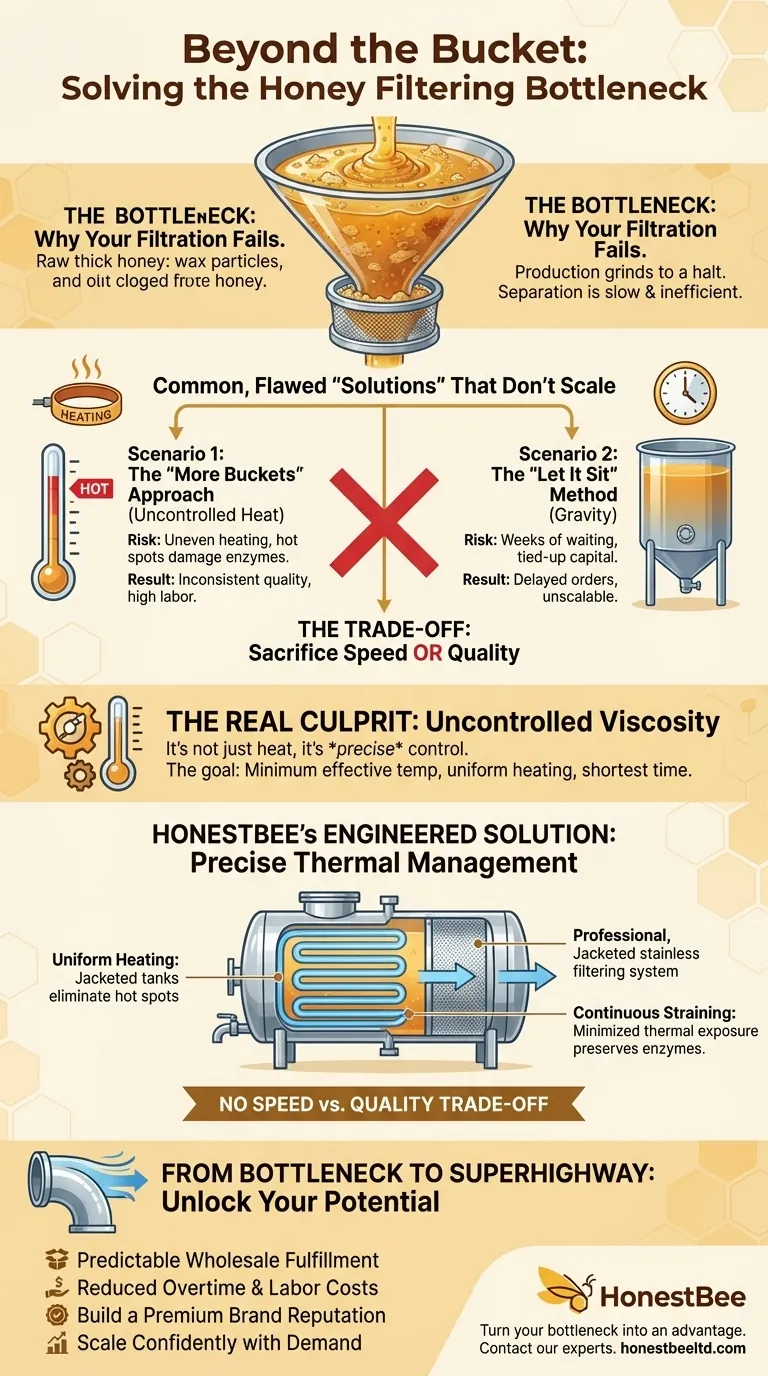
The Commercial Beekeeper's Dilemma: The Costly 'Solutions' That Don't Scale
If you're like many growing apiaries, you’ve probably tried to scale up the methods that worked when you only had a few hives. This usually leads to one of two frustrating scenarios.
Scenario 1: The "More Buckets" Approach
You try to speed things up with gentle heat, warming the honey to make it flow through strainers faster. But managing this across multiple large containers is a nightmare. Some batches get too hot, risking the destruction of the very enzymes that define "raw" honey. Others remain too cool, and the straining process slows to a crawl. You’re left with an inconsistent product, high labor costs, and a process that feels more like a frantic juggling act than a professional operation.
Scenario 2: The "Let It Sit" Method
Frustrated with the risks of heat, you might try the settling and decanting method. You fill a large tank and wait for weeks as gravity slowly does its work. While this is gentle on the honey, it’s brutal on your business. That tank represents tied-up capital and delayed orders. You can't respond quickly to customer demand because your inventory is stuck in a multi-week holding pattern.
Both of these scaled-up hobbyist methods force a damaging trade-off: you must sacrifice either product quality for the sake of speed, or production speed for the sake of quality. This compromise directly impacts your bottom line, limits your growth, and puts your brand's reputation for premium raw honey at risk.
The Real Culprit: It's Not Heat, It's Uncontrolled Heat
Here is the fundamental truth that these common methods miss: the problem isn't the act of filtering, nor is heat the enemy. The root cause of the bottleneck is the inability to precisely control honey's viscosity.
Raw honey is thick. Its high viscosity is why it flows so slowly. Gently warming it reduces this viscosity, allowing it to pass through a filter with ease. The key word here is gently.
The "More Buckets" approach fails because it applies heat unevenly. A warming band on a steel drum creates hot spots that cook the honey nearby while leaving the core cold. The "Let It Sit" method fails because it doesn't address viscosity at all, making it commercially unviable.
The real challenge isn't a choice between speed and quality. It’s a challenge of engineering. The goal is to apply the minimum effective temperature, evenly and consistently, for the shortest possible time to enable efficient filtration without damaging the product.
Engineered for Flow: The Principle of Precise Thermal Management
To solve this root problem, you don't need a better bucket; you need a system designed specifically for the physics of honey. This is where professional-grade equipment moves beyond being a simple container and becomes an engineered solution.
HONESTBEE’s commercial-grade filtering systems are built around this principle of precise control. They aren't just larger versions of hobbyist tools; they are designed from the ground up to eliminate the speed vs. quality trade-off.
- Uniform Heating: Instead of crude warming bands, our systems utilize jacketed tanks or integrated warming plates that provide even, low-temperature heat. This eliminates dangerous hot spots and ensures the entire batch reaches the optimal, safe temperature for flow.
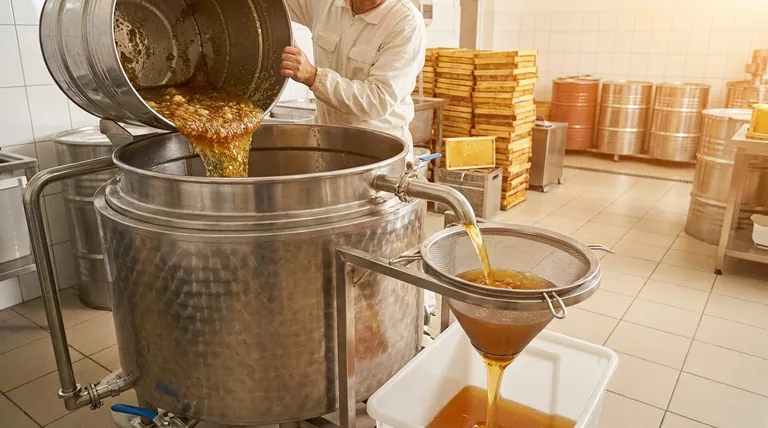
- Continuous, Efficient Straining: The honey is warmed just enough to flow smoothly through fine-mesh filters in a continuous process. It isn't held at temperature for hours on end. This minimizes thermal exposure, perfectly preserving the enzymes and delicate character of your raw honey.
This isn't a "magic box." It's a tool built from a deep understanding of the problem. It solves the core issue of viscosity control, transforming filtering from a chaotic, manual process into a reliable and repeatable stage of your production line.
From Bottleneck to Superhighway: Unlocking Your Apiary's True Potential
When you remove your biggest production bottleneck, you do more than just filter honey faster. You unlock a new level of operational capability.
The entire workflow—from extraction to bottling—becomes a smooth, continuous process. Harvest days no longer signal the start of a week-long filtering headache. You can process your entire run quickly and efficiently, with the confidence that every single jar meets your highest quality standards.
This newfound efficiency means you can:
- Fulfill large wholesale orders with predictable lead times.
- Reduce overtime and labor costs associated with manual filtering.
- Build a stronger brand reputation for consistently premium, pure, and truly raw honey.
- Scale your business confidently, knowing your production can keep pace with growing demand.
Your equipment should be a partner in your growth, not an obstacle. Moving beyond stop-gap solutions is the most critical step in professionalizing your operation and securing its future. If you're ready to turn your biggest production headache into a competitive advantage, our team is here to help design a system that fits the unique scale and needs of your apiary. Contact Our Experts.
Visual Guide
Related Products
- Electric Double Wall Honey Filtering Machine Purifier Equipment for Honey Processing Plant
- Honey Concentrating and Filtering Dehumidifier Machine 2T Capacity for Honey
- Professional Stainless Steel Honey Filtering Machine with Water Bath Heating for Beekeeping
- Two-Stage Plastic Honey Filter for Buckets
- Automatic Honey Filling and Filtering Machine for Beekeeping Bottle Filling
Related Articles
- From Chaos to Clarity: The Physics and Psychology of Honey Filtering
- How Professional Honey Filtration Preserves Quality While Meeting Food Safety Standards
- The Sticky Bottleneck: Why Your Honey Filtering Fails and How to Fix It for Good
- Why Your Honey Filtering is Slow and Inconsistent—And How to Fix It for Good
- Optimizing Honey Filtration: How Mesh Sizes Shape Quality and Market Appeal