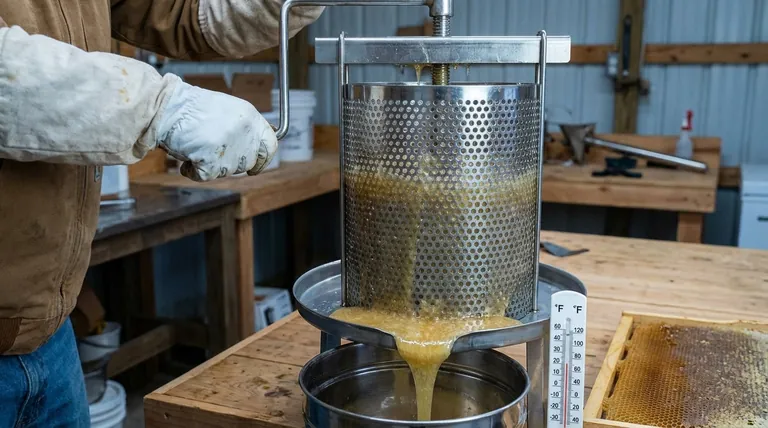
Does this scene sound familiar? You’re standing in front of your honey press, which you’ve cranked down with significant force. But instead of a steady flow of liquid gold, you’re getting a frustratingly slow, thick drip. Hours, or even days, go by. You’ve put in the hard work all season, yet a large portion of your valuable honey remains trapped in the comb, and the entire extraction process has ground to a halt.
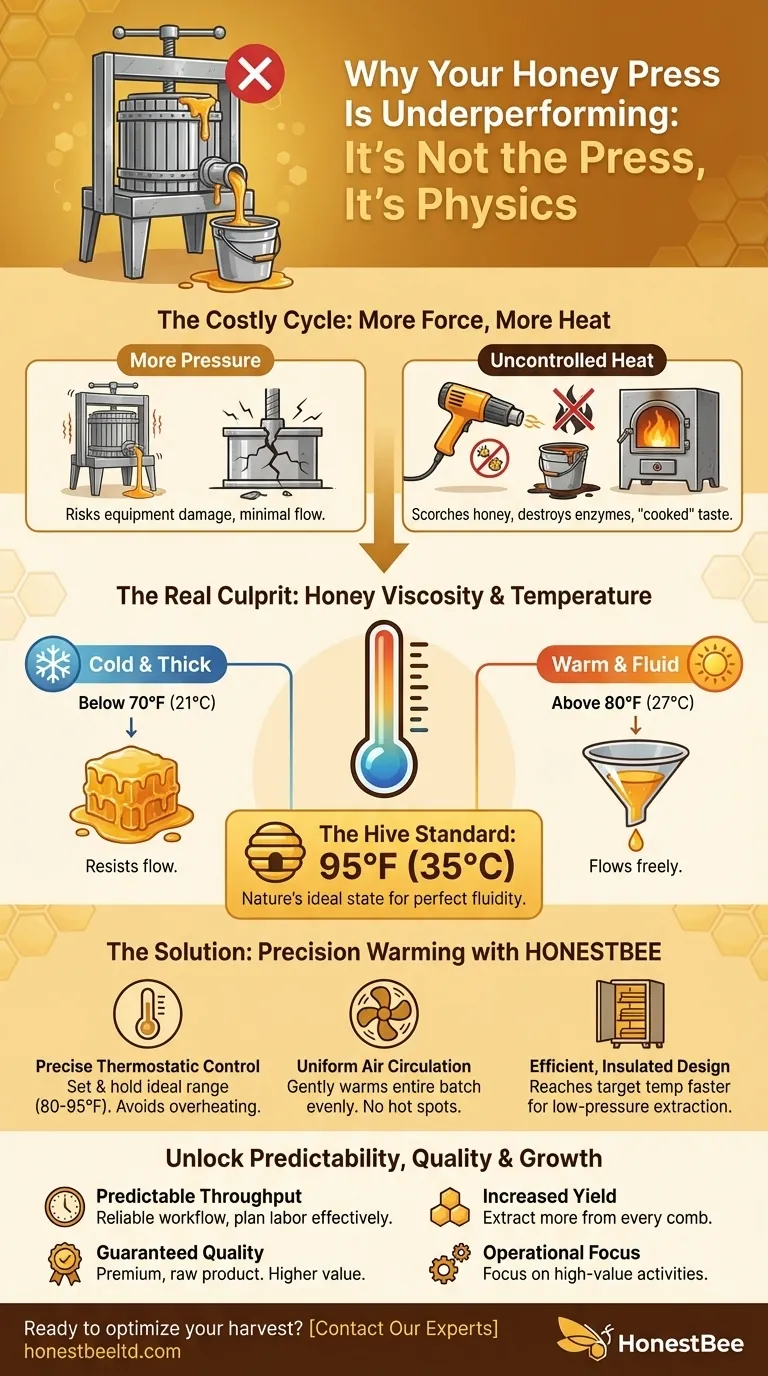
The Costly Cycle of "More Force, More Heat"
For commercial apiaries, this isn't just an annoyance; it's a direct hit to the bottom line. When faced with a slow press, the two most common reactions are to apply more force or more heat. Both are costly mistakes.
Applying more pressure to cold, thick comb rarely works. It puts immense strain on your equipment, risking damage to expensive presses, while yielding minimal results. The honey is simply too viscous—too thick—to move.
The other approach is applying quick, uncontrolled heat. You might use a heat gun on the press cage or place buckets near a furnace. While this might get some honey flowing, it does unseen damage. This "brute force" heating creates hot spots that scorch the honey, destroying the delicate enzymes and subtle flavors that define a premium raw product. The result? A lower-grade product, customer complaints about a "cooked" taste, and a damaged reputation. This vicious cycle costs you time, money, and the trust of your buyers.
The Real Culprit: It’s Not Pressure, It’s Physics
The breakthrough comes when you stop blaming your press and start understanding the science of honey. The problem isn't a lack of force; it's a lack of fluidity. The key to that fluidity is one simple, powerful factor: temperature.
Honey's viscosity is incredibly sensitive to temperature.
- Below 70°F (21°C): Honey is thick, stubborn, and resists flowing under any amount of pressure.
- Above 80°F (27°C): Its viscosity drops dramatically. It becomes fluid and flows freely.
Thinking Like a Bee: The 95°F Secret
The perfect temperature for extraction isn't an arbitrary number; it's nature's number. A healthy beehive maintains a constant internal temperature of around 95°F (35°C). At this temperature, honey is at its ideal, natural state of fluidity.
The goal, therefore, is not to "heat" the honey but to gently and uniformly warm your comb to mimic the hive environment. By restoring the honey to its natural state, you allow it to be extracted efficiently and completely, without excessive force. Haphazard heating fails because it pushes small sections of honey far past the critical 104°F (40°C) threshold, where quality degradation begins. It's using a sledgehammer when what you really need is a thermostat.
The Right Tool for the Right Temperature: Moving from Guesswork to Precision
To truly solve this problem, you need to eliminate guesswork and achieve consistent, gentle, and uniform warmth. You need a tool designed specifically to bring your entire harvest to that perfect 80-95°F (27-35°C) sweet spot without creating destructive hot spots.
This is precisely why HONESTBEE provides professional-grade warming cabinets and temperature control systems for commercial operations. Our equipment is engineered based on a deep understanding of honey's physical properties.
- Precise Thermostatic Control allows you to set and hold the ideal temperature, ensuring honey becomes fluid without ever approaching the damage zone.
- Uniform Air Circulation gently warms every frame and bucket evenly, eliminating the hot spots that ruin flavor and destroy enzymes.
- Efficient, Insulated Design ensures your entire batch reaches the target temperature, preparing it for a fast, complete, and low-pressure extraction.
Our systems aren't just heaters; they are purpose-built tools that turn a frustrating, unpredictable process into a controlled, scientific one.
Beyond the Press: Unlocking Predictability, Quality, and Growth
When you master temperature control, everything changes. The benefits extend far beyond a single extraction day.
- Predictable Throughput: Your extraction workflow becomes reliable and repeatable. You can accurately plan your labor and processing schedules, knowing a batch will be ready in hours, not days.
- Guaranteed Quality: You can confidently market and sell your honey as premium, raw, and unadulterated, commanding a higher price and building a brand known for excellence.
- Increased Yield: By ensuring low viscosity, you extract significantly more honey from every comb, leaving less valuable product behind.
- Operational Focus: Instead of wrestling with stubborn equipment, you and your team can focus on higher-value activities—managing your apiary, developing new products, and growing your distribution network.
Don't let inconsistent temperatures dictate your profits and create unnecessary work. Investing in the right equipment transforms honey extraction from a source of frustration into a streamlined, profitable, and predictable part of your business. If you're ready to move past the slow drip and unlock the full potential of your harvest, let's talk about how the right tools can be tailored to your specific operation. Contact Our Experts.
Visual Guide
Related Products
- Stainless Steel Manual Honey Press with Guard for Pressing Honey and Wax
- Stainless Steel Honey Press Wax Press with Tank
- Easy Use Manual Stainless Steel Honey Press for Honey Comb
- Electric Honey Press Machine for Squeezing Honey Comb Press Equipment
- 10L Stainless Steel Electric Honey Press Machine
Related Articles
- The Unseen System: Why a Honey Press is More Than Just a Tool
- Why a Honey Press is the Smart Choice for Small-Scale Beekeepers
- The Last Drop: Maximizing Yield and Purity with a Stainless Steel Honey Press
- Beyond Brute Force: Why Your Honey Press Is Costing You Quality and Yield
- Why Your Honey Press Is a Sticky, Contaminated Mess—And How to Fix It Permanently