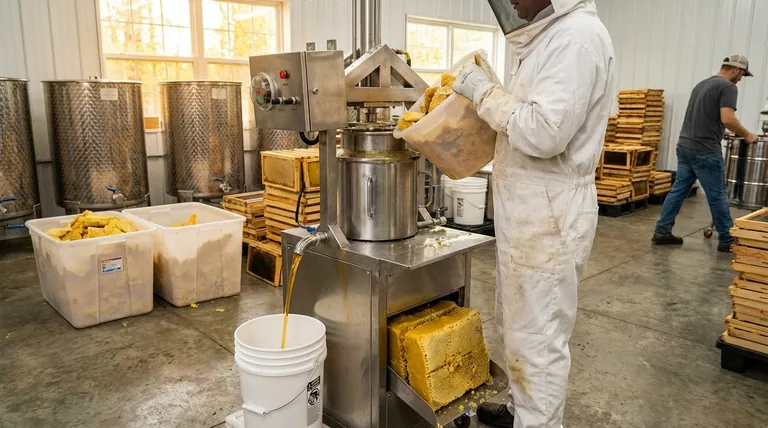
It's a familiar scene at the end of a long, sticky day of harvesting. Your extractor has done its job, spinning out gallons of golden honey. But over in the corner sits a growing mountain of wax cappings, burr comb, and broken pieces—all saturated with honey. What do you do with it? For many commercial operations, this is where efficiency breaks down and profits are lost.
The Costly Struggle with Cappings and Broken Comb
Every commercial beekeeper knows this problem. You've just extracted the bulk of your harvest, but a significant amount of valuable honey remains trapped in the wax cappings you sliced off the frames.
The common "solutions" are often inefficient compromises:
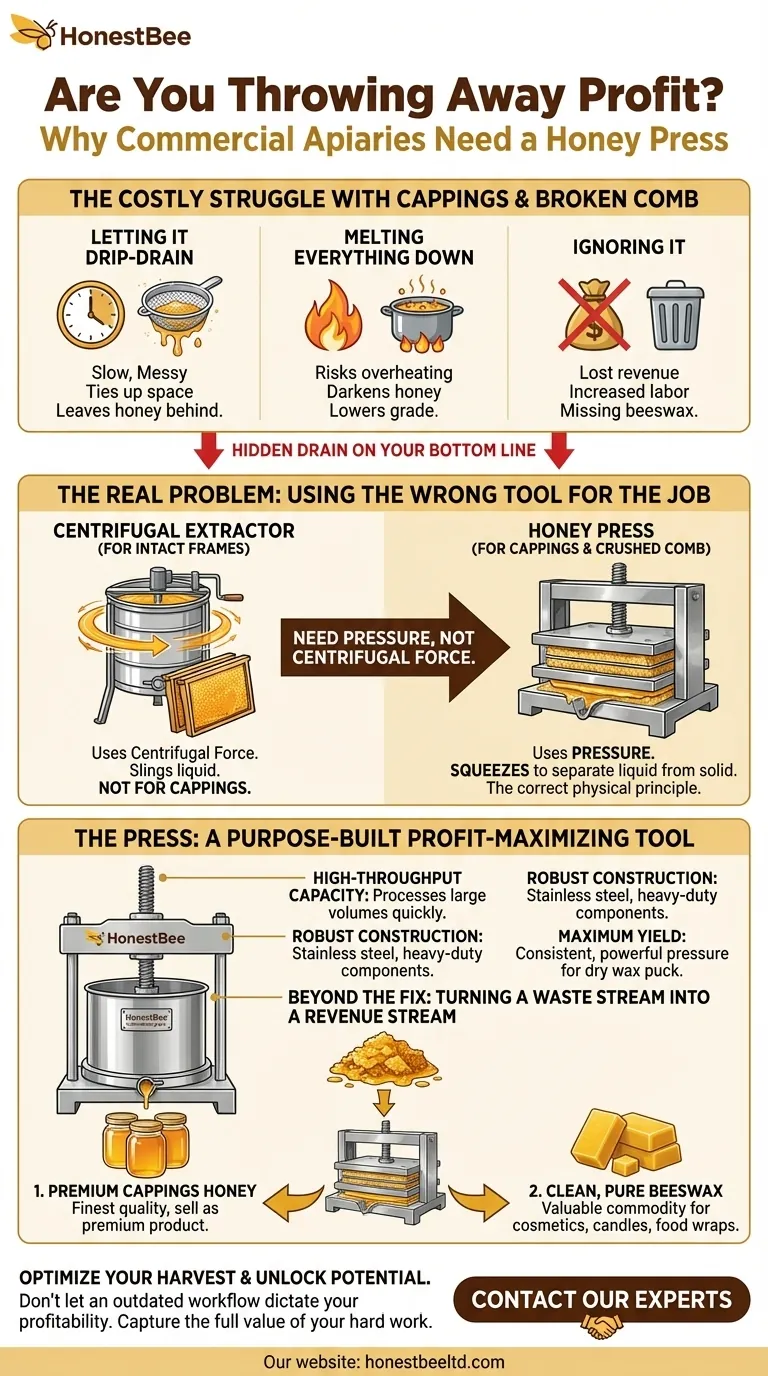
- Letting it drip-drain: This is a slow, messy process that takes days and leaves a large percentage of the honey behind. It also ties up space and equipment.
- Melting everything down: This approach risks overheating and darkening the honey, lowering its grade and value. It's a brute-force method that sacrifices quality for convenience.
- Ignoring it: Some simply accept this as a cost of doing business, writing off the trapped honey and wax as unavoidable waste.
The business consequences are substantial. You're not just losing honey; you're losing revenue. You're increasing labor costs with time-consuming cleanup. And you're missing out on a second high-value product: clean, pure beeswax. This isn't a minor inconvenience; it's a hidden drain on your bottom line, harvest after harvest.
The Real Problem: Using the Wrong Tool for the Job
The belief that honey presses are only for hobbyists is a costly misconception. The struggle with cappings isn't a sign of a flawed harvest; it's a sign of a tool mismatch.
Your centrifugal extractor is a masterpiece of engineering designed for one specific task: removing honey from the intact cells of a frame. It uses centrifugal force to sling liquid honey outwards while preserving the delicate wax comb structure.
But this principle is completely ineffective for a mass of wax cappings or crushed comb. There are no open cells to sling from. You are dealing with a mixture of a liquid (honey) and a solid (wax). Trying to deal with this using drip-methods or melters is like trying to haul gravel with a sports car—it’s the wrong vehicle for the terrain.
The fundamental principle required here is not centrifugal force, but pressure. To efficiently separate the liquid honey from the solid wax, you need a tool designed to squeeze, not spin. The common solutions fail because they don't address this core mechanical need.
The Press: A Purpose-Built Profit-Maximizing Tool
To solve the problem of trapped honey, you need a tool that applies direct, immense pressure to crush the wax and force every last drop of honey out. This tool is a honey press.
For a commercial operation, a honey press isn't a replacement for an extractor; it's an essential partner. It’s the specialized tool that perfectly handles the valuable byproducts your primary extraction process creates.
HONESTBEE’s commercial-grade honey presses are designed specifically for this role. They are not the small-scale presses of a hobbyist. They are built with:
- High-Throughput Capacity: To process the large volume of cappings a commercial harvest generates quickly and efficiently.
- Robust Construction: Made from stainless steel and heavy-duty components to withstand the rigors of daily use in a demanding environment.
- Maximum Yield: Engineered to apply consistent, powerful pressure that extracts the maximum amount of honey, leaving behind a compact, dry puck of beeswax.
Our presses directly solve the root problem by applying the correct physical principle, turning a messy, inefficient task into a streamlined, profitable process.
Beyond the Fix: Turning a Waste Stream into a Revenue Stream
Once you integrate a dedicated honey press into your workflow, the entire equation changes. What was once a problem becomes a new opportunity.
That mountain of sticky cappings is no longer a waste product. It's the source of two distinct, high-value revenue streams:
- Premium Cappings Honey: The honey pressed from cappings is often considered among the finest quality, and can be sold as a premium product.
- Clean, Pure Beeswax: The press yields compact, easy-to-handle blocks of pure beeswax, a valuable commodity for cosmetics, candles, and food wraps, which you can sell at a premium price.
By solving this single operational bottleneck, you don't just stop losing money; you create a new profit center. You reduce waste, increase your total yield, and diversify your product offerings—all of which strengthens the financial health of your apiary.
Your operation is built on efficiency, and every ounce of honey counts. Don't let an outdated workflow dictate your profitability. By equipping your team with the right tools for every part of the job, you can ensure you're capturing the full value of your hard work. Let's discuss how the right equipment can address your specific operational challenges and unlock new potential for your business. Contact Our Experts to get a quote and optimize your harvest process.
Visual Guide
Related Products
- Stainless Steel Manual Honey Press with Guard for Pressing Honey and Wax
- Stainless Steel Honey Press Wax Press with Tank
- Easy Use Manual Stainless Steel Honey Press for Honey Comb
- Electric Honey Press Machine for Squeezing Honey Comb Press Equipment
- 10L Stainless Steel Electric Honey Press Machine
Related Articles
- The Unseen System: Why a Honey Press is More Than Just a Tool
- Why a Honey Press is the Smart Choice for Small-Scale Beekeepers
- The Last Drop: Maximizing Yield and Purity with a Stainless Steel Honey Press
- Beyond Brute Force: Why Your Honey Press Is Costing You Quality and Yield
- Why Your Honey Press Is a Sticky, Contaminated Mess—And How to Fix It Permanently