The Friction of a Sticky Job
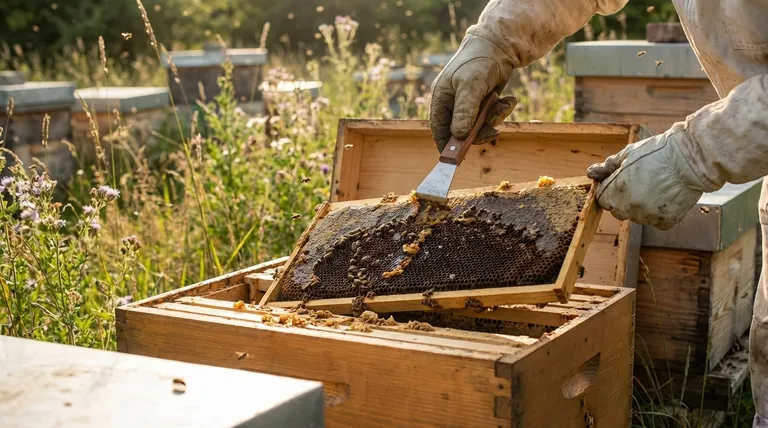
It’s a familiar scene in any apiary. A beekeeper, sleeves rolled up, wrestling with a frame caked in a stubborn mix of beeswax and propolis. The standard hive tool scrapes and slips, a blunt instrument against a problem that requires precision.
This small, recurring struggle isn't just an annoyance. It's a symptom of a larger operational drag. We have a psychological bias toward the "good enough" tool—the one that can do the job, even if it does it poorly. But in a system like an apiary, where actions are repeated hundreds or thousands of times, the hidden cost of "good enough" compounds into significant lost time and energy.
The Anatomy of a Problem: Wax and Propolis
Bees are master builders. Their use of wax and propolis—a resinous "bee glue"—is a sign of a healthy, productive colony. They use it to seal gaps, reinforce structures, and maintain a sterile environment.
But this natural process creates a challenge for the beekeeper. On frames, this buildup is more than just messy:
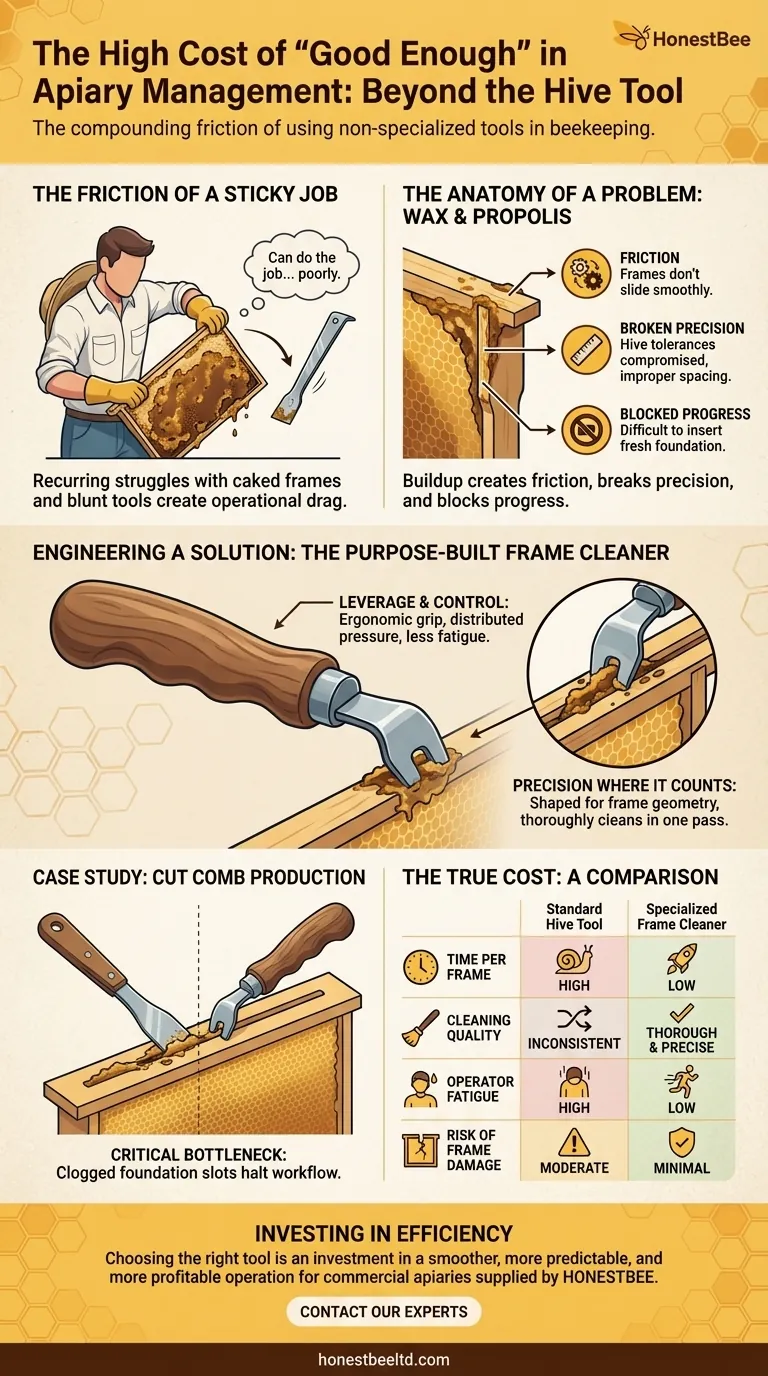
- It creates friction: Frames no longer slide in and out of the hive body smoothly.
- It breaks precision: The tight tolerances of the hive are compromised, leading to improper spacing.
- It blocks progress: Clogged top and bottom bars make it difficult, sometimes impossible, to insert fresh sheets of foundation.
The problem isn't the bees' work; it's our interface with it. The challenge is to maintain the integrity of the equipment without fighting against the hive's natural tendencies.
Engineering a Solution: The Purpose-Built Frame Cleaner
When a tool is designed to solve one problem perfectly, it feels less like a piece of metal and more like a key unlocking a stubborn mechanism. This is the engineering romance behind the dedicated frame cleaning tool. It's not a multi-tool; it’s a specialist.
Designed for Leverage and Control
The first point of contact is the handle. A large wooden handle isn't an aesthetic choice; it's a principle of physics. It provides superior leverage and an ergonomic grip that distributes pressure across the hand.
For a commercial beekeeper cleaning dozens or hundreds of frames, this means less hand fatigue and more consistent, controlled force through the entire task. It turns a straining effort into a steady, efficient process.
Precision Where It Counts
The business end of the tool is shaped to match the specific geometry of a frame's top and bottom bars. It's designed to fit into the exact crevices where buildup causes the most issues. Unlike the flat, general-purpose edge of a standard hive tool, its specialized head cleans thoroughly in a single pass.
This is the difference between brute force and applied science.
A Case Study in Efficiency: Cut Comb Production
Nowhere is the cost of "good enough" more apparent than in specialized operations like cut comb honey production. This process requires beekeepers to frequently replace the foundation within the frames.
The narrow slot in the frame's top bar is the critical entry point for a new sheet of foundation. After the first season, this slot becomes invariably clogged with wax. A standard hive tool is too clumsy to clear it effectively.
This single, tiny bottleneck can halt the entire workflow. The beekeeper is left with a choice: spend an inordinate amount of time struggling with an inadequate tool, or risk damaging the frame. The dedicated frame cleaner, with its precisely shaped head, clears this slot cleanly and quickly, keeping the production line moving.
The True Cost: A Comparison
The debate is not whether a standard hive tool can clean a frame. It’s about the total cost of that choice when scaled across an entire operation.
| Metric | Standard Hive Tool | Specialized Frame Cleaner |
|---|---|---|
| Time Per Frame | High | Low |
| Cleaning Quality | Inconsistent, often incomplete | Thorough and precise |
| Operator Fatigue | High | Low |
| Risk of Frame Damage | Moderate | Minimal |
For commercial apiaries and equipment distributors supplied by HONESTBEE, these metrics are not trivial. They translate directly to labor costs, equipment longevity, and overall productivity.
Choosing the right tool is an investment in a smoother, more predictable, and more profitable operation. It acknowledges that in beekeeping, as in any complex system, efficiency is born from purpose-built solutions. For operations where every minute matters, equipping your team for the specific task at hand is the first step toward excellence. Contact Our Experts
Visual Guide
Related Products
- Professional 600D Oxford Cloth Beekeeping Tool Bag with 8 Pockets and Elastic Loops
- Professional Large-Format Hive Number Set for Beekeeping
- Yellow Plastic Bucket Pail Perch for Beekeeping
- Durable Plastic Hive Number Set for Beekeeping
- Modern Flat-Mount Hive Number Set for Beekeeping
Related Articles
- How to Master Essential Beekeeping Tools Safely and Efficiently
- The Human Interface: Why a Beekeeper's Calm is the Ultimate Hive Tool
- Essential Beekeeping Tools: How Strategic Preparation Boosts Hive Health, Safety, and Honey Yields
- Essential Beekeeping Tools: How to Choose and Use Gear for Safe, Efficient Hive Management
- How to Choose Beekeeping Tools: A Practical Guide for Every Budget and Climate