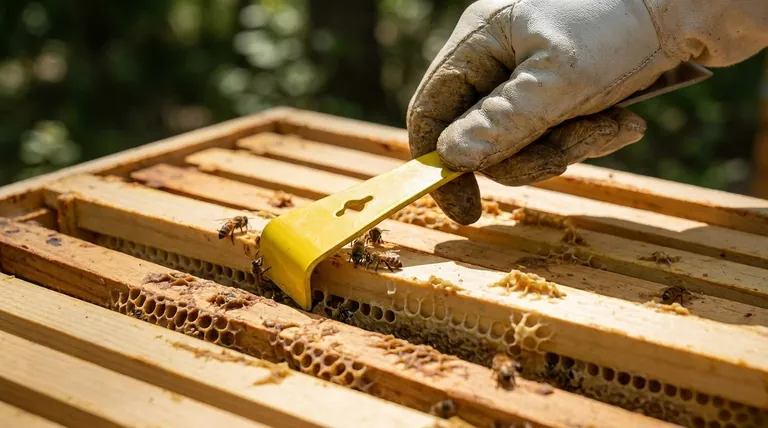
The Beekeepers' Dilemma
An apiary is a system of immense complexity. Yet, its management often hinges on the simplest of instruments: the hive tool.
This piece of steel is more than a lever. It's a communication device. In the hands of a calm operator, it is an instrument of quiet negotiation. In the hands of a hurried one, it is a trigger for chaos.
The core challenge isn’t just avoiding a slip of the blade. It's understanding that every movement you make sends a signal—either one of calm assurance or one of predatory threat. For a commercial operation, where hundreds of hives must be managed with efficiency and safety, mastering this single tool is a non-negotiable discipline.
A System with Two Channels
Effective hive tool use operates on two distinct channels simultaneously. One is physical, concerning your own safety. The other is behavioral, concerning the colony's tranquility. A failure in one often leads to a failure in the other.
Channel 1: The Physical Interface with the Tool
A hive tool is designed to apply force. Its edges pry, its flat surfaces scrape. The primary risk to the operator is a sudden, uncontrolled release of kinetic energy—a slip.
This most often happens when scraping propolis. Your muscle memory pushes the tool forward, but your other hand, bracing the frame, sits directly in its potential path. The mental mistake is focusing solely on the task (removing propolis) while forgetting the system (your body's position relative to the tool).
Safety here is a matter of physics and ergonomics. Always direct force away from your body. Ensure your non-dominant hand is never in the line of fire. It's a simple rule, but one easily forgotten under the pressure of a long day in the bee yard.
Channel 2: The Behavioral Signal to the Colony
Bees don't understand your intent. They understand vibration and velocity.
A sudden, jarring motion as you crack a propolis seal is, to them, indistinguishable from a bear tearing the hive apart. It is an unambiguous signal of danger, and it triggers a coordinated defensive response.
The antidote is deliberate, steady pressure. Insert the tool and apply slow, gentle leverage. Work your way around the hive body, loosening the seal incrementally. You are communicating that you are not a threat. This calm, confident handling is what keeps the hive's collective temperament from escalating.
Calibrated Actions for Predictable Outcomes
Each function of a hive tool is a discrete physical task with a corresponding behavioral impact. Mastering them means turning conscious effort into unconscious competence.
Separating Structures: The Art of the Gentle Pry
- Action: Insert the chisel-end into the seam between hive bodies.
- Technique: Apply steady, building pressure rather than a sharp jerk. Work multiple points around the seam to distribute the force and break the seal evenly.
- Psychological Impact: This minimizes the sudden "pop" and vibration that alarms the colony.
Manipulating Frames: Controlled Elevation
- Action: Use the J-hook or curved end to lift the edge of a frame.
- Technique: Pry just enough to break the propolis seal and get a firm grip with your fingers. This provides maximum control and minimizes the risk of dropping the frame.
- Psychological Impact: A dropped frame is a massive shock to the hive, risking the queen and triggering intense defensive behavior. Controlled movement prevents this entirely.
Surface Maintenance: The Discipline of the Scrape
- Action: Removing burr comb and propolis from frames and hive bodies.
- Technique: Brace the component on a stable surface. Use smooth, even strokes, always directed away from yourself.
- Psychological Impact: This is primarily a personal safety issue. A deep cut not only ends your workday but the resulting commotion and potential blood scent can agitate the nearby colony.
Systemic Risk: When the Tool Becomes the Hazard
For a commercial apiary, small risks, when multiplied across hundreds or thousands of hives, become significant operational liabilities. The choice and maintenance of a hive tool are not trivial matters.
The Compounding Cost of Neglect
A tool caked in old propolis and wax becomes sticky and difficult to handle. It requires more force to use.
More force means a higher probability of slippage. A higher probability of slippage means a greater risk of personal injury and a greater chance of jarring the hive. Across an entire operation, this small point of friction degrades both safety and efficiency. A well-designed tool, made from quality steel, is easier to clean and maintain, mitigating this risk at its source.
The Fallacy of the Sharpened Edge
Some beekeepers sharpen their tools for easier cutting. While this may seem efficient, it fundamentally changes the risk profile of the instrument.
A standard hive tool is a pry bar; a sharpened one is a knife. The risk of a serious laceration from a routine slip increases dramatically. For a professional operation focused on standardized, safe procedures, a standard, unsharpened edge is the more reliable and responsible choice.
| Safety Focus | Key Precaution | The Systemic Rationale |
|---|---|---|
| Operator Safety | Scrape away from your body; keep hands clear. | Prevents injuries that cause downtime and operational disruption. |
| Colony Tranquility | Use gentle, deliberate prying motions. | Maintains a calm apiary, increasing efficiency and safety for all hives. |
| Equipment Integrity | Keep tools clean and in good repair. | Reduces the force required, lowering the risk of slips and errors at scale. |
Designing for Calm
Ultimately, safe beekeeping is not about bravery; it's about good system design. It's about controlling the few variables you can in a highly dynamic environment. The hive tool is the most fundamental variable.
Choosing professional-grade equipment is the first step in that design. A durable, well-balanced hive tool isn't a cost; it's an investment in control, safety, and predictability. It’s the physical embodiment of the calm intent required to manage a thriving apiary. For commercial operations where reliability is paramount, this choice is everything.
At HONESTBEE, we equip professional apiaries and distributors with the durable, high-quality tools necessary to build a safe and efficient system of work. Let us help you enhance your operational safety and effectiveness. Contact Our Experts
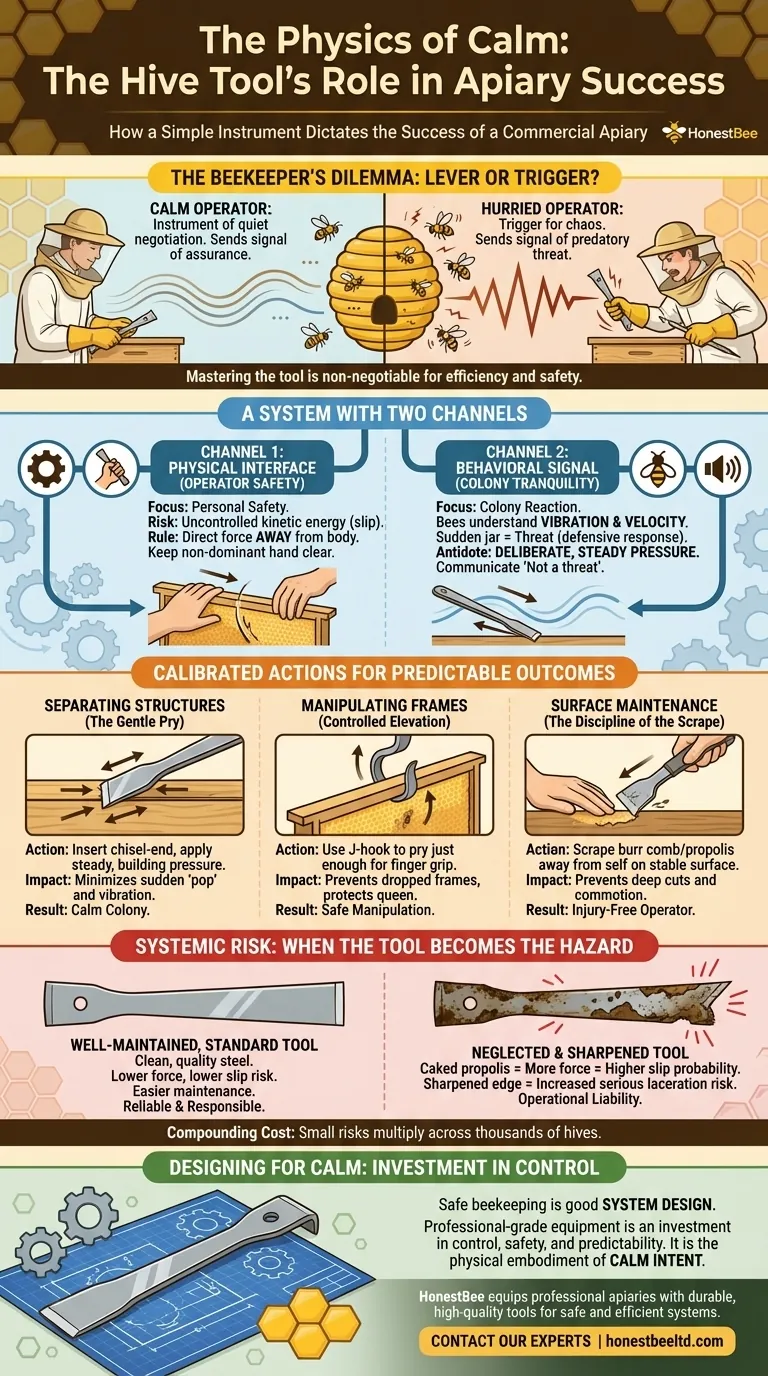
Visual Guide
Related Products
- Professional Multi-Function Stainless Steel Hive Tool
- Professional Stainless Steel Pry-Bar Hive Tool
- HONESTBEE Professional Long Handled Hive Tool with Precision Cutting Blade
- HONESTBEE Premium Italian Style Hive Tool with Hardwood Handle
- Ergonomic Plastic Frame Spacer Tool for Rapid Hive Management Beekeeping
Related Articles
- The Physics of Flow: How a Single Hive Tool Redefines the Beekeeper's Workflow
- The Essential Guide to Hive Tools in Modern Beekeeping
- The Beekeeper's Scalpel: How a Simple Hive Tool Governs Apiary Health
- How to Choose Hive Tools That Match Your Beekeeping Workflow
- The Apiary as a System: Why Your Hive Tool is More Than Just Steel



















