The Anxiety of Abundance
Imagine a thriving city during an unprecedented economic boom. Resources are pouring in faster than they can be managed. Every warehouse is full, every road is congested, and the housing market is gridlocked. A sense of productive claustrophobia sets in. The only logical response is to expand—to find new territory.
This is the internal state of a honeybee colony during a strong nectar flow.
For the bees, this abundance is a double-edged sword. Worker bees, driven by an ancient instinct, fill every available hexagonal cell with nectar. But this relentless efficiency creates a crisis. The queen, the heart of the colony, runs out of space to lay her eggs. The nursery is being converted into a pantry.
This condition, known as being "honey bound," triggers a single, powerful biological alarm: it's time to swarm. The colony's collective mind decides its home is too small, and the queen leaves with half the population to found a new city, depleting the workforce and honey production of the original hive.
A Solution Born from Separation
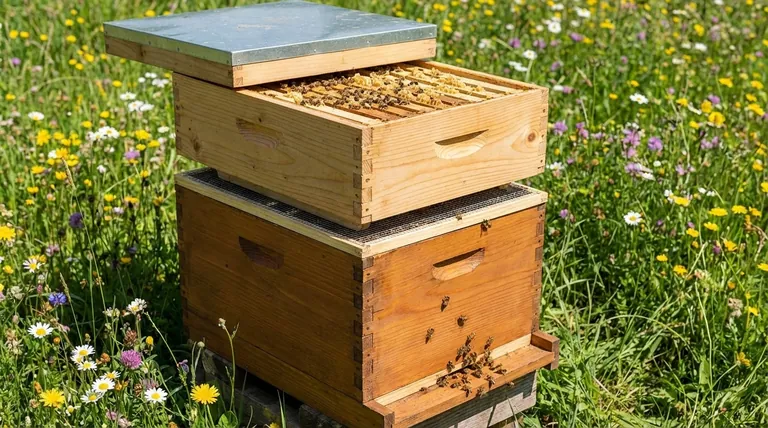
The honey super is the beekeeper's architectural intervention to this crisis. It’s not just an extra box; it’s a strategic expansion that fundamentally alters the colony's internal logic.
By placing a super on top of the hive's main living quarters—the brood boxes—the beekeeper introduces a clear zoning ordinance. The lower levels are designated as the residential and nursery zone. The new upper level becomes the commercial and industrial zone, dedicated entirely to surplus resource storage.
This simple separation is profound. It tells the colony: "Your home is not shrinking. There is a new frontier right above you."
Channeling an Instinct
The honey super provides an immediate outlet for the bees' overwhelming drive to forage and store. It gives the workforce a grand project, redirecting the energy that would have otherwise culminated in swarming.
Instead of feeling cornered and preparing to divide, the colony remains focused and unified, channeling the flood of nectar into this new, dedicated space. The anxiety of abundance is transformed back into productive purpose.
The Unseen Gatekeeper
This elegant system is often perfected with one more tool: the queen excluder. Placed between the brood boxes and the honey supers, this simple screen acts as a one-way gate.
The gaps are large enough for worker bees to pass through freely, but too small for the larger queen. This ensures she remains in the "nursery," keeping the honey supers pure. The frames above will contain only honey, free of eggs and larvae.
While some beekeepers debate its use, arguing it can create a slight bottleneck for workers, the excluder is a powerful tool for creating a clean, predictable, and highly efficient harvesting system.
| Management Style | With Queen Excluder | Without Queen Excluder |
|---|---|---|
| Honey Purity | Guaranteed brood-free honey. | Risk of brood mixed with honey. |
| Harvesting | Simple; entire boxes can be removed. | Requires frame-by-frame inspection. |
| Hive Traffic | May slightly slow worker movement. | Unimpeded flow between boxes. |
| Ideal For | Commercial operations focused on efficiency. | Beekeepers prioritizing minimal intervention. |
The Physics and Logistics of the Harvest
A well-managed hive is a marvel of natural engineering, but it must coexist with the physical limitations of the beekeeper. The design of the honey super reflects this human-centric reality.
The Simple Genius of Sizing
Honey supers are almost always "shallow" or "medium" depth, not the "deep" boxes used for brood. The reason is pure physics. A deep box filled with honey can weigh over 80 pounds (36 kg). That's not just heavy; it's a workplace hazard.
Using shallower supers is an elegant design choice. It breaks an unmanageable load into modular, manageable units, prioritizing the beekeeper's safety and sustainability. For commercial apiaries, where hundreds of supers are lifted in a day, this is not a convenience—it's a core operational requirement.
Timing as a Conversation
Knowing when to add a super is less about following a calendar and more about having a conversation with the colony.
Add it too early, and the bees have a vast, empty attic to heat and defend, stressing their resources. Add it too late, and they may have already made the decision to swarm.
The colony tells you when it's ready. When the last super added is about 70-80% full of bees, nectar, and comb, they are signaling that they need more room. They are asking for the next floor to be built.
Designing Your Apiary's Operating System
Ultimately, the honey super is a component in a larger system designed to achieve a specific goal. Your approach depends on your objective:
- For Maximum Yield: Use queen excluders and proactively add supers just ahead of the nectar flow to ensure the colony never feels constrained.
- For Ease of Handling: Standardize on shallow supers. The lighter weight protects your body and streamlines your workflow.
- For Minimal Intervention: Consider forgoing excluders, but be prepared for the extra management that comes with a more "natural" hive layout.
For commercial apiaries and equipment distributors, these aren't just choices; they are critical business decisions. The quality, durability, and design of your hive components directly impact your efficiency and profitability. Having a reliable supply of precisely manufactured supers and frames isn't a luxury—it's the foundation of a scalable operation.
At HONESTBEE, we provide the high-quality, wholesale beekeeping supplies that large-scale operations depend on to build and manage their productive systems. Contact Our Experts
Visual Guide

Related Products
- Heavy Duty Castellated Iron Frame Spacer for Honey Supers
- Durable 16 Way Circular Bee Escape for Efficient Honey Harvesting
- Digital Honey Refractometer for Precision Measurement of Optimal Honey Quality
- Precision Honey Refractometer Instrument for Quality Assessment
- Professional Plastic Honey Dipper for Easy Honey Drizzling
Related Articles
- How Stored Honey Frames Accelerate Colony Recovery: A Beekeeper’s Guide
- The Art of Apiary Architecture: How a Simple Box Prevents a Beehive from Self-Destructing
- How Honey Frames Naturally Manage Queen Bees Without Compromising Colony Health
- Bee Space: The Architectural Principle Governing a Honeybee Society
- The Beekeeper's Dilemma: Managing Vertical Space and Colony Psychology