The Bottleneck in the Honey House
Picture the scene. It’s the end of a long, hot season. The air in the honey house is thick with the sweet smell of success. But the work is far from over.
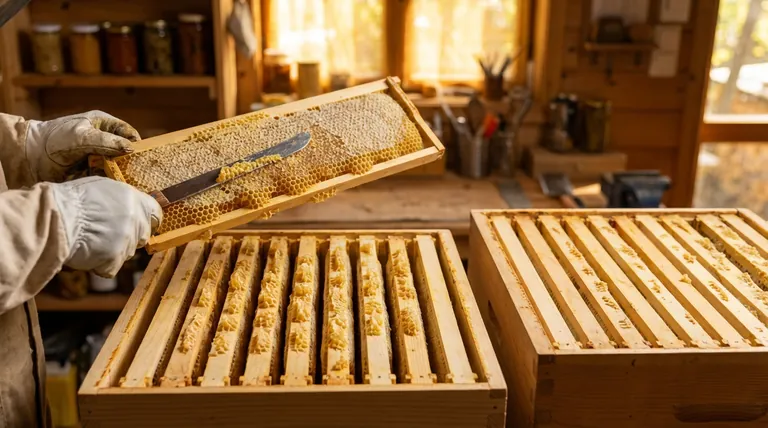
You pick up a heavy frame, dripping with honey. Your uncapping knife dips and snags, struggling to navigate the uneven landscape of the honeycomb. You’re forced to dig into the low spots, tearing comb, wasting honey, and losing precious time. Each frame is a minor battle, a small point of friction that, when multiplied by hundreds or thousands, becomes a significant operational bottleneck.
Now, imagine a different scenario. The knife glides across the frame in a single, clean pass. A perfect sheet of white wax cappings falls away, revealing a flawless wall of liquid gold.
The difference between these two scenes is not luck. It’s engineering. And it begins with a counterintuitive decision: deliberately using one less frame than the hive was designed for.
The Architect and the Blueprint
To understand this efficiency hack, you must first understand the mind of the honeybee. Bees are not random builders; they are slaves to a single, immutable architectural rule.
It’s called "bee space."
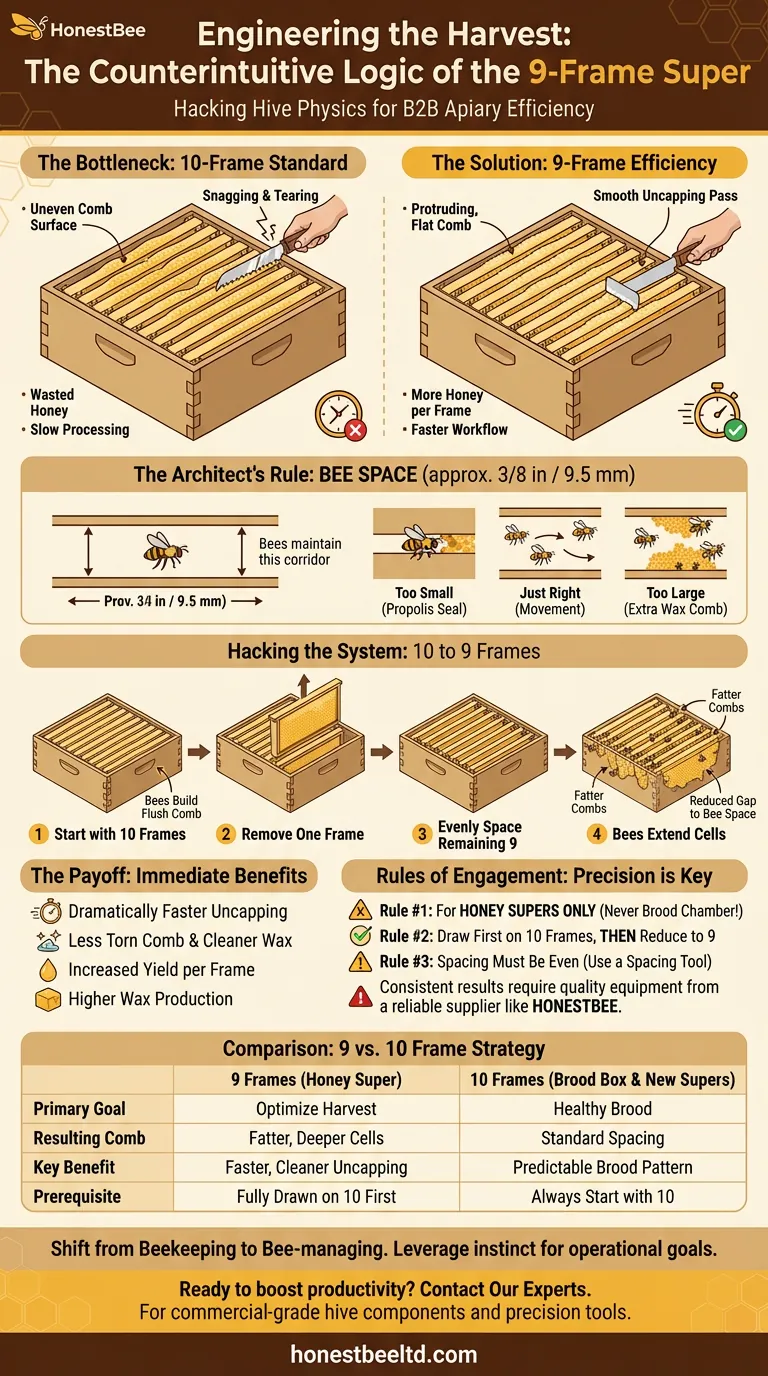
This is a specific gap, roughly 3/8 of an inch (9.5 mm), that bees instinctively maintain as a corridor for movement.
- Any space smaller than this, they seal with propolis.
- Any space larger, they fill with extra wax comb.
This isn't a suggestion; it's the fundamental law of hive physics. Their entire world is built around this single measurement. As a beekeeper, this law isn't a constraint—it's a lever you can pull.
Hacking the System: From 10 Frames to 9
When you place 10 frames in a standard 10-frame super, you create perfect, consistent bee space between them. The bees build accordingly, creating comb that is flush with the wooden frame.
But when you remove one frame and distribute the remaining nine evenly, you create gaps that are slightly larger than bee space.
This triggers a predictable, hard-wired response.
The bees perceive this "excess" space as a structural flaw and immediately work to correct it. They extend the honeycomb cells on each frame, drawing them out further until the gap between the comb faces is reduced back to their preferred dimension.
The result is a set of fatter, wider combs that protrude significantly beyond the edges of the frame. This isn't a defect; it's the entire point.
The Payoff: A Revolution in Uncapping
This small adjustment in the hive transforms the difficult work in the honey house.
Those protruding combs create a single, raised, and remarkably flat plane of wax cappings across the frame's surface. The low spots that plague a standard 10-frame setup are gone.
The benefits are immediate and compounding:
- Speed: Uncapping becomes dramatically faster, often accomplished in one or two smooth passes.
- Cleanliness: There's less torn comb and less honey mixed in with the wax cappings.
- Yield: Each fatter frame holds more honey. For commercial apiaries, this adds up.
- Wax Production: For those harvesting wax, this method yields significantly heavier cappings. Some even reduce to 8 frames to maximize this effect.
Rules of Engagement: Precision is Not Optional
This technique is a powerful tool, but it's a precision instrument, not a blunt object. Applying it incorrectly creates more problems than it solves.
Rule #1: For Honey Supers Only
This strategy must never be used in the brood chamber. The queen requires the predictable, standard spacing of 10 frames to lay her eggs in an efficient pattern. Introducing wider, irregular comb in her domain creates chaos, makes inspections nearly impossible, and dramatically increases the risk of crushing her when removing a frame.
Rule #2: Draw First, Reduce Later
Never start a new super with 9 frames of bare foundation. Faced with wide-open spaces, the bees will build a chaotic maze of wavy, interconnected comb that will be a nightmare to manage for years.
The correct procedure is to first allow the bees to fully draw out the comb on all 10 frames. Once that initial structure is built, you can remove one frame and re-space the remaining nine.
Rule #3: Spacing Must Be Even
To achieve that perfect, flat plane for uncapping, the frames must be spaced perfectly. A visual guess isn't good enough. Inconsistency will lead to brace comb and defeat the purpose.
This is where professional equipment becomes non-negotiable. Using a dedicated frame spacing tool ensures every gap is identical. For a commercial operation, where efficiency gains are measured in time and money, the quality and standardization of your hive bodies and frames are paramount. Equipment from a reliable supplier like HONESTBEE ensures that the boxes are built to precise specifications, allowing management techniques like this to be deployed consistently and effectively across an entire apiary.
Comparison: 9-Frame vs. 10-Frame Strategy
| Aspect | 9 Frames (Honey Super) | 10 Frames (Brood Box & New Supers) |
|---|---|---|
| Primary Goal | Optimize honey harvesting workflow | Establish healthy brood development & comb |
| Resulting Comb | Fatter, deeper cells for easy uncapping | Standard, consistent spacing for the queen |
| Key Benefit | Faster, cleaner uncapping; more honey per frame | Predictable brood pattern; easier inspections |
| Critical Prerequisite | Comb must be fully drawn on 10 frames first | Always use 10 frames to start a new box |
Ultimately, shifting from 10 frames to 9 in your honey supers is about more than just a simple trick. It represents a psychological shift from being a beekeeper to a beemanager. It’s about understanding the deep, instinctual rules of the hive and creating an environment where the bees’ natural tendencies align perfectly with your operational goals.
It is a small change that reflects a deep understanding of the system—the essence of elegant engineering.
Ready to implement strategies that boost your apiary's productivity and profitability? For commercial-grade hive components and tools designed for precision management, Contact Our Experts
Visual Guide
Related Products
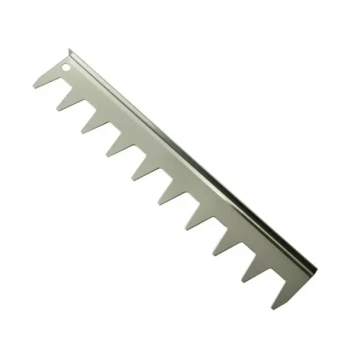
- Stainless Steel 9 Frame Hive Spacer Durable Precise for Commercial Beekeeping
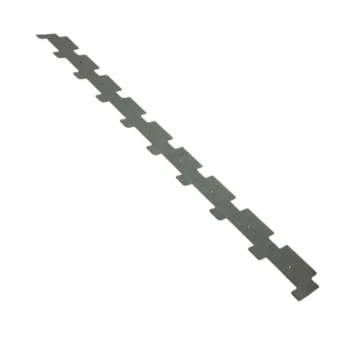
- Heavy Duty Castellated Iron Frame Spacer for Honey Supers
- Durable Plastic Frame Spacer
- Premium Frame Grip with Ergonomic Wood Handles