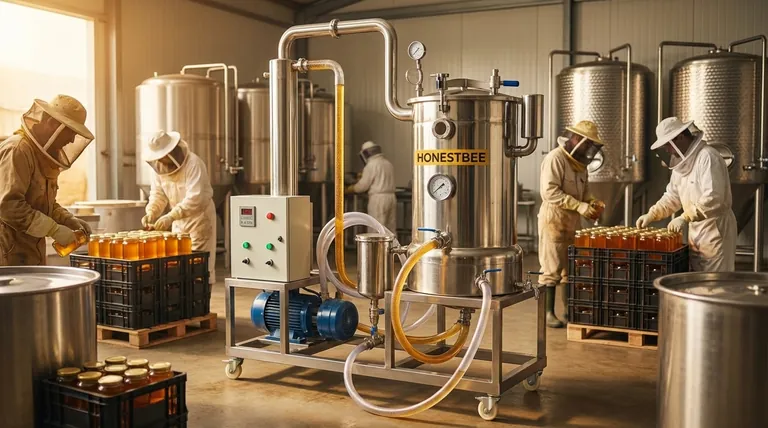
You've had a record harvest. The honey is pure, the quality is exceptional, and the orders are pouring in. To meet the demand, you invested in a new, higher-capacity stainless steel honey pump. You set it up, flip the switch, and... the circuit breaker trips. Or perhaps it runs with a concerning groan, moving honey at a fraction of its rated speed, threatening to overheat. Your new solution has just become your biggest bottleneck.
The Vicious Cycle of "Good Enough" Solutions
If this scenario feels familiar, you're not alone. Many commercial apiaries, in their push to scale, hit this exact wall. The immediate instinct is to find a quick fix:
- Trying a heavy-duty extension cord or a voltage converter.
- Running the pump in short bursts to prevent it from tripping the power.
- Blaming the pump manufacturer for a "weak" motor and trying a different brand.
These are merely band-aids on a deeper wound. While you're wrestling with these workarounds, the real costs are mounting. Production schedules slip, fulfillment deadlines are missed, and valuable staff time is wasted troubleshooting equipment instead of processing honey. The worst part? That lucrative contract from a major distributor seems further out of reach than ever, because your operation simply can't guarantee the required volume.
This isn't an equipment failure; it's an infrastructure mismatch.
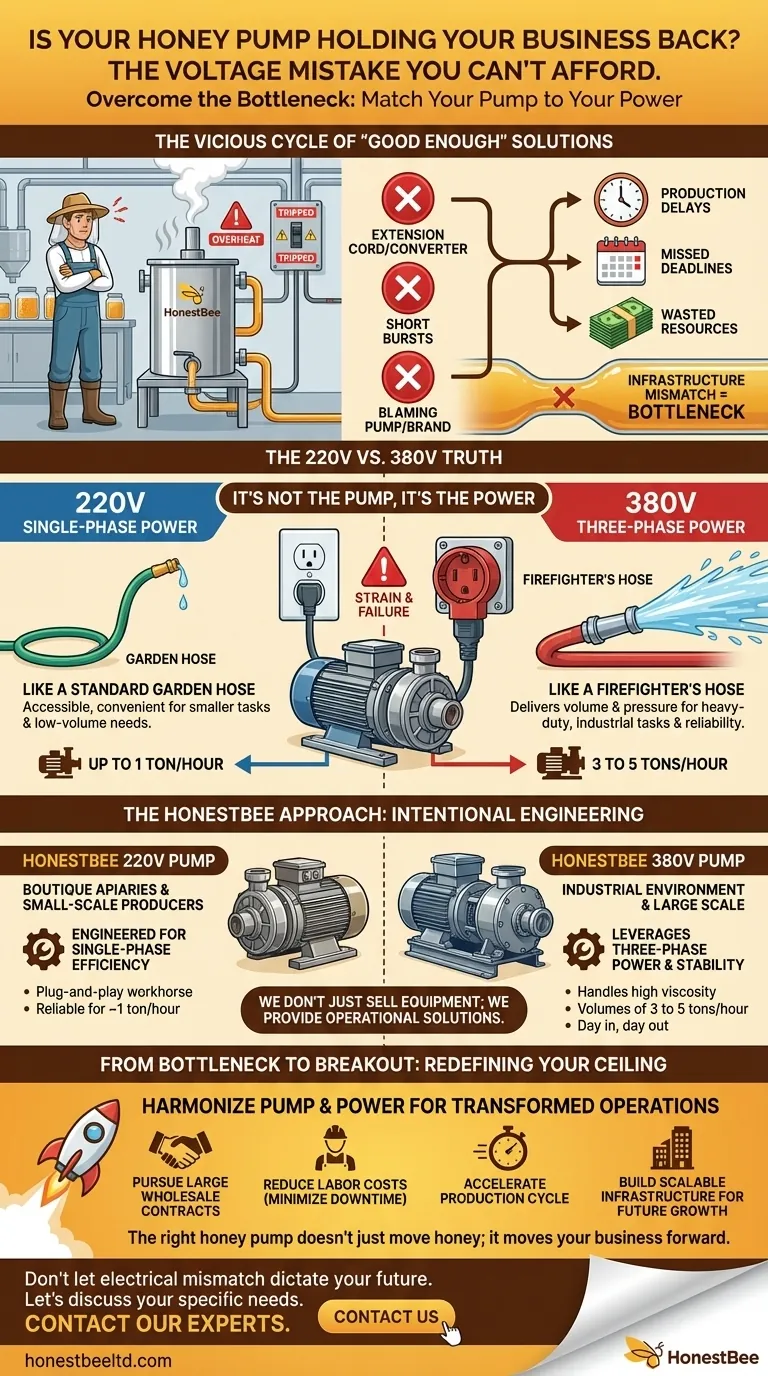
It's Not the Pump, It's the Power: The 220V vs. 380V Truth
The frustrating truth is that the "common solutions" fail because they ignore the fundamental principle at play: the type of electrical power your facility provides. The choice between a 220V pump and a 380V pump isn't about finding a matching plug—it's about matching your operational ambition to your electrical reality.
Think of it this way:
-
220V Single-Phase Power is like a standard garden hose. It’s accessible everywhere, perfect for smaller tasks like washing a car or watering flowers. It's convenient and gets the job done for low-volume needs.
-
380V Three-Phase Power is like a firefighter's hose. It delivers a vastly greater volume and pressure of water, consistently and efficiently. It's designed for heavy-duty, industrial tasks where performance and reliability are non-negotiable.
Trying to run a high-capacity pump on a 220V circuit is like trying to fight a warehouse fire with a garden hose. You'll get a trickle of water, the hose will be strained, and you'll fail to solve the real problem. The pump isn't weak; your power supply is simply not designed to meet its demands.
Matching the Motor to Your Mission: The HONESTBEE Approach
To truly solve this problem, you need a tool that is engineered for the power source you have, or you need to upgrade your power for the tool your scale demands. A solution designed with a deep understanding of this principle isn't a happy accident; it's intentional engineering.
This is precisely why we offer stainless steel screw honey pumps in both configurations. We don't just sell equipment; we provide operational solutions.
-
Our 220V pumps are engineered to run at peak efficiency on single-phase power. They are the perfect, plug-and-play workhorses for boutique apiaries and smaller-scale producers who need reliability for capacities up to around 1 ton per hour.
-
Our 380V pumps are built for the industrial environment. Their motors are designed to leverage the superior efficiency and stability of three-phase power, effortlessly handling high-viscosity honey at volumes of 3 to 5 tons per hour, day in and day out.
By selecting the pump that aligns with your electrical system and production goals, you eliminate the root cause of the bottleneck. No more tripped breakers, no more struggling motors—just smooth, predictable, high-volume honey flow.
From Bottleneck to Breakout: Redefining Your Production Ceiling
When your pump works in harmony with your power system, your entire operation is transformed. The ceiling on your growth is suddenly lifted. Instead of worrying about equipment failures, you can focus on bigger opportunities:
- Confidently pursue large wholesale contracts, knowing your processing capacity can handle the volume.
- Dramatically reduce labor costs by minimizing downtime and maximizing throughput per hour.
- Accelerate your production cycle, moving honey from extractor to storage to bottling faster than ever before.
- Build a scalable infrastructure that's ready for your future growth, not one that holds it back.
The right honey pump doesn't just move honey; it moves your business forward.
Don't let an electrical mismatch dictate the future of your operation. The HONESTBEE team doesn't just sell pumps—we understand the physics of production efficiency and the challenges of scaling a commercial apiary. Let's discuss your specific capacity needs and electrical infrastructure to ensure you're equipped for success. To build a more resilient and profitable processing line, Contact Our Experts.
Visual Guide
Related Products
- Honey Convey Pump Screw Honey Pump for Viscous Liquid
- Honey Convey Pump Economy Gear Pump for Viscous Liquid
- Economy Small Honey Filling Machine Honey Bottle Filler Packaging Machine
- Manual Honey Filling Machine Bottling Machine for Honey
- Automatic Honey Filling and Filtering Machine for Beekeeping Bottle Filling
Related Articles
- How Honey Pumps Protect Quality and Adapt to Modern Beekeeping Needs
- How Honey Screw Presses Deliver Higher Yields With Less Waste
- Preserving the Golden Harvest: The Gentle Engineering of Honey Pumps
- The Two Meanings of a Honey Pump: A Guide to Flow, Precision, and Profit
- How Honey Screw Presses Solve Hygiene, Durability, and Efficiency Challenges for Small Beekeepers