The Weight of a Single Measurement
The late afternoon sun casts long shadows across the apiary. Every beekeeper knows the feeling: the dull ache in the lower back after a day of inspections, a physical reminder that beekeeping is a profoundly physical job. That ache often begins with a single, seemingly simple decision: the depth of your bee boxes.
A bee box is more than a container; it's a component in a living machine. Its dimensions are not arbitrary. They are a deliberate act of design, a choice that dictates your workflow, your physical strain, and the very structure of your colony's world. The depth of a box is a strategic choice long before it's a physical reality.
The Unseen Architecture of the Hive
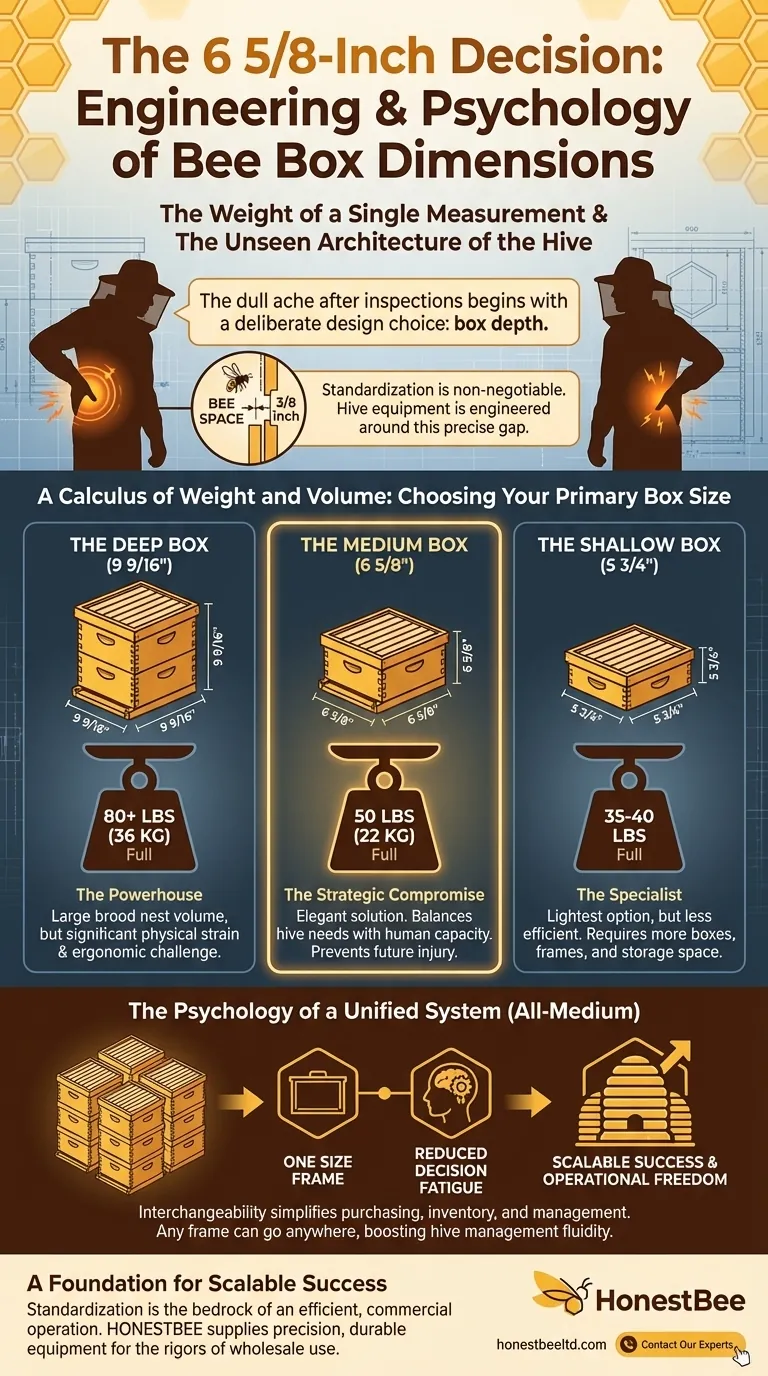
At the heart of modern beekeeping is a concept called "bee space"—a precise gap (about 3/8 of an inch) that bees will leave open for movement. Anything smaller they seal with propolis; anything larger they fill with comb. Hive equipment is engineered around this principle.
This is why standardization is non-negotiable. A medium bee box, also known as an Illinois or Western super, has a depth of exactly 6 5/8 inches (170 mm). This isn't a suggestion; it's the specification that ensures a frame from one box will fit perfectly into another, even if they come from different manufacturers. This silent grammar allows an entire industry to function.
Function Dictates Form
Hive bodies serve two primary functions:
- Brood Chambers: The lower boxes where the queen lays eggs and rears the next generation.
- Honey Supers: The upper boxes where bees store the surplus honey that is eventually harvested.
The genius of the medium box lies in its ability to serve both roles without compromise.
A Calculus of Weight and Volume
Choosing your primary box size is a direct trade-off between hive capacity and human capacity. There is no single correct answer, only the optimal choice for your philosophy and physical limits.
The Deep Box (9 9/16"): The Powerhouse
Traditionally, deep boxes are used for brood. Their large, uninterrupted volume allows a prolific queen to establish a massive brood nest, which can lead to booming populations.
The cost is physical. A full deep box, laden with brood, pollen, and honey, can weigh over 80 pounds (36 kg). Lifting one is a significant physical event, and a stack of them represents a serious ergonomic challenge.
The Medium Box (6 5/8"): The Strategic Compromise
The medium box is the elegant solution. When full of honey, it weighs a more manageable 50 pounds (22 kg). This 30-pound difference is not trivial; it's the distinction between a sustainable practice and a future back injury.
It provides ample space for either honey or brood, making it a master of versatility. It strikes a perfect balance between giving the bees what they need and respecting the limits of the beekeeper.
The Shallow Box (5 3/4"): The Specialist
The lightest option, a full shallow super, might only weigh 35-40 pounds. While appealing, this comes at the cost of efficiency. You need more boxes, more frames, and more storage space for the same amount of honey, adding complexity to your operation.
The Psychology of a Unified System
The most compelling argument for the medium box is not just its weight but the operational simplicity it unlocks. Many commercial beekeepers adopt an "all-medium" hive system.
This means every box in the apiary—for brood, for honey, for every colony—is the same 6 5/8-inch size.
The Freedom of Interchangeability
The human mind craves simplicity. In the complex system of an apiary, reducing variables is a powerful strategic advantage. With an all-medium system:
- You only need one size of box and one size of frame. This simplifies purchasing, inventory, and assembly.
- Any frame can go anywhere. You can move a frame of honey down to feed a brood nest or pull a frame of brood up to boost a weaker colony. This fluidity is a massive advantage in hive management.
- Decision fatigue is reduced. You spend less mental energy managing equipment and more time observing and understanding your bees.
By imposing the constraint of a single box size, you grant yourself an enormous amount of operational freedom.
A Foundation for Scalable Success
Choosing a box size isn't just about a single hive; it's about building the foundational template for your entire apiary. For commercial beekeepers and distributors, this decision is paramount. Standardization isn't a preference; it's the bedrock of an efficient, scalable, and physically sustainable business.
At HONESTBEE, we understand that precision and reliability are the cornerstones of a successful commercial operation. We supply durable, dimensionally-accurate beekeeping equipment designed for the rigors of wholesale and commercial use. Our commitment to quality ensures the interchangeability and dependability you need to build your apiary on a solid foundation.
If you're ready to streamline your operation with a versatile, unified system, Contact Our Experts
Visual Guide
Related Products
- Portable Bee Mating Hive Boxes Mini Mating Nucs 8 Frames for Queen Rearing
- Plastic Transporting Bee Packages and Nuc Boxes for Beekeeping
- Styrofoam Mini Mating Nuc Box with Frames Feeder Styrofoam Bee Hives 3 Frame Nuc Box
- JZBZ Style Professional Battery Box with 20 Shipping Cages
- Langstroth Honey Bee Box Hive Boxes for Different Depths
Related Articles
- The Essential Guide to Beehive Boxes: Maximizing Colony Health and Productivity
- Why Your Bee Boxes Don't Match: The Secret to Flawless Apiary Scaling
- How Smaller Nuc Box Frames Improve Brood Health Through Thermal Regulation
- The Thermodynamics of a New Colony: Why a Smaller Nuc Box Is a Stronger Start
- Architecting Royalty: The Nuc Box as a Queen's Crucible