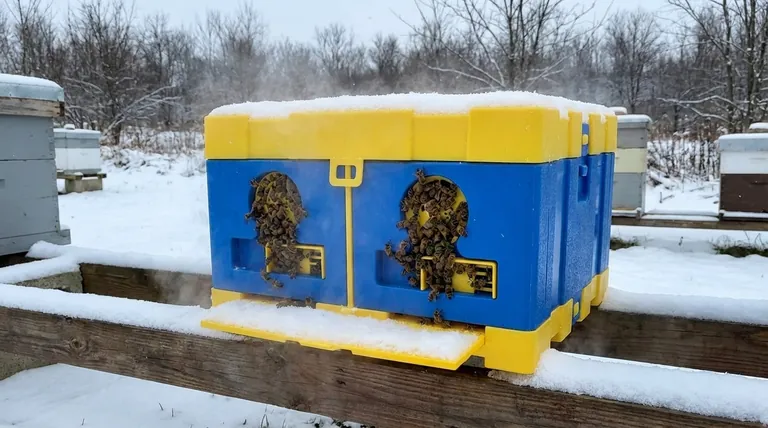
The Unseen Enemy of Winter
For a honey bee colony, winter is not just a season of cold. It is a six-month battle against entropy—a relentless thermodynamic assault that seeks to drain the hive of its most precious resource: heat.
Inside the hive, the bees form a cluster, a living furnace vibrating to generate warmth. This furnace runs on a single fuel: honey. Every degree of temperature maintained, every day survived, comes at a cost measured in stored nectar.
For the beekeeper, this battle is a source of profound anxiety. Winter losses are not just a line item; they are a systemic failure. The question is how to engineer a system that gives your colonies a fighting chance.
A Lesson in Cooperative Thermodynamics
The double nuc box is often misunderstood as a simple space-saving tool. It is not. It is a piece of social architecture designed to facilitate cooperation at a thermodynamic level.
The system is elegant: a standard hive box is divided by a thin wooden wall, creating two adjacent, independent chambers. Each houses a small nucleus colony with its own queen and entrance.
The Clustering Advantage
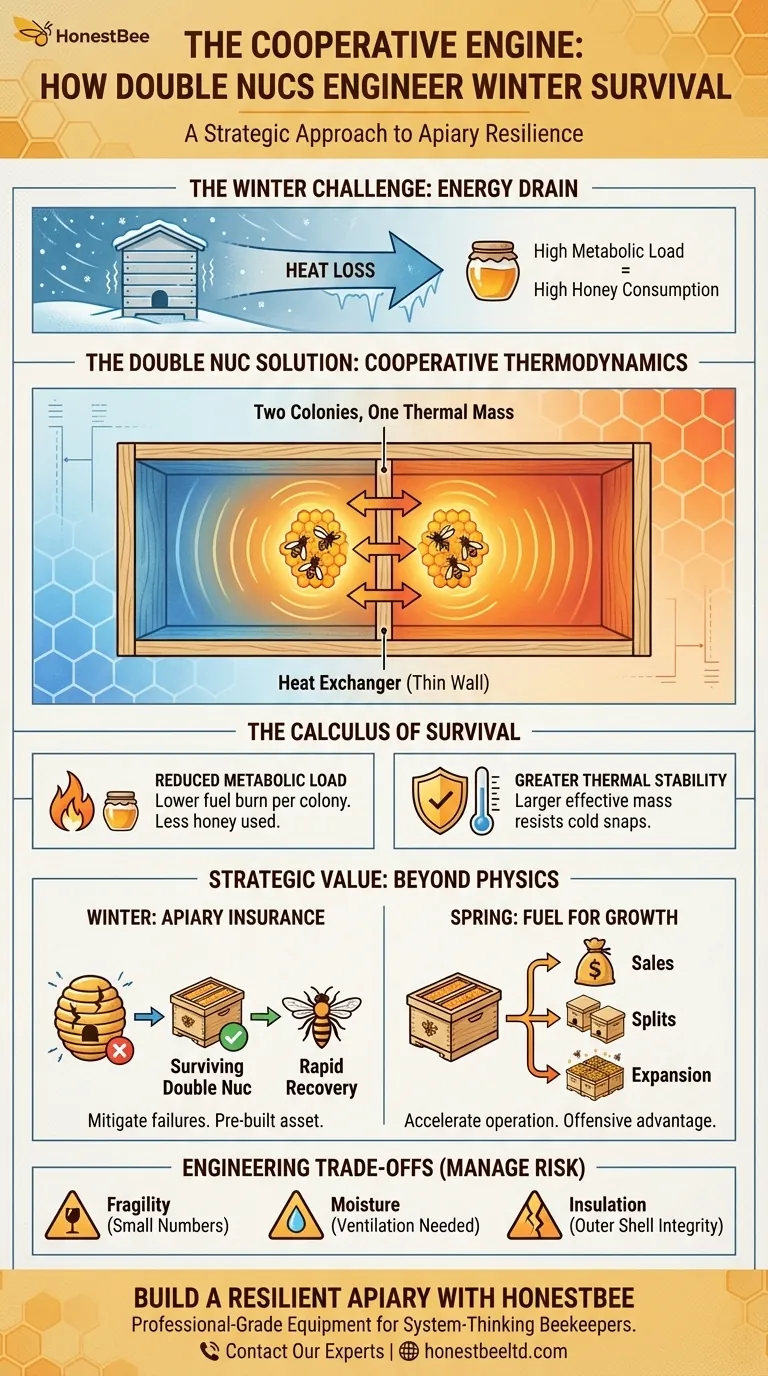
In the depths of winter, the two colonies do something remarkable. Driven by instinct, their individual heat-generating clusters gravitate toward the warm central divider. They press against it, effectively merging their thermal efforts without ever physically mixing.
The thin wall becomes a heat exchanger, not an insulator. The two small, vulnerable clusters begin to function as a single, larger, and more stable thermal mass.
The Calculus of Survival
This simple act of shared warmth has powerful consequences for the colony's energy budget.
- Reduced Metabolic Load: By sharing the work of heat generation, each colony burns less fuel. Their collective metabolism is more efficient, which translates directly to lower honey consumption.
- Greater Thermal Stability: A larger effective mass is less susceptible to sudden temperature drops, protecting the bees during the most extreme cold snaps.
They are no longer two small colonies fighting winter alone; they are a cooperative engine working in unison.
Beyond Survival: The Strategic Value of Redundancy
The true power of this system, however, extends beyond physics and into the realm of strategy. It allows the beekeeper to manage risk and build a more resilient operation.
Psychologically, beekeepers often focus on saving their large, established production hives. But resilience isn't about protecting individual units; it's about ensuring the survival of the system.
Building an "Insurance Policy"
Overwintering small nucleus colonies in double nucs is the ultimate form of apiary insurance. If a large production hive fails over the winter—a common and costly event—you don't start from zero in the spring.
You have a queen-right, ready-to-grow colony waiting. What would have been a catastrophic loss becomes a manageable setback. You are not just replacing bees; you are deploying a pre-built asset.
Fueling a Springtime Expansion
The best-case scenario is even better. If all your hives survive, those overwintered nucs are no longer an insurance policy; they are fuel for growth.
They can be sold to other beekeepers, used to make early-season splits, or expanded into new production hives, accelerating your operation's growth far faster than starting from scratch. This strategy turns a defensive winter posture into an offensive springtime advantage.
The Engineering Trade-offs: Acknowledging Reality
No system is without its challenges. An objective approach requires understanding the variables you must manage.
- Fragility of Small Numbers: While the shared heat provides a huge advantage, each colony is still small. They have less margin for error against disease or prolonged extreme weather.
- The Threat of Moisture: Two clusters produce twice the respiratory moisture. Without proper upper ventilation or insulation, this condensation can become a deadly threat, chilling the very bees the system is designed to protect.
- The Shell Must Be Strong: The internal heat exchange is only effective if the outer walls and top cover of the box are well-insulated to prevent that precious, co-generated heat from escaping into the environment.
A System for a Purpose
The double nuc isn't a universal solution, but it is a powerful tool for a beekeeper with specific goals.
- For Maximizing Survival: It gives late-season splits and weaker colonies their best possible chance to see the spring.
- For Building Resilience: It allows you to create redundant "insurance" colonies to mitigate winter losses and guarantee a strong start to the next season.
- For Resource Efficiency: It lets you maintain two viable colonies with a smaller footprint and significantly lower honey consumption than supporting them separately.
Implementing this strategy requires robust, well-designed equipment that can withstand the pressures of winter and the demands of a commercial operation. At HONESTBEE, we supply professional-grade double nuc boxes and beekeeping equipment designed for apiaries that think in systems.
If you're ready to build a more resilient and efficient apiary, let's talk about the right tools for the job. Contact Our Experts
Visual Guide
Related Products
- Twin Queen Styrofoam Honey Bee Nucs Mating and Breeding Box
- Styrofoam Mini Mating Nuc Box with Frames Feeder Styrofoam Bee Hives 3 Frame Nuc Box
- 5 Frame Langstroth Poly Nuc Corrugated Plastic Nuc Boxes
- 5 Frame Wooden Nuc Box for Beekeeping
- Automatic Heat Preservation 6 Frame Pro Nuc Box for Honey Bee Queen Mating
Related Articles
- The Thermodynamics of a New Colony: Why a Smaller Nuc Box Is a Stronger Start
- Architecting Royalty: The Nuc Box as a Queen's Crucible
- Why Your Bee Boxes Don't Match: The Secret to Flawless Apiary Scaling
- The Architect's Dilemma: How a Nuc Box Solves a Honeybee Swarm's Housing Crisis
- Designing for Instinct: Why the Nuc Box is the Perfect Swarm Trap


