Does this scenario sound familiar? You've invested in efficient centrifugal extractors, optimized your workflow for maximum honey yield, yet you're still fighting a costly, uphill battle. One season it’s a sudden outbreak of disease that wipes out several hives. The next, it’s a wax moth infestation that destroys your carefully stored frames, forcing you to buy expensive treatments or run commercial freezers around the clock.
You're following the industry playbook—preserve the drawn comb at all costs—but your profits are being eaten alive by problems that never seem to go away. You’re trapped in a cycle of defense, not growth.
The Endless Battle Against a Hidden Enemy
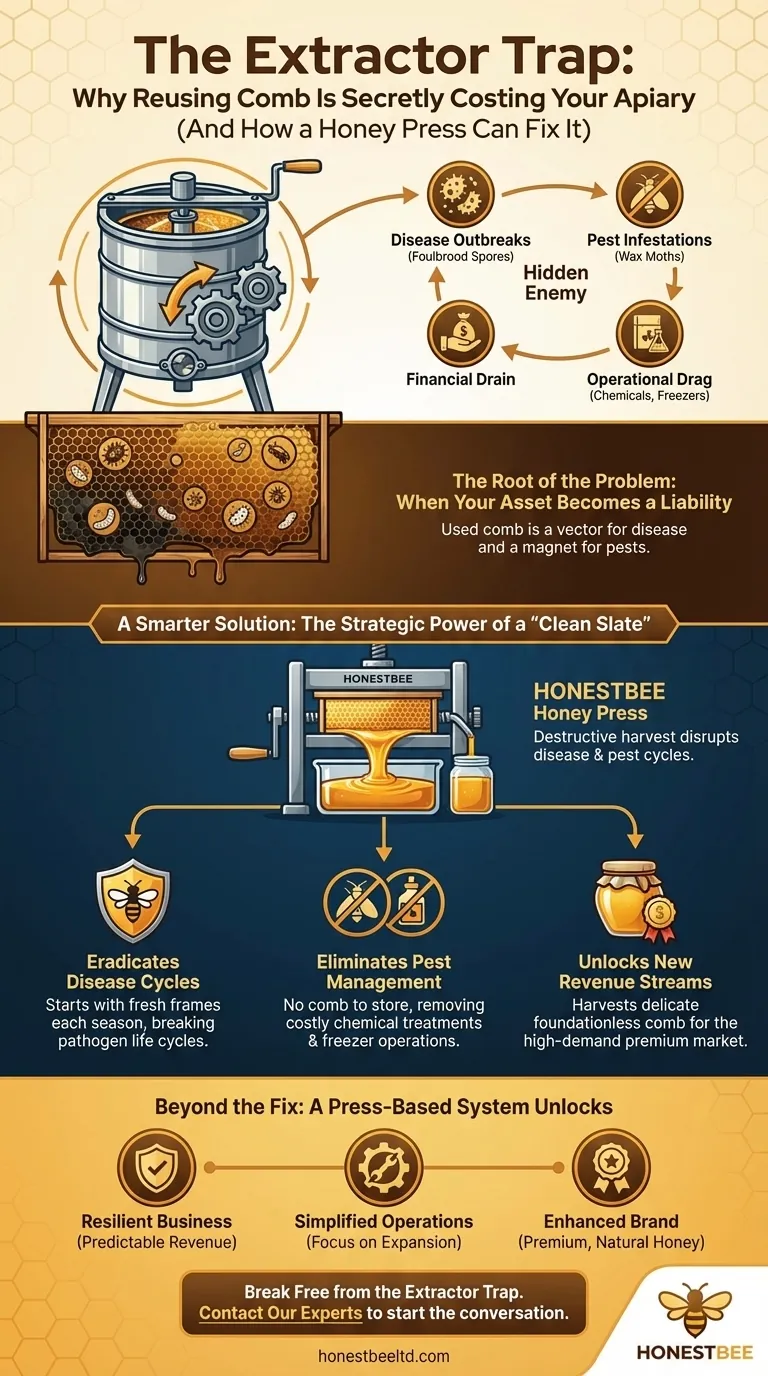
For most commercial beekeepers, the drawn honeycomb is considered the most valuable asset in the apiary, second only to the bees themselves. The logic is simple: since it takes bees 6-8 pounds of honey to produce one pound of wax, reusing comb saves bee energy and boosts honey production.
This belief leads to a standard set of practices:
- Heavy Investment in centrifugal extractors designed to preserve the comb.
- Complex Storage Operations involving chemical treatments (like Para-Moth) or dedicated freezer space to protect empty frames from pests.
- Constant Vigilance against diseases that can linger in old wax and wood.
But what if this core belief is flawed? The relentless focus on preserving comb introduces significant, often hidden, business risks:
- Financial Drain: A single disease outbreak can cost thousands in lost hives and production. The ongoing expense of pest control chemicals and electricity for freezers adds up, directly cutting into your margins.
- Operational Drag: Your team's valuable time is spent managing, treating, and storing empty frames instead of focusing on hive health and expansion.
- Stifled Innovation: You're unable to tap into the premium market for honey from natural, foundationless comb because it's too fragile for your extractor, disintegrating under the intense centrifugal force.
These solutions are merely treating the symptoms. The real problem lies in the very "asset" you're working so hard to protect.
The Root of the Problem: When Your Asset Becomes a Liability
The turning point comes when you shift your perspective: used honeycomb is not just an asset; it's a potential vector for disease and a magnet for pests.
Every season you reuse comb, you are potentially carrying over the problems from the last. Pathogen spores responsible for diseases like American Foulbrood can remain viable in old wax for years. Wax moth larvae have a built-in food source. You aren't just giving your bees a head start on honey production; you're giving diseases and pests a head start, too.
This is why the "common solutions" fail. They don't eliminate the source of the problem.
- Chemical treatments add cost and risk, and pests can develop resistance.
- Freezing comb is an energy-intensive and logistically challenging workaround, not a solution.
To truly build a resilient apiary, you need to break the cycle. You need a system that prioritizes a "clean slate" each season. This requires a harvest method that doesn't rely on preserving old comb.
A Smarter Solution: The Strategic Power of a "Clean Slate"
To eliminate the risks embedded in old comb, you need a tool designed for a different philosophy—one that prioritizes hive health and operational simplicity over the reuse of a potential liability. That tool is the honey press.
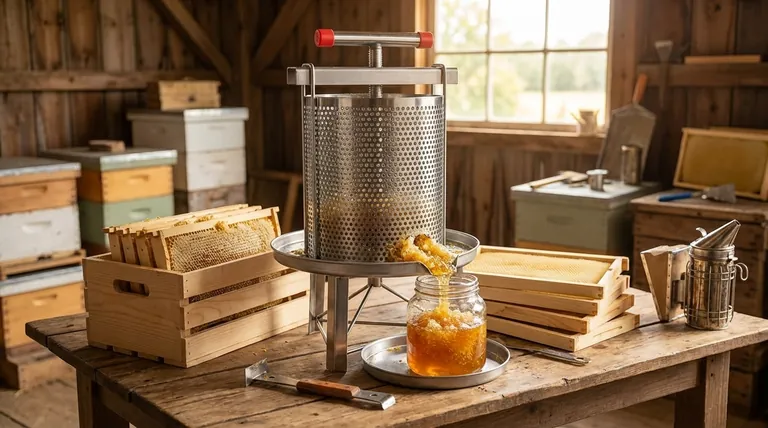
A honey press enables a "destructive harvest," where the comb is crushed and strained to release the honey. While this sounds counterintuitive, it is a powerful strategic choice that directly solves the root problems that extractors perpetuate.
How HONESTBEE Presses Are Designed for a Health-First Apiary
Our heavy-duty honey presses are not just an alternative; they are the purpose-built foundation for a more robust and efficient beekeeping operation. They are engineered for commercial apiaries and distributors who understand that long-term resilience is more profitable than short-term yield.
- It Eradicates Disease Cycles: By ensuring you start with fresh frames and foundation each season, the press system fundamentally disrupts the life cycle of pathogens that hide in old comb. You move from reactive treatment to proactive prevention.
- It Eliminates Pest Management Entirely: With a press, there is no comb to store. The wax is rendered for other uses, and the entire costly and labor-intensive process of fighting wax moths is removed from your operation. Your storage space, capital, and labor are immediately freed up.
- It Unlocks New Revenue Streams: The press is the only viable method for harvesting from delicate, foundationless comb. This allows you to enter the high-demand premium market for natural, raw honey, commanding a higher price per pound and differentiating your brand.
Beyond the Fix: What a Press-Based System Unlocks
When you stop fighting the endless battle of preserving old comb, your business can move from merely surviving to actively thriving. A press-based system isn't about sacrificing yield; it's about redefining success.
By adopting this strategy, you can:
- Build a More Resilient Business: Drastically reduce financial losses from disease and pest control, creating more predictable revenue.
- Simplify Your Operations: Re-allocate labor, capital, and facility space from comb storage to more productive activities like apiary expansion or marketing.
- Enhance Your Brand: Position your operation as a provider of premium, natural honey, backed by a philosophy of superior hive hygiene and health.
If your current equipment is locking you into a cycle of high costs and recurring problems, it's time to consider a new strategy. Transitioning from an extractor-centric model to a press-based system is more than an equipment change—it's a fundamental shift towards building a healthier, more profitable, and sustainable commercial apiary.
Are you ready to break free from the extractor trap and build a more resilient beekeeping business? Let's discuss how a press-based system can be tailored to your specific operational goals. Contact Our Experts to start the conversation.
Visual Guide
Related Products
- Stainless Steel Manual Honey Press with Guard for Pressing Honey and Wax
- Stainless Steel Honey Press Wax Press with Tank
- Easy Use Manual Stainless Steel Honey Press for Honey Comb
- Electric Honey Press Machine for Squeezing Honey Comb Press Equipment
- 10L Stainless Steel Electric Honey Press Machine
Related Articles
- The Unseen System: Why a Honey Press is More Than Just a Tool
- Why a Honey Press is the Smart Choice for Small-Scale Beekeepers
- The Last Drop: Maximizing Yield and Purity with a Stainless Steel Honey Press
- Beyond Brute Force: Why Your Honey Press Is Costing You Quality and Yield
- Why Your Honey Press Is a Sticky, Contaminated Mess—And How to Fix It Permanently