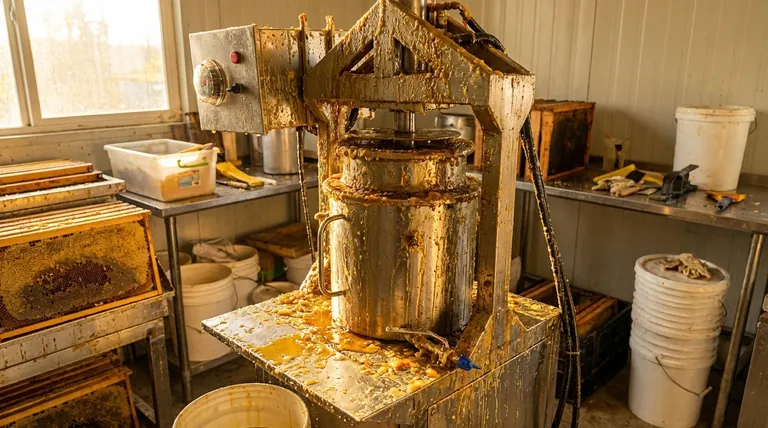
The harvest was a success. The air is thick with the sweet smell of honey, and your tanks are slowly filling. But in the corner stands the one piece of equipment that dampens the satisfaction: the honey press, coated in a stubborn, sticky layer of beeswax and residual honey. You face the familiar, frustrating chore of cleanup—a battle you know will consume hours and likely end in a compromise, not a victory.
It’s a scene that plays out in commercial apiaries everywhere. You've just spent weeks or months tending to your bees to produce the purest honey, only to risk it all in the final processing stage with equipment that’s never truly clean.
The Vicious Cycle of Scrubbing and Scraping
If you run a commercial beekeeping operation, you've likely tried every trick in the book to clean your press:
- The High-Pressure Hose-Down: You blast it with water, hoping to dislodge the mess. The loose honey washes away, but the waxy residue just clings on, laughing at your efforts.
- The All-in-One Soapy Scrub: You go straight in with hot water and detergent, creating a sudsy, sticky slurry that smears the wax across every surface instead of removing it.
- The "Good Enough" Scrape: You pry off the biggest chunks of the wax cake and call it a day, leaving a thin, tacky film that becomes a magnet for dust, bacteria, and pests.
Each of these common methods fails, and the consequences go far beyond simple frustration. This single, unresolved operational bottleneck has significant business costs:
- Product Contamination: Old honey and wax residue can harbor mold and bacteria (like Clostridium botulinum), fermenting and tainting the flavor and purity of your next premium batch. A single contaminated run can damage your brand's reputation for quality.
- Wasted Labor: Every hour your team spends fighting a sticky press is an hour not spent on hive management, bottling, or sales. In a commercial operation, those labor hours are a direct hit to your bottom line.
- Equipment Degradation: Improper cleaning allows acidic honey residue to corrode metal parts and encourages rust. The hardened wax buildup can also damage the press cage over time, shortening the lifespan of your valuable equipment.
Why does a seemingly simple task cause so much trouble? Because most people are trying to solve the wrong problem.
The Root of the Problem: You're Fighting Two Different Enemies
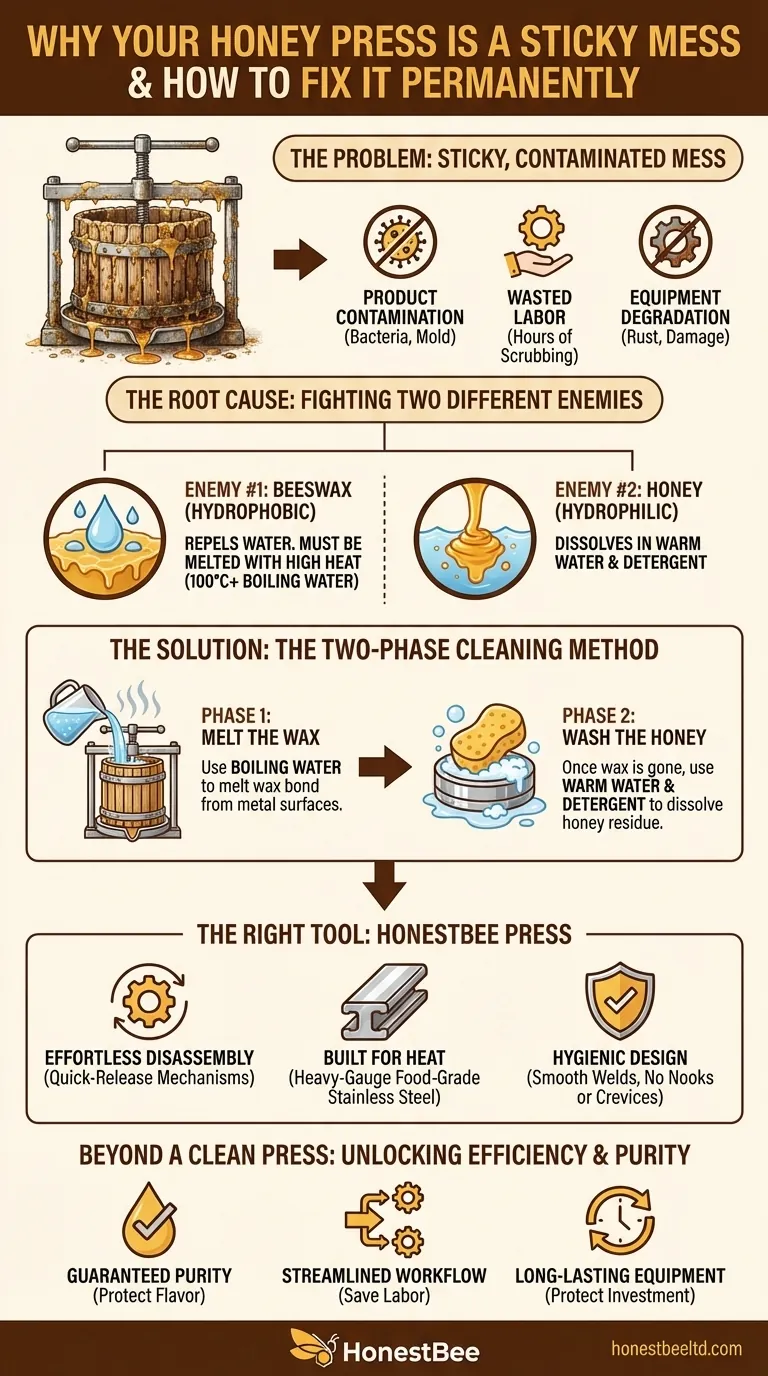
The reason your cleaning efforts fail is that you are treating two fundamentally different substances—beeswax and honey—as if they are the same. They are not. To clean your press effectively, you must defeat them one at a time.
Enemy #1: The Physical Barrier of Beeswax
Beeswax is a lipid. It is hydrophobic, meaning it repels water. Its melting point is approximately 145°F (63°C). Trying to wash it away with warm, soapy water is like trying to wash a greasy, hardened skillet with lukewarm water; you’ll just smear the grease around.
The Solution: You cannot wash solid wax away. You must physically remove it. The most effective way to do this is with high heat—specifically, boiling water. The heat instantly melts the wax, breaking its bond with the metal and allowing it to be scraped or rinsed away.
Enemy #2: The Sticky Residue of Honey
Honey is essentially a supersaturated sugar solution. It is hydrophilic, meaning it dissolves easily in water. Unlike wax, it responds perfectly to a traditional wash.
The Solution: Once the protective, water-repellent layer of wax is gone, the honey underneath is completely exposed. At this point, warm water and a food-safe detergent can easily dissolve and wash away every last sticky trace, ensuring a hygienically clean surface.
The "common" cleaning methods fail because they try to wash away honey while it's still trapped behind a waterproof wall of wax. You must first demolish the wall (melt the wax), and only then can you clean the room behind it (wash the honey).
The Right Tool for the Right Job: A Press Designed for Cleaning
Understanding this two-phase principle is half the battle. The other half is having equipment that doesn't fight you every step of the way. To execute this cleaning method efficiently, you need a honey press that is designed for the entire operational cycle, including disassembly and cleaning.
This is the core philosophy behind HONESTBEE's wholesale line of beekeeping equipment. Our honey presses are engineered not just for maximum extraction, but for minimal downtime. They are the ideal tool for implementing the two-phase cleaning method because they are built with it in mind:
- Effortless Disassembly: Our presses feature simple, robust designs with quick-release mechanisms. You can take apart the cage, press plate, and collection tray in minutes, not hours, giving you complete access to every component.
- Built to Withstand Heat: The press cages and all honey-contact surfaces are constructed from heavy-gauge, food-grade stainless steel. They are designed to handle the thermal shock of boiling water day after day, without warping, degrading, or leaching contaminants.
- Hygienic by Design: With smooth welds and minimalist construction, we've eliminated the nooks, crannies, and crevices where old wax and honey love to hide. Fewer hiding spots mean a faster, more thorough clean.
An HONESTBEE press isn't just a piece of equipment; it's a component of a smarter workflow. It transforms cleaning from a dreaded chore into a predictable, efficient process.
Beyond a Clean Press: Unlocking Efficiency and Purity
When you stop fighting your equipment and adopt a process that works, you unlock new potential for your apiary.
A reliably clean press means you can guarantee the purity of every batch, protecting your honey's delicate flavor profile and your brand's premium standing. It means turning hours of frustrating labor into a quick, streamlined task, freeing up your team to focus on growing your business. It means protecting your investment with equipment that lasts for season after season of hard work.
By solving the persistent problem of press cleaning, you don't just get a cleaner machine—you build a more profitable, efficient, and reputable commercial operation.
Your focus should be on producing the best honey, not on wrestling with your equipment. If you're tired of the endless cycle of sticky, contaminated presses and are ready to equip your apiary or distribution network for real-world commercial demands, let's talk. Contact Our Experts to discuss how our wholesale equipment can help you ensure the quality of every single harvest.
Visual Guide
Related Products
- Stainless Steel Manual Honey Press with Guard for Pressing Honey and Wax
- Stainless Steel Honey Press Wax Press with Tank
- Easy Use Manual Stainless Steel Honey Press for Honey Comb
- Electric Honey Press Machine for Squeezing Honey Comb Press Equipment
- 10L Stainless Steel Electric Honey Press Machine
Related Articles
- The Unseen System: Why a Honey Press is More Than Just a Tool
- Why a Honey Press is the Smart Choice for Small-Scale Beekeepers
- The Last Drop: Maximizing Yield and Purity with a Stainless Steel Honey Press
- Beyond Brute Force: Why Your Honey Press Is Costing You Quality and Yield
- Are You Throwing Away Profit? Why Commercial Apiaries Need a Honey Press