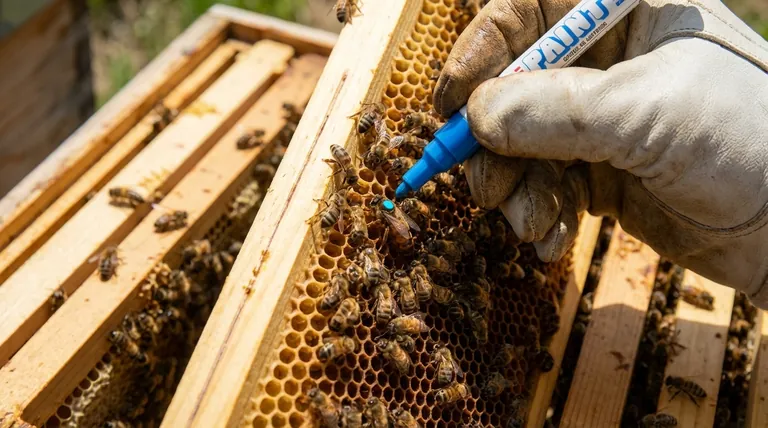
You’re standing over an open hive, the air thick with the hum of fifty thousand bees. Your goal is simple: find the queen. You need to confirm she’s healthy and laying well. But the minutes tick by, and the search becomes a frantic game of "Where's Waldo?" in a swirling, buzzing city. The dot of paint you applied last season is gone. Vanished. Now, a quick inspection has turned into a disruptive, time-consuming hunt that puts the entire colony on edge. Is she still there? Was she superseded? Is your colony now queenless and unproductive?
This single, frustrating moment is a symptom of a much larger, and more costly, problem in commercial beekeeping.
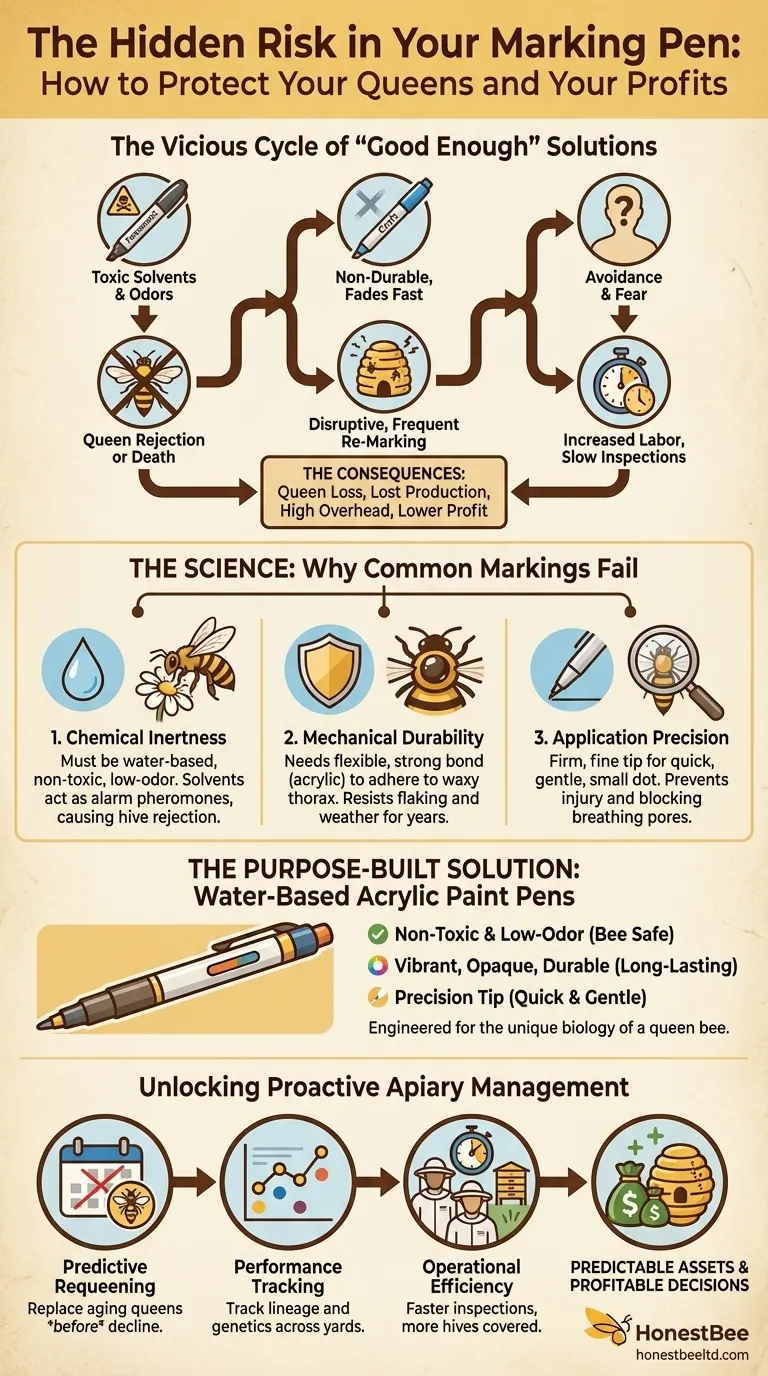
The Vicious Cycle of "Good Enough" Solutions
For commercial apiaries, time is money and a healthy queen is the engine of profit. The inability to quickly and reliably identify a queen has direct financial consequences. Yet, many beekeepers find themselves trapped in a cycle of failed or sub-optimal marking strategies.
Does any of this sound familiar?
- The "Any Pen Will Do" Gamble: You grab a generic permanent marker or a cheap craft pen. It seems to work, but a week later, you find the queen dead or the colony in an uproar, trying to supersede her. The toxic solvents in the paint have poisoned her or the foreign odor caused the workers to reject her.
- The Disappearing Mark: You use a non-toxic, kid-safe marker. The queen is unharmed, but by the next inspection, the mark has flaked off or faded completely. You’re right back where you started, forced to stress the queen and the colony by finding and re-marking her all over again.
- The "Too Risky" Avoidance: You’ve heard horror stories of crushed queens or paint in the wrong places, so you decide not to mark them at all. While safer in the short term, this decision costs you countless hours over the season. Every hive check is slow and inefficient, dramatically increasing your labor costs and limiting the number of hives your team can effectively manage.
These aren't just minor inconveniences. A lost queen means the cost of a replacement, weeks of lost honey production, and the labor to requeen the hive. Inefficient inspections mean higher overhead and lower profitability across your entire operation.
It’s Not the Brand, It’s the Science: The Real Reason Markings Fail
The common thread in these failures is a misunderstanding of the fundamental problem. The challenge isn't just about applying color; it's about applying a biologically-compatible material to a living, breathing, and chemically sensitive creature.
The "good enough" solutions fail because they ignore the underlying material science. A successful mark must satisfy three non-negotiable criteria:
1. Chemical Inertness
The marker's formula is paramount. It must be water-based, non-toxic, and low-odor. Why? The world of a bee is a world of chemical signals. A solvent-based paint releases fumes that are not only potentially toxic but can also act as an alarm pheromone, causing the colony to identify their own queen as a foreign threat. Once dry, the paint must be completely inert, forming a stable layer that doesn't leach chemicals or degrade over time.
2. Mechanical Durability
A bee's thorax is a hard, slightly waxy, and flexible part of its exoskeleton. A mark fails when the paint can't form a strong, yet flexible, bond with this surface. Cheap paints become brittle and flake off as the queen moves. The ideal paint is an acrylic formula that cures into a durable, weather-resistant layer—much like a high-quality exterior house paint—that adheres for the queen's entire multi-year lifespan.
3. Application Precision
The queen is both incredibly valuable and incredibly fragile. The marking process must be fast and gentle. This is where the delivery system—the pen itself—matters. A tool with a firm, fine tip allows for a single, small dot of paint to be applied with minimal pressure and perfect placement on the thorax. Pressing too hard or applying a blob of runny paint can injure the queen or block her spiracles (breathing pores).
The common solutions fail because they solve for one variable but ignore the others. The hardware store marker is visible but toxic. The kid's craft marker is safe but not durable. Avoiding the task preserves the queen but destroys your efficiency.
The Right Tool Isn’t a Product, It’s a Purpose-Built Solution
To solve this problem once and for all, you need to stop thinking about a "pen" and start thinking about a "marking system" that is purpose-built for the unique biology of a queen bee.
This is why experienced commercial beekeepers and equipment distributors rely on tools like water-based acrylic paint pens. They aren't a magical brand; they are the physical embodiment of the right scientific principles:
- Their water-based acrylic formula is non-toxic and low-odor, ensuring the queen's safety and acceptance by the hive.
- Their vibrant, opaque pigment is designed for adhesion and durability, creating a mark that lasts for years, not weeks.
- Their precision pen format allows for a quick, controlled, and gentle application, minimizing stress on your most valuable asset.
At HONESTBEE, we understand that professional beekeeping is a business of managing risks and maximizing efficiency. As a wholesale supplier, we don't just move boxes. We source and provide equipment that is proven to meet these critical operational demands. We select tools like these pens because they are not just supplies; they are a solution engineered from a deep understanding of the beekeeper's core challenges.
Beyond Finding Queens: Unlocking Proactive Apiary Management
When you solve the marking problem reliably, something powerful happens. You move beyond the reactive, stressful hunt for a single bee and unlock a new level of strategic management for your entire apiary.
With a clear, color-coded system (e.g., the international standard of White, Yellow, Red, Green, Blue), you can tell a queen's age at a glance. This simple data point transforms your operation:
- Predictive Requeening: You can proactively replace aging queens before their productivity drops, preventing unexpected downtime and swarming.
- Performance Tracking: You can easily track the lineage and performance of different queen genetics across your yards.
- Operational Efficiency: Your team can perform inspections faster and more confidently, covering more hives per day with less disruption to the bees.
Ultimately, a reliable marking system turns every hive into a predictable asset, not a mystery box. It reduces queen loss, lowers labor costs, and provides the data you need to make smarter, more profitable decisions at scale.
This is the shift from simply keeping bees to running a successful beekeeping business. It begins with understanding the science behind your tools and choosing a partner who does the same. Let's discuss how the right equipment can fortify your operation against hidden risks and unlock new potential for growth. Contact Our Experts.
Visual Guide
Related Products
- Queen Bee Marking Pen POSCA Queen Marking Pens for Beekeeping Bee Markers
- Queen Bee Marking Pen UNI Medium Point for Queen and Bee Marking
- Plastic Long Marker Device for Catching and Marking Bees Queen Bee Marking Tube and Cage
- One Hand Yellow Queen Marking Catcher Tube Cage Beekeeper Tool Accessory for Queen Bee
- Queen Bee Marking Tube Cage Bottle Catcher Holder with Clear Plastic Plunger Marker
Related Articles
- How to Mark Queen Bees Safely: Tools and Techniques for Hive Success
- How to Mark Queen Bees Without Stressing Your Colony: Precision Techniques for Beekeepers
- How to Mark Queen Bees Safely: Balancing Efficiency and Colony Health
- The Signal in the Swarm: Queen Bee Marking as a System for Clarity
- How Queen Bee Marking Transforms Hive Management: A Beekeeper's Guide