It's a frustrating, all-too-common scenario for beekeepers. You've diligently refilled the entrance feeder all winter. You've provided gallons of sugar syrup. Yet, during a late winter inspection, you find a weak, dwindling cluster or, worse, a dead colony, just inches away from a full frame of honey. They had food, so why did they starve?
This isn't a sign of a mysterious disease or poor genetics. It's often the direct result of using the wrong tool for a critical job.
The Costly Cycle of Ineffective Feeding
For commercial apiaries, winter losses are not just a disappointment; they're a direct hit to the bottom line. Every lost colony is lost revenue, either from honey production or pollination contracts. To prevent this, beekeepers try a range of feeding methods, often with mixed results.
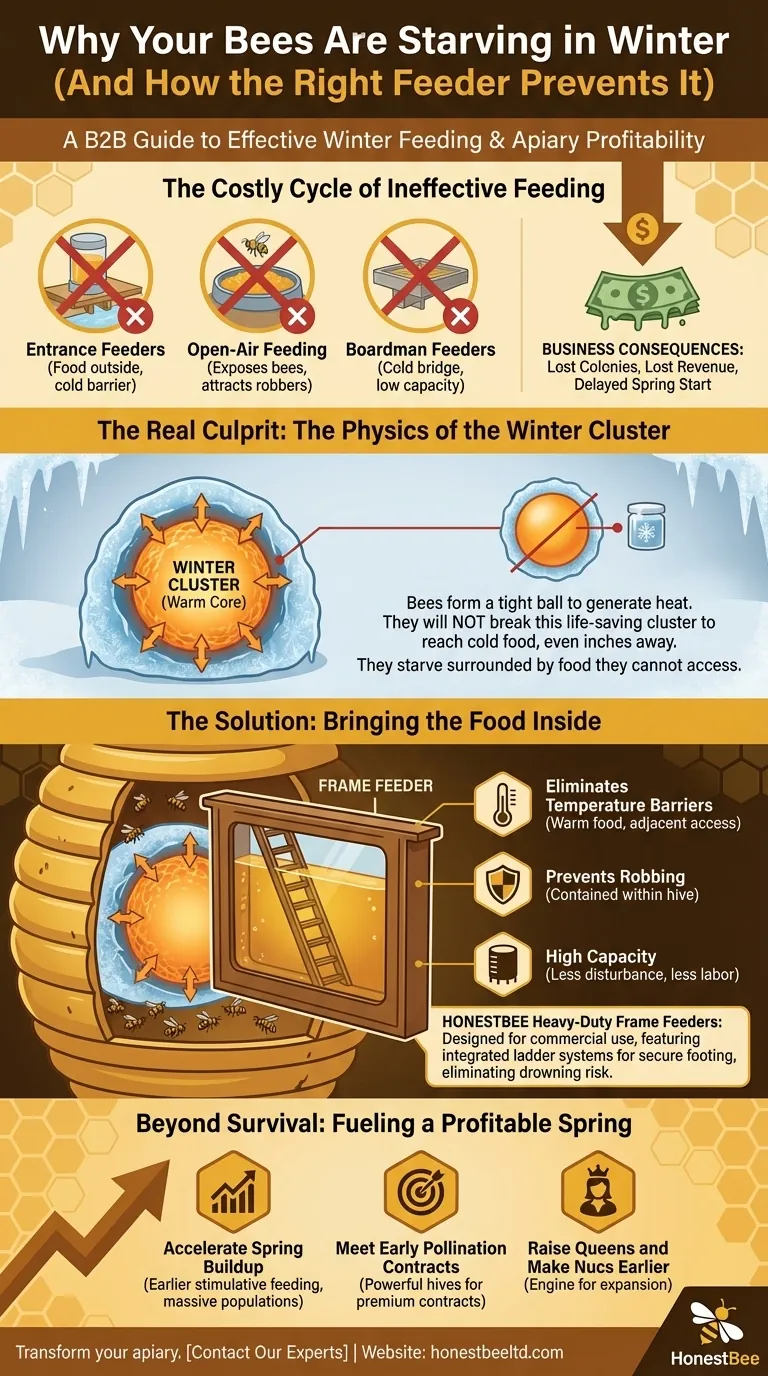
- Entrance Feeders: They seem convenient, but they place the food source outside the warm hive. In cold weather, bees cannot and will not break their life-saving cluster to travel to a cold entrance. The food is inaccessible when they need it most.
- Open-Air Feeding: This method is even worse. It not only exposes your bees to the cold but also broadcasts a "free food" signal to every colony in the area, triggering intense robbing behavior that can decimate your weaker hives.
- Boardman Feeders: Like entrance feeders, they create a cold bridge and can chill the brood. They also have a small capacity, requiring frequent refills that disturb the hive.
The business consequences are stark: higher-than-average winter losses, weaker colonies in the spring, and a delayed start to the season, potentially jeopardizing early pollination contracts. You spend time and money on feed that the bees can't even use, watching your investment literally freeze outside the hive.
The Real Culprit: The Physics of the Winter Cluster
The reason these common methods fail isn't complicated. It comes down to a fundamental principle of bee biology: the winter cluster.
When temperatures drop, honey bees form a tight ball to generate and conserve heat. The outer layer of bees acts as insulation, while the inner bees vibrate their wing muscles to produce warmth, keeping the core temperature stable. This cluster is their survival mechanism.
Here is the critical truth: Bees will not break this cluster to access food if it means exposing themselves to lethal cold.
An entrance feeder, just a few feet away, might as well be a mile away on a cold day. The colony is physically trapped by its own survival strategy. They will starve, surrounded by food, because they simply cannot afford the energy or heat loss required to reach it.
This is why your previous efforts may have failed. They worked against the bees' natural behavior, not with it. You weren't just feeding bees; you were asking them to make a life-or-death choice they are biologically programmed to refuse.
The Solution: Bringing the Food Inside
To solve this problem, you don't need a new kind of feed. You need to change its location. The solution is to place a high-volume food source inside the hive, directly adjacent to the cluster, where bees can access it without breaking formation.
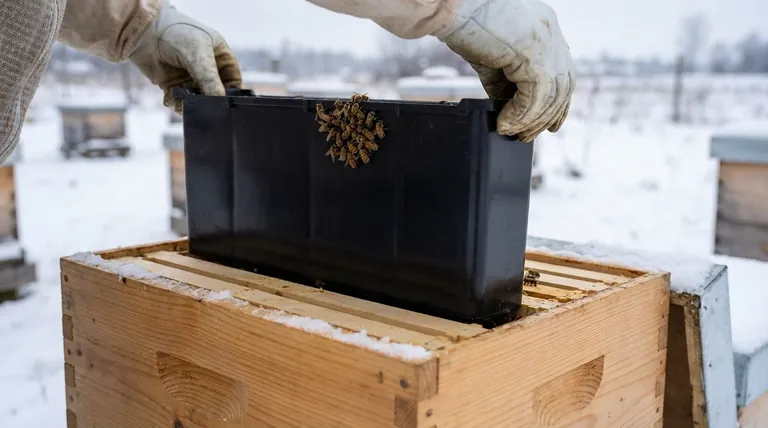
This is precisely what a frame feeder is engineered to do. By replacing one or two frames within the brood box, a frame feeder becomes part of the hive's internal, insulated environment. It solves the core problem by:
- Eliminating Temperature Barriers: The syrup is kept at the ambient hive temperature, right next to the bees. They can move from the cluster to the feeder and back without a dangerous temperature drop.
- Preventing Robbing: Because the feeder is entirely contained within the hive, it doesn't attract bees from neighboring colonies, protecting your operation from robbing frenzies.
- Providing High Capacity: Holding up to two gallons, quality frame feeders reduce the frequency of refills. This means less disturbance for the colony and less labor for your team.
A well-designed frame feeder isn't just a container; it's a strategic tool built on a deep understanding of bee biology. At HONESTBEE, our heavy-duty frame feeders are designed for commercial use, featuring robust, integrated ladder systems that give bees secure footing and virtually eliminate the risk of drowning—addressing the single biggest drawback of older, inferior designs.
Beyond Survival: Fueling a Profitable Spring
When you solve the winter feeding problem, you do more than just increase survival rates. You create a powerful advantage for your entire operation.
With a reliable internal food source, your colonies don't just survive winter; they enter spring stronger and ready for explosive growth. You can:
- Accelerate Spring Buildup: Start stimulative feeding earlier, regardless of outside temperature, to encourage brood rearing and build massive populations for early nectar flows.
- Meet Early Pollination Contracts: Have powerful, populous hives ready to go when the first almond or apple blossoms appear, securing premium pollination contracts.
- Raise Queens and Make Nucs Earlier: Strong overwintered colonies are the engine for expansion, allowing you to produce nucleus colonies and raise queens weeks ahead of competitors struggling with weak hives.
Solving the fundamental challenge of cold-weather feeding transforms beekeeping from a game of winter survival into a predictable, manageable business process.
Stop letting your investment in feed go to waste and your colonies pay the price. It's time to equip your hives with a tool that works with their biology, not against it. Let's discuss how the right equipment can fortify your apiary, reduce your winter losses, and set you up for your most productive season yet. Contact Our Experts.
Visual Guide
Related Products
- Professional In-Hive Frame Bee Feeder by HONESTBEE
- In-Hive Dual Compartment Frame Bee Feeder for Targeted Colony Nutrition
- Professional In-Hive Bee Feeder HONESTBEE Frame for Beekeeping
- 3.5L Plastic Beehive Frame Feeder Deep Frame Water Feeder for In Hive Use
- Rapid Bee Feeder White Plastic 2L Round Top Feeder for 8 or 10-Frame Bee Hives
Related Articles
- How to Choose Between Frame and Gravity Feeders for Healthy Honey Bee Colonies
- How to Choose the Right Bee Feeder for Your Hive’s Health and Efficiency
- An Operator's Calculus: The Hidden Trade-offs of High-Capacity Bee Feeders
- How to Choose Between Frame and Gravity Feeders for Optimal Hive Health
- Why Your In-Hive Feeders Leak—And How One Piece of Equipment Prevents Disaster