You’ve done the hard work. Your bees have delivered a fantastic harvest, the culmination of a full season’s effort. But then, during processing, the frustration begins. The filtering line slows to a crawl, clogged yet again. Or worse, after bottling, you notice the final product isn’t as brilliantly clear as it should be. Perhaps a distributor even calls to mention a subtle "off" flavor in the last shipment.
You've checked everything—the honey itself, the temperature, the filter mesh size—but you can't find the source of the problem. It's a costly and demoralizing mystery that undermines all your work.
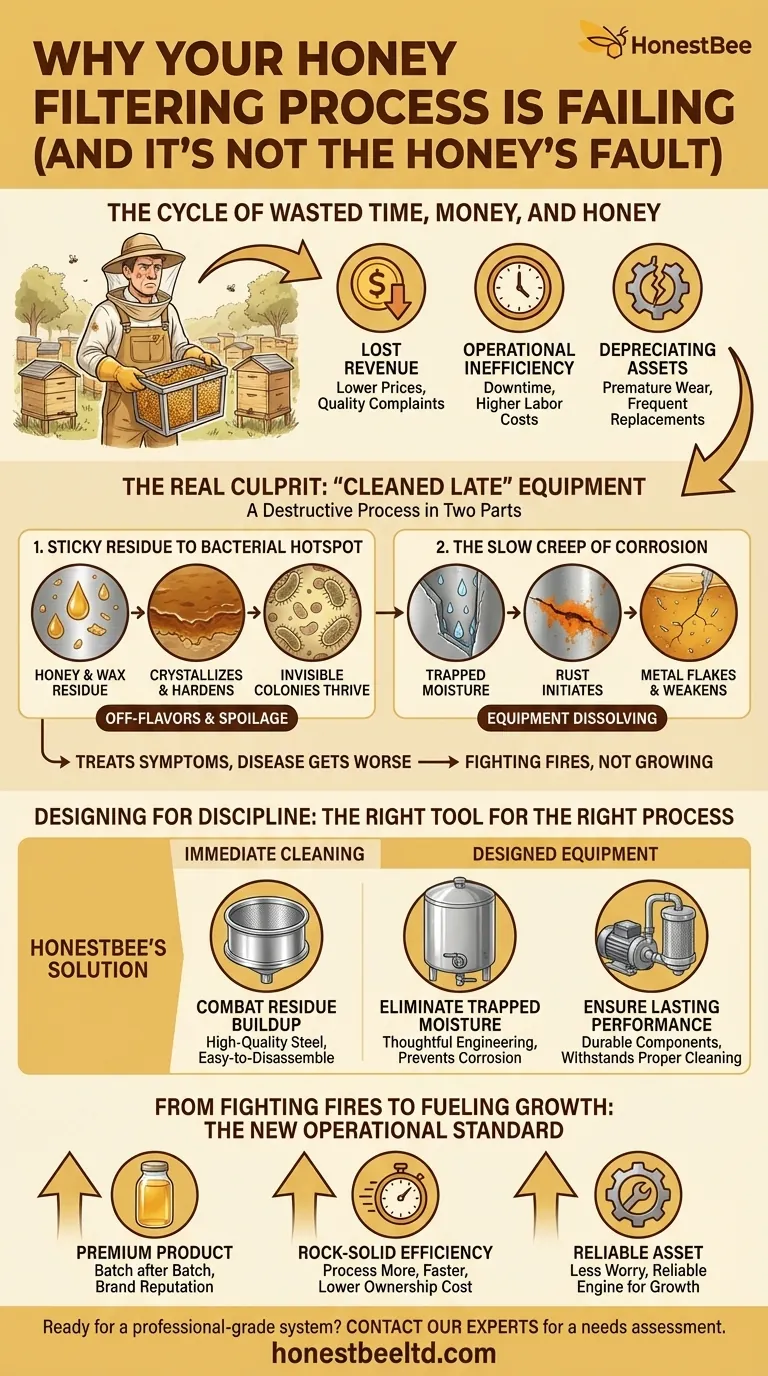
The Cycle of Wasted Time, Money, and Honey
If this scenario feels familiar, you are not alone. Many commercial apiaries find themselves in a constant battle with their filtering equipment. The common response is to treat the symptoms: you replace filters more frequently, scrub the tanks harder between uses, or simply accept a certain amount of product loss and downtime as "the cost of doing business."
But these are reactive, costly measures that don't solve the underlying issue. The true costs are hidden but significant:
- Lost Revenue: Every batch that lacks premium clarity or purity is a batch that can't command a premium price. A single quality complaint from a distributor can jeopardize a valuable relationship.
- Operational Inefficiency: Unplanned downtime during the critical post-harvest window means lost hours and higher labor costs. A slow, clogged system directly limits how much honey you can process and sell.
- Depreciating Assets: Constantly fighting with your equipment causes premature wear and tear. Aggressive scrubbing scratches surfaces, and stop-gap fixes often lead to bigger breakdowns, forcing you to replace expensive machinery far sooner than you should.
You’re stuck in a cycle of fighting fires, when you should be focused on growing your business. The problem isn't your effort; it's that you're fighting the wrong enemy.
The Real Culprit: What Happens When Equipment is "Cleaned Late"
Most beekeepers understand the need to clean their equipment. The fundamental mistake, however, is viewing this as a simple janitorial task that can be put off. The truth is a matter of chemistry and biology: the moment you finish filtering, a clock starts ticking, and a destructive process begins.
From Sticky Residue to Bacterial Hotspot
When honey and microscopic wax particles are left on surfaces—even for a few hours—they don't just sit there. The sugars begin to crystallize, and the wax hardens, creating a tough, glue-like film. This isn't just "dirt"; it's a bonded layer that clings to stainless steel, lodges deep inside filter pores, and hides in pipe fittings and pump mechanisms.
Worse, this hardened residue is the perfect food source for wild yeasts and bacteria. These invisible colonies thrive in the residue. When you run your next, pristine batch of honey through this "clean-looking" equipment, you are unknowingly introducing contaminants that create off-flavors and spoil your product's purity. This is why even aggressive scrubbing later often fails—the contamination is already locked in.
The Slow Creep of Corrosion
The second part of the problem is moisture. After a delayed wash, it's nearly impossible to dry every nook and cranny where water can get trapped under that hardened residue. This trapped moisture initiates corrosion. That rust isn't just an aesthetic problem; it's your equipment literally dissolving. These microscopic metal particles can flake off and end up in your honey, while the weakened metal becomes prone to cracks and leaks.
This is why the common "solutions" fail. Replacing filters is a band-aid when the contamination source is the tank or pump. Scrubbing harder with abrasive tools creates micro-scratches on your stainless steel, ironically creating more places for bacteria and residue to hide. You are treating the symptoms, while the disease gets worse.
Designing for Discipline: The Right Tool for the Right Process
To permanently break this cycle, you don’t need harsher chemicals or more elbow grease. You need to stop the problem at its source. This requires two things: an ironclad process of immediate cleaning and equipment that is designed to make this process fast and foolproof.
This is the core philosophy behind HONESTBEE's commercial-grade beekeeping supplies. Our filtering equipment isn't just built to process honey; it's engineered for the entire operational lifecycle, with a focus on making proper maintenance simple and effective.
Our systems are the ideal tool to implement the correct process because they directly address the root causes of failure:
- To Combat Residue Buildup: Our equipment is built with high-quality, food-grade stainless steel and features smooth, polished welds and easy-to-disassemble designs. This minimizes the microscopic crevices where honey and wax can get trapped, making immediate washing faster and far more effective.
- To Eliminate Trapped Moisture: Thoughtful engineering ensures our tanks, pumps, and fittings drain completely and quickly. By eliminating the pockets where water can hide, we help you prevent corrosion from ever starting, protecting the integrity of your honey and the longevity of your investment.
- To Ensure Lasting Performance: We supply durable, high-performance filters and components that are designed to withstand the rigors of a commercial operation, including repeated—and proper—cleaning cycles. This means you spend less time and money replacing worn-out parts and more time producing a quality product.
From Fighting Fires to Fueling Growth: The New Operational Standard
When you solve the maintenance problem at its root, the benefits extend far beyond just having clean equipment. You fundamentally change your operational reality.
Instead of worrying about consistency, you can confidently deliver a premium product, batch after batch, strengthening your brand reputation and justifying higher prices. Instead of suffering unpredictable downtime, you gain rock-solid operational efficiency, allowing you to process more honey, faster, when it matters most. You transform your equipment from a liability into a reliable asset that lowers your total cost of ownership and drives profitability.
Your equipment shouldn't be a source of constant worry. It should be a reliable engine for your business's growth. Solving the maintenance puzzle isn't just about cleaner honey; it's about unlocking operational efficiency, protecting your brand's reputation, and improving your bottom line. If you're ready to move beyond quick fixes and establish a truly professional-grade processing system, our experts are here to help you assess your needs and find the right equipment for your scale. Contact Our Experts.
Visual Guide
Related Products
- Professional Stainless Steel Honey Filtering Machine with Water Bath Heating for Beekeeping
- Electric Double Wall Honey Filtering Machine Purifier Equipment for Honey Processing Plant
- Professional Stainless Steel Honey Filter with Support Handle
- Professional Honey Filter with Tripod Support Stand
- Professional Cone-Shaped Honey Filter with Reinforced Steel Ring
Related Articles
- The Sticky Bottleneck: Why Your Honey Filtering Fails and How to Fix It for Good
- The Quality vs. Scale Dilemma: Why Your Honey Filtering Process Is Broken (And How to Fix It for Good)
- Why Your Honey Filtering is Slow and Inconsistent—And How to Fix It for Good
- Optimizing Honey Filtration: How Mesh Sizes Shape Quality and Market Appeal
- Beyond the Sticky Mess: Why Your Honey Filtering Method Is Secretly Killing Your Growth