Honey extractors and wax melting equipment serve as the critical measurement tools for quantifying the productivity gains associated with mite control treatments. By mechanically separating and standardizing the harvest of bee products, these machines allow researchers to derive precise weight data, which is necessary to calculate the financial return of specific interventions.
Core Takeaway Evaluating the economic viability of treatments requires more than just counting mites; it requires measuring production. Extractors and melters convert raw hive output into measurable data points, enabling a direct, weight-based comparison between treated colonies and untreated control groups.
The Mechanics of Data Collection
Standardizing the Extraction Process
To evaluate a treatment accurately, the method of harvest must be consistent across all test subjects. Honey extractors and wax melters provide a standardized method for processing hive frames. This eliminates human error or variability that might occur with manual harvesting techniques.
Isolating Honey Yields
Honey extractors utilize centrifugal force to separate mature honey from the combs. This process allows for the complete removal of liquid honey without destroying the comb structure. The resulting output can be weighed precisely to determine the total honey yield per colony.
Processing Beeswax for Measurement
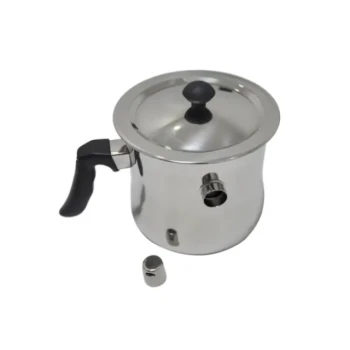
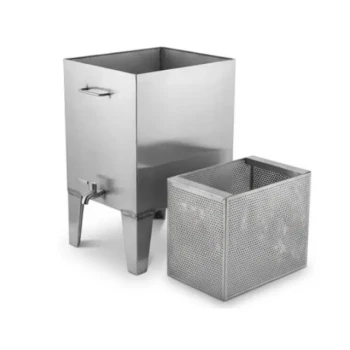
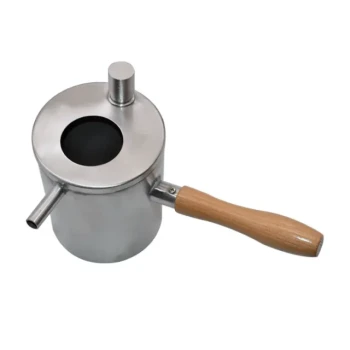
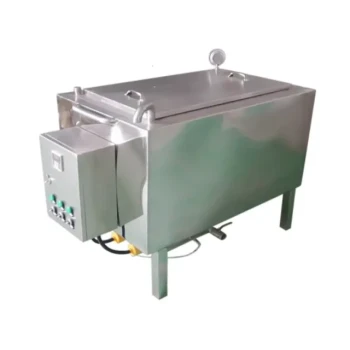
Wax melting equipment uses heat to render old combs and cappings into pure beeswax. Just as with honey, this equipment allows researchers to obtain a definitive weight for the wax produced. This captures the secondary economic value generated by the colony.
Translating Biology into Economics
The Comparative Analysis
The economic impact is determined by comparing the output weights of treated colonies against control groups. For example, researchers might apply natural spruce extracts to one group while leaving another untreated. Both groups are then processed through the same machinery.
Quantifying Productivity Improvements
If the equipment reveals a statistically significant increase in the weight of honey and wax from the treated group, the treatment is deemed economically beneficial. The machinery transforms a biological result (healthier bees) into a financial metric (kilograms of product).
Understanding the Trade-offs
Equipment Dependence
While these machines provide accurate data, they require specific protocols to ensure validity. If the extraction time or temperature varies between batches, the yield data may be skewed. Consistency in machine operation is just as important as the biological treatment itself.
Yield vs. Input Costs
The equipment measures gross output, not net profit. While the machines can confirm higher yields, a complete economic analysis must also factor in the cost of the treatment and the operation of the machinery itself.
Making the Right Choice for Your Goal
To effectively utilize this equipment for economic evaluation, consider your primary objective:
- If your primary focus is scientific validation: Ensure strict adherence to identical extraction cycles and temperatures for both treated and control groups to maintain data integrity.
- If your primary focus is commercial ROI: Use the weight data provided by the machines to calculate the specific dollar value of the increased yield against the cost of the mite treatment.
The precision offered by mechanical extraction is the bridge between biological experimentation and proven economic value.
Summary Table:
| Equipment Type | Primary Function in Evaluation | Key Data Point Produced |
|---|---|---|
| Honey Extractor | Centrifugal separation of liquid honey from combs | Precise honey yield weight (kg/lb) |
| Wax Melter | Thermal rendering of cappings and old combs | Total beeswax production weight |
| Control Group | Baseline measurement without treatment | Standardized productivity benchmark |
| Analytical Tools | Comparative weight and cost-benefit analysis | Return on Investment (ROI) ratio |
Maximize Your Apiary's Economic Potential with HONESTBEE
To accurately measure the success of your mite control programs, you need reliable, industrial-grade equipment that delivers consistent results. HONESTBEE specializes in supporting commercial apiaries and distributors with a comprehensive range of wholesale beekeeping solutions. From high-capacity honey extractors and wax melting machinery to automated honey-filling lines, we provide the tools you need to transform your biological yields into measurable profits.
Whether you are scaling a commercial operation or supplying the next generation of beekeepers, our hardware and industry consumables are designed for durability and precision. Contact HONESTBEE today to discuss how our professional machinery can optimize your production and prove the value of your hive management strategies.
References
- L. Romanchuk, Seymour Furman. Natural spruce extract is an effective remedy to fight against varroatosis in organic beekeeping. DOI: 10.15421/2020_254
This article is also based on technical information from HonestBee Knowledge Base .
Related Products
- Stainless Steel Jack Type Honey Comb Press Machine Wax and Honey Separator
- Stainless Steel Honey Press Wax Press with Tank
- Beeswax Melter for Candle Making Honey Bee Wax Melter
- Professional Thermostatic Conical Honey Melter
- Honey Wax Separating Wax Press with Metal Screw Wax Separator Machine
People Also Ask
- Can you heat honey to separate from wax? A Guide to Preserving Honey Quality
- How do you separate honey from wax at home? A Simple Guide to Zero-Waste Harvesting
- How do you separate honey from wax cappings? Choose the Best Method for Your Harvest
- How do I separate honey from wax? A Two-Stage Process for Maximum Yield
- What temperature does wax separate from honey? Achieve Clean, Efficient Honey Rendering