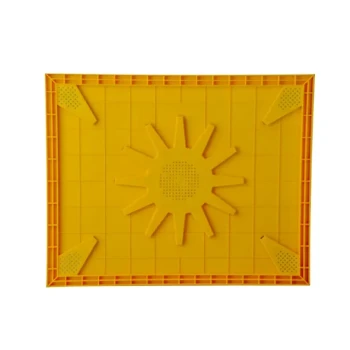
Sticky boards serve as a diagnostic tool placed at the bottom of a beehive to trap and quantify naturally falling parasites. Specifically targeting the Varroa destructor mite, these adhesive-coated sheets provide beekeepers with critical data on infestation severity without requiring invasive hive inspections.
The primary value of using a sticky board is transforming pest control from a guessing game into a precise science. By establishing a quantitative baseline for infestation, beekeepers can administer medication only when necessary, preventing both chemical contamination of honey and colony collapse due to insufficient treatment.
The Mechanics of Passive Monitoring
Capturing the Data
Sticky boards function as a passive trap. They are placed beneath the colony, often under a screened or solid bottom board.
As bees move through the hive, mites naturally detach and fall. Gravity directs these parasites onto the adhesive surface below, where they remain trapped for analysis.
The Assessment Window
To generate reliable data, the board is typically left in place for a specific duration, ranging from 24 to 72 hours.
This timeframe allows the beekeeper to capture a representative "snapshot" of the infestation level at a specific moment, rather than relying on a momentary observation.
Minimal Disturbance
Because the board is inserted at the bottom of the hive, the process causes minimal disturbance to the colony structure or the bees' daily routine.
This allows for frequent monitoring without the stress associated with opening the hive body for deep inspections.
The Strategic Value of Quantitative Assessment
Moving Beyond "Blind Medication"
The most critical function of the sticky board is eliminating blind medication.
Without data, beekeepers may treat hives that do not need it, or under-treat hives with severe infestations. Sticky boards provide a quantitative indicator—a hard number—that dictates whether intervention is required.
Preventing Drug Residues
Overusing medication is a significant risk in modern beekeeping.
By limiting chemical treatments to times when mite counts exceed safe thresholds, beekeepers significantly reduce the risk of drug residues contaminating the honey and wax.
Ensuring Sufficient Control
Conversely, relying on guesswork can lead to insufficient control of the parasite.
Regular monitoring ensures that if an infestation spikes, the beekeeper detects it immediately and applies the precise medication needed to protect the colony.
Understanding the Trade-offs
Monitoring vs. Treatment
It is vital to distinguish that sticky boards are diagnostic tools, not treatment devices.
While they trap mites, their purpose is not to reduce the mite population, but to count it. Relying on them for control rather than assessment would be a fatal error for the colony.
The "Snapshot" Limitation
The data provided is a snapshot of natural mite fall.
Beekeepers must understand that the count on the board is an indicator of the total population, not a census. Accurate interpretation of this count is required to understand the true severity of the infestation.
Making the Right Choice for Your Goal
Effective hive management relies on interpreting the data correctly to make informed decisions.
- If your primary focus is Pest Management: Use the mite count to determine if the infestation has reached the specific threshold that requires immediate chemical intervention.
- If your primary focus is Product Quality: Rely on the quantitative data to prove that treatment is unnecessary, ensuring your honey remains free of chemical residues.
The sticky board is the bridge between observation and action, ensuring you only intervene when the data confirms it is necessary.
Summary Table:
| Feature | Description |
|---|---|
| Primary Function | Diagnostic tool for quantifying natural Varroa mite fall |
| Monitoring Window | Typically 24 to 72 hours for an accurate snapshot |
| Key Benefit | Prevents blind medication and chemical residue in honey |
| Impact on Bees | Minimal disturbance; no need to open the main hive body |
| Nature of Tool | Passive monitoring only (not a treatment device) |
Maximize Your Colony Productivity with HONESTBEE
At HONESTBEE, we specialize in supporting commercial apiaries and distributors with high-performance beekeeping solutions. Whether you need precise diagnostic tools, specialized hive-making machinery, or bulk industry consumables, our comprehensive wholesale offering is designed to scale your operations efficiently.
Our value to you:
- Full-Spectrum Supply: From honey-filling machines to essential hardware and cultural merchandise.
- Professional Quality: Tools engineered for the rigors of commercial honey production.
- Strategic Partnership: We help you maintain healthy colonies and pure product standards.
Ready to upgrade your apiary’s efficiency? Contact us today to explore our wholesale catalog!
References
- Ségolène Maucourt, Pierre Giovenazzo. Comparison of three methods to multiply honey bee (Apis mellifera) colonies. DOI: 10.1007/s13592-017-0556-9
This article is also based on technical information from HonestBee Knowledge Base .
Related Products
- Langstroth Solid Bottom Board for Beekeeping
- Solid Bottom Board Australian Pine Wood Langstroth Bottom Board for Wholesale
- Langstroth Screen Bottom Board for Beekeeping Wholesale
- HONESTBEE Multi Exit Plastic Bee Escape Board for Efficient Honey Harvesting
- Australian Pine Wood Langstroth Screen Bottom Board for Wholesale
People Also Ask
- What are the functions of solid bottom boards for a beehive? Essential Thermal Protection and Winter Survival Tips
- What is the purpose of a solid bottom board for bee hives? Enhance Hive Health and Winter Survival
- How does climate influence the choice between a solid and screened bottom board? Optimize Your Hive for Local Weather
- What is the primary function of a bottom board in a modern modified beehive system? Essential Foundation Guide
- What are the characteristics of a solid bottom board for a beehive? Boost Colony Health and Thermal Insulation