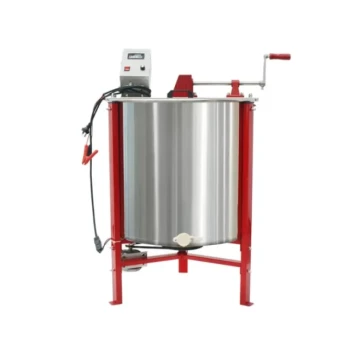
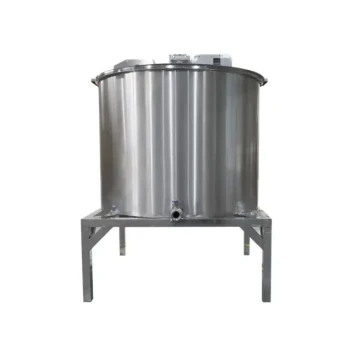
Advanced honey production relies on automated centrifugal technology and closed-loop systems to fundamentally outperform manual methods. By integrating multi-stage filtration and high-precision filling, these machines maximize processing throughput while maintaining a sterile environment that virtually eliminates human contact and contamination risks.
Core Takeaway Automation in honey production provides a dual advantage: it secures food safety through closed-environment processing and significantly boosts biological efficiency. By preserving honeycomb structures during extraction, machines allow bees to conserve energy for honey production rather than wax rebuilding, effectively shortening harvest cycles.
Revolutionizing the Extraction Process
The Shift to Centrifugal Force
Manual extraction often involves crushing or straining, which is slow and destructive. Industrial-grade machines use controlled centrifugal force to spin honey out of the frames.
This method achieves high-efficiency separation without physical damage to the comb.
Enhancing Production Efficiency
Mechanical extraction drastically reduces the time required to process each frame.
This speed minimizes labor costs and creates a continuous workflow that manual labor cannot match. It bridges the gap between raw apiary output and the demands of global markets.
The Biological Advantage: Preserving the Colony
Protecting the Honeycomb Structure
A critical, often overlooked benefit of advanced extraction is the preservation of the honeycomb integrity.
Because the centrifugal process is non-destructive, the wax combs remain intact after the honey is removed.
Energy Conservation for Bees
Bees expend significant energy secreting wax to build nests.
When intact combs are returned to the hive, bees do not need to rebuild. They can immediately redirect their energy toward foraging and honey production.
Shortening the Production Cycle
The ability to reuse combs allows for more frequent harvests within a single flowering period.
This optimizes the return on investment by increasing the total honey output per colony over the season.
Precision in Filling and Packaging
Exact Volumetric Control
Manual bottling leads to inconsistencies in weight and volume.
Industrial filling machines feature high-precision metering systems. This ensures every unit meets exact weight specifications, which is vital for retail standards.
Vacuum and Anti-Drip Technology
Advanced machines utilize vacuum sealing to maintain product stability during storage and transportation.
Coupled with anti-drip systems, this technology prevents waste and ensures the final packaging remains clean and professional.
Ensuring Hygiene and Safety
The Closed-Loop Environment
Manual processing exposes honey to open air, debris, and human handling.
Automated lines operate within closed environments that isolate the product from external pollution.
Standardization and Compliance
Multi-stage filtration systems automatically remove impurities while preserving physical properties.
This rigorous standardization ensures the product meets strict food safety and hygiene standards required for large-scale distribution.
Understanding the Trade-offs
Capital Investment vs. Scale
Advanced machinery requires a significant upfront capital expenditure compared to manual tools.
This investment is only improved by high-volume production; for small-scale operations, the ROI may not justify the cost.
Technical Maintenance Requirements
Automated systems introduce complexity regarding maintenance and calibration.
Operators must possess technical skills to manage the equipment, and a machine breakdown can halt the entire production line, creating a single point of failure.
Making the Right Choice for Your Goal
To determine if advanced automation is the right step for your operation, consider your specific objectives:
- If your primary focus is increasing total yield: Prioritize centrifugal extraction equipment that preserves honeycombs, allowing your bees to produce more honey per season.
- If your primary focus is retail distribution: Invest in closed-loop filling machines with vacuum sealing to guarantee the hygiene certifications and shelf stability required by major retailers.
True scalability in honey production is achieved when you synchronize mechanical efficiency with the biological needs of the hive.
Summary Table:
| Feature | Manual Methods | Advanced Machinery |
|---|---|---|
| Extraction Method | Crushing or straining (Destructive) | Centrifugal force (Non-destructive) |
| Honeycomb Status | Often destroyed; requires rebuilding | Intact; ready for immediate reuse |
| Hygiene Level | High risk of external contamination | Closed-loop sterile environment |
| Filling Accuracy | Variable; manual inconsistencies | High-precision volumetric metering |
| Production Cycle | Longer; bees must rebuild wax | Shorter; bees focus on honey collection |
| Scalability | Limited by manual labor hours | High-volume continuous workflow |
Scale Your Honey Production with HONESTBEE
Transitioning from manual labor to industrial automation is the key to unlocking the full potential of your apiary. HONESTBEE specializes in empowering commercial apiaries and distributors with professional-grade solutions that bridge the gap between hive and market.
From high-efficiency centrifugal extraction systems that preserve your combs to precision honey-filling machines that ensure retail-ready consistency, our comprehensive wholesale portfolio is designed for your growth. We supply the full spectrum of beekeeping tools, specialized hive-making machinery, and essential industry consumables.
Ready to maximize your harvest and streamline your operations? Contact HONESTBEE Today to discover how our equipment can transform your production efficiency and product quality.
References
- Yusuf Shehu Folaranmi Gbolahan, Oluwabunmi Oluwaseun Popoola. Mapping the Conceptual Structure of Beekeeping from 1980 to 2020. DOI: 10.5530/jscires.12.1.016
This article is also based on technical information from HonestBee Knowledge Base .
Related Products
- Precision Durable Efficient HONESTBEE Rotary Honey Filling Machine
- Automatic Honey Filling and Filtering Machine for Beekeeping Bottle Filling
- Economy Small Honey Filling Machine Honey Bottle Filler Packaging Machine
- Fully Automatic Honey Filling Packaging Machine for Processing Line
- Small Honey Filling Machine Sachet Packing Equipment Single Nozzle
People Also Ask
- How do honey filling machines work? Achieve Precision & Speed for Your Apiary
- What is a key feature of the new generation of the honey filling machine? The Advanced Electronic Control Unit
- What quality control role does professional honey filling equipment perform? Ensure Consistency and Product Stability
- How do high-precision honey filling machines ensure quality? Optimize Your Commercial Production with HONESTBEE
- What are the common types of bottling machines used for honey? Choosing the Right Solution for Your Apiary