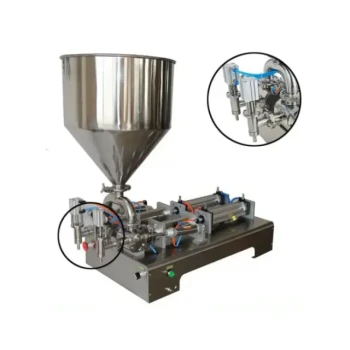
Automated filling machines fundamentally elevate quality control by replacing variable manual processes with precise, isolated mechanical systems. They utilize advanced gravimetric or volumetric technology to guarantee strict volume consistency while establishing a "closed path" environment that shields the honey from external contaminants.
The Core Insight: While often viewed strictly as efficiency tools, automated filling machines serve a critical role in product preservation. By isolating honey from oxygen and moisture during the final transfer, they lock in the biochemical stability and sensory profile that defines high-quality honey.
Preserving Sensory and Chemical Integrity
The Importance of the "Closed Path"
The primary reference highlights that these machines establish a completely closed path from the storage tank to the final packaging container.
This isolation is the single most effective method for minimizing the honey's exposure to ambient air.
By removing the liquid's contact with the open environment, you directly prevent the degradation of enzyme activity, color, and aroma.
Controlling Oxidation and Moisture
Honey is hygroscopic, meaning it naturally absorbs moisture from the air.
Automated systems prevent this absorption, which is critical for maintaining specific biochemical indicators.
Keeping moisture low and preventing oxidation ensures that Hydroxymethylfurfural (HMF) levels remain within optimal ranges, preserving the honey's freshness and shelf life.
Ensuring Hygiene and Biological Safety
Eliminating Secondary Contamination
Manual handling introduces inevitable risks of human error and biological contamination.
Automated machinery utilizes sterile filling technology to create a physical barrier against these risks.
This significantly reduces the probability of airborne molds and yeasts entering the finished product, acting as a hardware defense against fermentation and spoilage.
Consistent Sterility Standards
Commercial machinery often utilizes enclosed sterile operating environments.
These systems work in tandem with filtration units to ensure the final product meets high-level food hygiene standards.
This level of control is essential for producing honey that qualifies for international export and high-end retail markets.
Standardization and Volumetric Precision
Gravimetric and Volumetric Systems
To maintain quality control over the quantity of the product, automated machines use high-precision weighing sensors or metering controls.
These systems ensure that every jar contains the exact specified volume, eliminating consumer complaints regarding under-filling.
Reducing Raw Material Loss
Precise dosing prevents the accidental over-filling common in manual operations.
By strictly adhering to set volumes, producers effectively reduce raw material loss.
This ensures that the maximum amount of processed honey makes it into a sellable package, directly impacting the commercial viability of the operation.
Operational Considerations and Trade-offs
The Requirement for Rigorous Calibration
While automation reduces manual error, it introduces a reliance on mechanical accuracy.
If sensors or volumetric pistons are not calibrated correctly, systemic errors will occur across the entire batch rather than just a single jar.
Maintenance of Sanitary Seals
The "closed path" is only as effective as the seals and cleaning protocols maintaining it.
Operators must adhere to strict maintenance schedules to ensure residues do not build up within the nozzles or hoses.
Failure to clean these enclosed systems can ironically lead to the very cross-contamination the machine is designed to prevent.
Making the Right Choice for Your Goal
Whether you are scaling a boutique apiary or managing a large industrial plant, the role of automation changes based on your specific quality targets.
- If your primary focus is Boutique/Medicinal Quality: Prioritize machines with advanced "closed path" systems to protect enzyme activity and keep HMF levels low.
- If your primary focus is Mass Market Retail: Focus on high-precision gravimetric sensors to ensure strict weight compliance and maximize yield per batch.
- If your primary focus is Export Compliance: Ensure the machinery offers a certified sterile filling environment to prevent yeast contamination and fermentation during shipping.
Ultimately, automation transforms the filling stage from a simple logistical step into a final, critical checkpoint for product purity.
Summary Table:
| Quality Control Factor | Benefit of Automation | Impact on Final Product |
|---|---|---|
| Physical Purity | Closed path systems & sterile environments | Prevents secondary contamination and fermentation |
| Chemical Stability | Minimizes exposure to oxygen and moisture | Lowers HMF levels and preserves enzyme activity |
| Volume Accuracy | Gravimetric or volumetric precision sensors | Ensures weight compliance and reduces product waste |
| Sensory Integrity | Reduced oxidation during final transfer | Locks in natural color, aroma, and flavor profiles |
Elevate Your Honey Production with HONESTBEE
Transitioning to automated systems is essential for commercial apiaries and distributors aiming for international export standards and maximum yield. At HONESTBEE, we specialize in providing the complete spectrum of beekeeping tools—from high-precision honey-filling machines and hive-making equipment to essential consumables and cultural merchandise.
Our machinery is designed to lock in the biochemical stability of your honey, ensuring every jar meets the highest sensory and hygiene standards. Unlock superior efficiency and product purity today—contact our experts at HONESTBEE!
References
- Pablo Sierra Figueredo, Juan Manuel Zaldívar-Cruz. Aspectos a valorar dentro de la bioeconomía y su sendero de eco – intensificación para el buen desempeño de la actividad apícola ante la variabilidad de la Actividad Solar y Geomagnética y los cambios climáticos. DOI: 10.5377/ribcc.v1i1.2149
This article is also based on technical information from HonestBee Knowledge Base .
Related Products
- Fully Automatic Honey Filling Packaging Machine for Processing Line
- Automatic Honey Filling and Filtering Machine for Beekeeping Bottle Filling
- Precision Durable Efficient HONESTBEE Rotary Honey Filling Machine
- Precision Automated Packaging Turntable Honey Spoon Filling Sealing Packing Machine
- Semi Automatic Small Honey Bottle Filling Machine Honey Filler
People Also Ask
- Why are fully automatic honey filling and packaging lines essential? Boost Your Honey's Market Value and Quality
- What is a fully-automatic honey filler? Streamline Your Production with High-Precision Automation
- How do automated honey filling and packaging machines affect profitability? Boost Margins with HONESTBEE Technology
- How do automated honey filling and packaging machines contribute to the market value of honey products? Maximize Your ROI
- How do industrial-grade automated honey filling and packaging machines mitigate the risk of physical contamination?