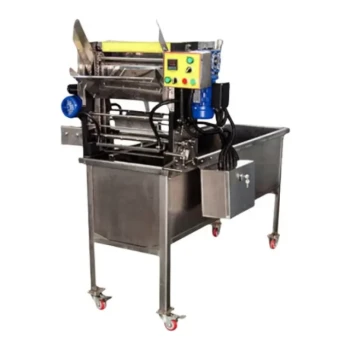
Automated honey-filling machines secure organic product quality primarily through the creation of fully enclosed, mechanized environments. These systems utilize precise flow control to isolate the honey from external pollutants and non-organic substances throughout the packaging process. By stabilizing the organic components from collection to the finished product, automation effectively eliminates the risk of secondary cross-contamination that often plagues manual handling.
The definitive advantage of automation in organic honey production is the establishment of a "closed-loop" ecosystem. By strictly controlling the environment from storage tank to final seal, these machines preserve the honey's natural chemical stability and enzyme activity while ensuring rigorous consistency.
Preserving Organic Integrity
For organic honey, maintaining the purity of the product is not just a preference; it is a regulatory requirement. Automated systems address this by physically separating the product from the environment.
Eliminating Environmental Exposure
The primary reference emphasizes the use of fully enclosed filling systems. This establishes a closed path that shields the honey from ambient air, dust, and airborne pathogens.
By minimizing air exposure, the machinery protects sensitive sensory indicators, such as natural aroma and color.
Preventing Secondary Contamination
Manual packaging introduces the risk of human error and biological contamination. Automated machines remove direct human contact from the equation.
This mechanical isolation prevents the introduction of non-organic substances, ensuring the product remains compliant with strict organic certifications.
Maintaining Chemical Stability
Organic honey is valued for its bioactive compounds. Automated fillers preserve these components by reducing the time honey spends in transit and processing.
By stabilizing the product quickly and efficiently, the machinery safeguards natural antioxidant activity and nutritional content that could degrade during slower, manual processes.
Precision Control and Consistency
Beyond hygiene, quality is defined by consistency and accuracy. Automated fillers utilize advanced control systems to manage the physical properties of the honey.
Viscosity Adaptation
Honey varies wildly in thickness, from fluid blossom honey to dense chestnut varieties. High-quality machines employ constant temperature filling and pressure adjustments tailored to specific viscosities.
This ensures the honey flows smoothly without requiring excessive heating, which could damage heat-sensitive enzymes.
Volumetric Accuracy
Machines utilize precise gravimetric (weight-based) or volumetric (piston-based) systems. This guarantees that every jar meets the exact net weight specifications stated on the label.
This strict consistency reduces raw material loss and ensures uniformity across large production batches.
Anti-Drip Technology
Automated nozzles are equipped with specialized anti-drip designs. This prevents honey from trailing onto the bottle neck or the machine itself.
A clean bottle neck is critical for creating a hermetic seal, preventing sticky residues that can harbor bacteria or attract pests.
Post-Processing and Sealing
The quality control process extends beyond the filling nozzle. The immediate post-processing steps are vital for long-term preservation.
Sterile Sealing Operations
Automated capping functions are integrated directly into the production line. This ensures the jar is sealed immediately after filling, locking out oxygen and moisture.
This efficient sealing process is decisive for preventing oxidation and fermentation during storage.
Aesthetic Standardization
Clean sealing and precise labeling enhance the visual appeal of the final product. Professional aesthetics are often a consumer's first indicator of product quality and hygiene standards.
Understanding the Trade-offs
While automation offers superior quality control, it introduces specific challenges that producers must manage.
Complexity of Sanitation
A "closed system" is only as clean as its internal components. If the internal piping or nozzles are not rigorously cleaned, they become a hidden source of systemic contamination.
Operators must adhere to strict Clean-in-Place (CIP) protocols to ensure the machine itself does not compromise the organic status of the honey.
Thermal Management Risks
While temperature control aids flow, improper calibration can lead to overheating. Even slight excess heat can degrade the specific enzymes that classify honey as "raw" or "organic."
Making the Right Choice for Your Goal
To select the right automation level for your organic operation, consider your specific production priorities.
- If your primary focus is Organic Certification: Prioritize machines with fully enclosed, clean-in-place (CIP) systems to guarantee zero contact with external pollutants.
- If your primary focus is Commercial Scalability: Prioritize machines with high-precision piston or gravimetric filling to maximize speed and minimize raw material waste.
- If your primary focus is Shelf-Life: Prioritize equipment with anti-drip nozzles and immediate automated capping to ensure an airtight, sterile seal.
Automation ultimately transforms honey packaging from a manual bottleneck into a rigorous quality control checkpoint, securing both the purity of the product and the trust of the consumer.
Summary Table:
| Feature | Quality Control Benefit | Technical Mechanism |
|---|---|---|
| Enclosed System | Prevents secondary contamination | Closed-loop path from tank to bottle |
| Precision Filling | Ensures volumetric accuracy | Gravimetric or piston-based sensors |
| Thermal Control | Preserves enzymes and bioactivity | Constant temperature viscosity management |
| Anti-Drip Nozzles | Guarantees hermetic sealing | Specialized vacuum or mechanical shut-off |
| CIP Protocols | Maintains sanitary standards | Automated Clean-in-Place internal cleaning |
Elevate Your Honey Production with HONESTBEE
At HONESTBEE, we understand that for commercial apiaries and distributors, organic integrity is non-negotiable. Our comprehensive range of honey-filling machines, hive-making hardware, and specialized beekeeping tools is designed to transform your production line into a high-precision, closed-loop ecosystem.
Whether you are looking to scale your wholesale operations or ensure the highest shelf-life standards, our machinery offers the perfect balance of automation and product care. Partner with us to secure your organic certifications and maximize efficiency.
Contact our team today to find the right equipment for your apiary!
References
- I Dobre, C. Fernoagă. Prevention of diseases in the beekeeping holdings – An essential condition for obtaining organic honey. DOI: 10.1016/j.jbiotec.2017.06.1031
This article is also based on technical information from HonestBee Knowledge Base .
Related Products
- Fully Automatic Honey Filling Packaging Machine for Processing Line
- Automatic Honey Filling and Filtering Machine for Beekeeping Bottle Filling
- Precision Durable Efficient HONESTBEE Rotary Honey Filling Machine
- Precision Automated Packaging Turntable Honey Spoon Filling Sealing Packing Machine
- Semi Automatic Small Honey Bottle Filling Machine Honey Filler
People Also Ask
- Why are fully automatic honey filling and packaging lines essential? Boost Your Honey's Market Value and Quality
- What is a fully-automatic honey filler? Streamline Your Production with High-Precision Automation
- How do automated honey filling and packaging machines affect profitability? Boost Margins with HONESTBEE Technology
- How do automated honey filling and packaging machines contribute to the market value of honey products? Maximize Your ROI
- How do industrial-grade automated honey filling and packaging machines mitigate the risk of physical contamination?