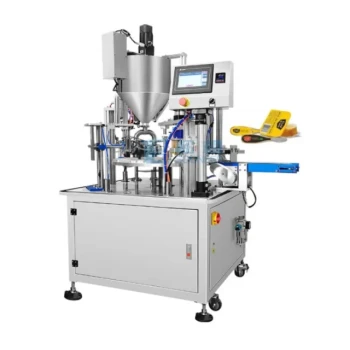
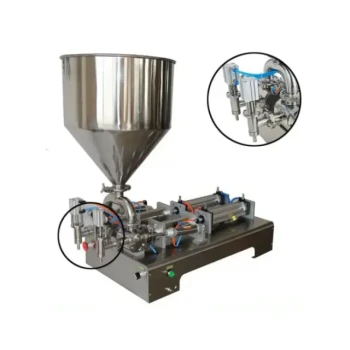
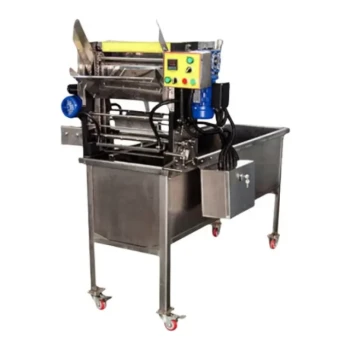
Automated honey-filling machines utilize closed-loop operations and precision metering to maintain strict quality control over honey products containing trace pesticide residues. By eliminating manual intervention, these systems prevent secondary contamination and ensure the uniform distribution of specific residues, such as lambda-cyhalothrin, across production batches.
Core Takeaway Industrial automation provides the technical consistency required for Life Cycle Impact Assessment (LCIA) compliance. By standardizing the filling process, producers can ensure that trace residues remain uniformly distributed within safety limits, preventing localized concentration spikes that could violate food safety standards.
The Role of Precision in Contaminant Management
Ensuring Residue Uniformity
When honey contains trace amounts of pesticides like lambda-cyhalothrin, the distribution of these chemicals must remain consistent. Precision metering systems dispense exact volumes, ensuring that no single unit receives a higher concentration of the product than another.
This uniformity is critical for batch testing. It guarantees that a sample taken from one jar accurately represents the chemical profile of the entire production run.
Preventing Secondary Contamination
Industrial-grade machines employ closed-loop operations. This isolates the honey from the external environment during the transfer from bulk storage to retail packaging.
By removing human contact and open-air exposure, these systems ensure that no new contaminants (biological or chemical) are introduced. This maintains the integrity of the original safety assessments performed on the raw honey.
Elevating Hygiene and Marketability
Eliminating Human Error
Manual packaging inherently introduces variability in weight and hygiene. Automated filling systems resolve the efficiency and sanitation challenges associated with post-harvest processing.
This automation transforms raw agricultural products into standardized commodities. It ensures that honey collected from high-yield regions is packaged rapidly without compromising sanitary requirements.
Standardization for Distribution
To enter commercial distribution chains, honey products must meet rigorous food hygiene standards. Automated quantitative packaging ensures the weight and purity of every unit are precise.
This consistency allows producers to achieve brand premiums. It signals to retailers and consumers that the product is stable, safe, and professionally processed.
Understanding the Trade-offs
Management vs. Remediation
It is vital to understand that filling machines do not remove pesticide residues. They simply manage the packaging of the product to ensure the existing residues do not exceed safety thresholds due to settling or poor mixing.
If the raw material exceeds safe residue limits, the filling machine cannot correct this. It is a tool for consistency, not purification.
Maintenance and Cross-Contamination
While closed-loop systems prevent external contamination, they require rigorous cleaning protocols. If not properly sanitized between batches, the machine itself can become a source of cross-contamination.
Residues from a previous batch could mix with a new, organic batch if the internal metering components are not thoroughly flushed.
Making the Right Choice for Your Production Line
To leverage automated filling for quality control effectively, align your equipment choice with your specific operational goals:
- If your primary focus is Regulatory Compliance (LCIA): Prioritize machines with high-precision metering and advanced closed-loop systems to guarantee the absolute uniformity of residue concentrations required for safety assessments.
- If your primary focus is Commercial Scale: Prioritize machines with high-throughput capabilities and automated cleaning cycles to handle large volumes from high-yield regions while minimizing downtime and hygiene risks.
Automated filling is not just about speed; it is the control mechanism that turns a variable raw material into a safe, compliant consumer product.
Summary Table:
| Feature | Quality Control Benefit | Impact on Pesticide Residue Management |
|---|---|---|
| Precision Metering | Eliminates volume variability | Ensures uniform distribution of residues; prevents concentration spikes |
| Closed-Loop System | Isolates honey from external air | Prevents secondary biological or chemical contamination |
| Quantitative Packaging | Standardized weight & purity | Guarantees compliance with food safety standards and LCIA metrics |
| Automated Cleaning | Reduces batch cross-over | Prevents residue transfer between organic and conventional batches |
Scale Your Apiary Success with HONESTBEE
Transitioning from manual processes to industrial automation is the key to maintaining the rigorous food safety standards required for global distribution. At HONESTBEE, we specialize in empowering commercial apiaries and distributors with high-precision machinery designed for the modern market.
Our Value to You:
- Advanced Honey-Filling Machines: Ensure absolute residue uniformity and eliminate human error with our closed-loop, precision-metered systems.
- Comprehensive Wholesale Portfolio: From hive-making and honey-filling machines to a full spectrum of beekeeping tools and industry consumables.
- Expert Support: We help you transform raw agricultural products into premium, standardized commodities that command market trust.
Ready to elevate your production line and ensure total product integrity? Contact HONESTBEE today to explore our comprehensive equipment and hardware solutions.
References
- Eleonora Crenna, Peter Fantke. Characterizing honey bee exposure and effects from pesticides for chemical prioritization and life cycle assessment. DOI: 10.1016/j.envint.2020.105642
This article is also based on technical information from HonestBee Knowledge Base .
Related Products
- Fully Automatic Honey Filling Packaging Machine for Processing Line
- Automatic Honey Filling and Filtering Machine for Beekeeping Bottle Filling
- Precision Durable Efficient HONESTBEE Rotary Honey Filling Machine
- Precision Automated Packaging Turntable Honey Spoon Filling Sealing Packing Machine
- Automatic Single-Dose Snap & Squeeze Honey Sachets Packing Machine
People Also Ask
- Why are fully automatic honey filling and packaging lines essential? Boost Your Honey's Market Value and Quality
- What is a fully-automatic honey filler? Streamline Your Production with High-Precision Automation
- How do automated honey filling and packaging machines affect profitability? Boost Margins with HONESTBEE Technology
- How do automated honey filling and packaging machines contribute to the market value of honey products? Maximize Your ROI
- How do industrial-grade automated honey filling and packaging machines mitigate the risk of physical contamination?