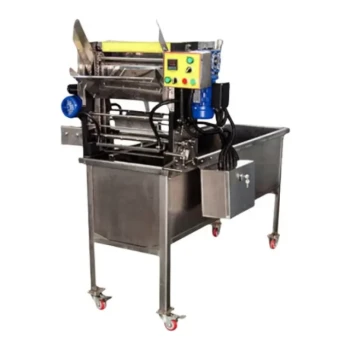
Automated honey filling machines serve as the critical bridge between raw harvest and commercial viability in the forest honey value chain. They contribute to the final packaging stage by executing high-precision quantitative filling and automatic sealing, which drastically reduces the risk of secondary pollution and ensures the product meets rigorous hygiene standards for distribution.
While increased efficiency is an obvious benefit, the true value of automation lies in standardization and preservation. By creating a controlled filling environment, these machines transform variable natural forest honey into a consistent, shelf-stable, and export-grade commercial product without compromising its delicate natural properties.
Preserving Product Integrity
In the forest honey value chain, the "final mile" of packaging is where quality is most often lost. Automation mitigates the risks inherent in manual processing.
Eliminating Secondary Contamination
Manual handling introduces biological risks, including bacteria and foreign particles. Automated systems operate in a closed or sterile environment, virtually eliminating human contact with the product.
This ensures the honey remains pure from the filtration tank to the sealed bottle. It is a strict requirement for meeting food safety standards in international markets.
Controlling Moisture and Aroma
Forest honey is highly sensitive to the environment; it is hygroscopic (absorbs moisture) and contains volatile aromatic compounds. Prolonged exposure to air during manual filling degrades quality.
Automated machines speed up the process and seal containers immediately. This minimizes air exposure, preserving the honey's distinct floral aroma and preventing fermentation caused by excess moisture absorption.
Enhancing Commercial Value
Beyond hygiene, the machine’s role is to convert a raw agricultural commodity into a standardized retail good.
Precision Quantitative Filling
Markets demand consistency. Automated machines utilize high-precision volumetric or mass-based metering to dispense the exact same amount of honey into every container.
This prevents material loss (overfilling) and compliance issues (underfilling). It ensures that a "500g" jar contains exactly 500g, building consumer trust.
Professional Aesthetic Standards
The visual appeal of the product is critical for high-end retail positioning. Automated capping ensures clean, tight seals without the sticky residue often left by manual pouring.
This standardized appearance signals quality to the consumer. It allows forest honey producers to compete directly with established global brands on supermarket shelves.
Understanding the Trade-offs
While automation offers immense benefits, it requires a strategic approach to implementation.
Capital vs. Volume
Automated lines represent a significant upfront investment. For small-scale apiaries with low output, the cost may outweigh the efficiency gains compared to semi-automatic or manual methods.
Maintenance and Flexibility
These machines require technical expertise to maintain and calibrate. Furthermore, changing bottle sizes or shapes often requires retooling, which can reduce flexibility for producers who offer many different package types.
Making the Right Choice for Your Goal
The decision to automate should align with your specific position in the value chain.
- If your primary focus is entering premium export markets: Prioritize machines with sterile filling environments to guarantee the hygiene certifications and extended shelf life required for international shipping.
- If your primary focus is scaling domestic mass-market supply: Prioritize high-throughput machines with mass-based metering to maximize speed and eliminate product giveaway (overfilling).
Automating the packaging stage is not merely a logistical upgrade; it is the technological guarantee of purity required to fully monetize high-value forest honey.
Summary Table:
| Feature | Manual Filling | Automated Filling | Value Contribution |
|---|---|---|---|
| Hygiene Control | High risk of contamination | Closed/Sterile environment | Meets international food safety standards |
| Filling Precision | Variable/Inconsistent | High-precision metering | Eliminates product loss & ensures compliance |
| Aroma Preservation | High air exposure | Rapid, sealed process | Maintains delicate floral profiles & moisture levels |
| Output Aesthetic | Manual capping/Residue | Standardized tight seals | Enhances premium retail positioning |
| Scale Suitability | Small-scale/Local | High-volume/Export | Drives commercial viability and scalability |
Scale Your Apiary Operations with HONESTBEE
Transitioning from manual processing to professional automation is the key to unlocking premium honey markets. HONESTBEE specializes in empowering commercial apiaries and distributors with high-performance honey-filling machines and integrated hive-making technology.
Our comprehensive wholesale portfolio is designed to enhance your efficiency and product integrity—from specialized beekeeping tools to advanced industrial machinery. Whether you are scaling domestic supply or targeting high-end export markets, we provide the hardware and industry consumables you need to succeed.
Ready to elevate your production standards?
Contact HONESTBEE experts today to discover how our equipment can transform your honey value chain.
References
- Janet Lowore, Adrian Wood. African Forest Honey: an Overlooked NTFP with Potential to Support Livelihoods and Forests. DOI: 10.1007/s00267-018-1015-8
This article is also based on technical information from HonestBee Knowledge Base .
Related Products
- Fully Automatic Honey Filling Packaging Machine for Processing Line
- Automatic Honey Filling and Filtering Machine for Beekeeping Bottle Filling
- Precision Durable Efficient HONESTBEE Rotary Honey Filling Machine
- Semi Automatic Small Honey Bottle Filling Machine Honey Filler
- Precision Automated Packaging Turntable Honey Spoon Filling Sealing Packing Machine
People Also Ask
- Why are fully automatic honey filling and packaging lines essential? Boost Your Honey's Market Value and Quality
- What is a fully-automatic honey filler? Streamline Your Production with High-Precision Automation
- How do automated honey filling and packaging machines affect profitability? Boost Margins with HONESTBEE Technology
- How do automated honey filling and packaging machines contribute to the market value of honey products? Maximize Your ROI
- How do industrial-grade automated honey filling and packaging machines mitigate the risk of physical contamination?