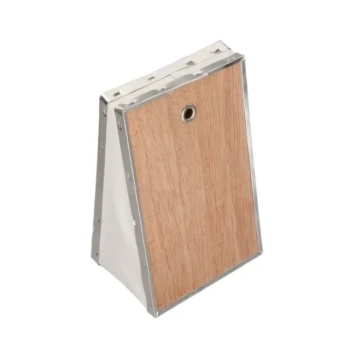
Bee smoking tools operate as a precision displacement mechanism that clears visual obstructions on the honeycomb. By directing smoke specifically at the lower edges of the comb, the inspector induces the bees to temporarily relocate, instantly revealing the underlying architecture and biological developments without physical contact.
The core utility of the smoking tool is its ability to expose critical hive data without disrupting the colony's infrastructure. It allows for a non-invasive "X-ray" view of the comb edges, ensuring accurate data collection while preserving the honeycomb's structural integrity.
The Mechanism of Displacement
Inducing Bee Movement
The smoke acts as a temporary driving mechanism rather than a sedative in this context. When applied, it triggers an immediate reaction that compels the bees to retreat from the area of application. This creates a clear window of visibility on the comb surface.
Targeting the Lower Edge
Effective inspection requires applying smoke specifically to the lower edge of the honeycomb. Bees naturally cluster densely in these areas, often completely obscuring the comb's boundaries. Targeted smoking forces this dense covering to shift upwards or away from the edge.
Enhancing Inspection Accuracy
Exposing Hidden Queen Cells
The primary goal of this displacement is to reveal hidden queen cells. These cells are often located along the comb margins and can be easily missed when covered by a thick layer of bees. Clearing the area ensures an accurate count of developing queens.
Observing Emergence Status
Beyond simple counting, visibility allows for detailed observation of the emergence status of new queens. Inspectors can assess the maturity of the cells and predict emergence timelines. This level of detail is impossible to obtain when the visual field is blocked by the colony population.
Understanding the Trade-offs
Non-Destructive vs. Temporary
The major advantage of this method is that it avoids damaging the honeycomb structure. Unlike physical scraping or shaking, smoking leaves the wax and brood intact. However, the effect is strictly temporary; inspectors must work efficiently before the bees return to cover the exposed areas.
Making the Right Choice for Your Goal
The use of smoke is a balancing act between visibility and disturbance. Use the following guidelines to align your technique with your inspection goals:
- If your primary focus is accurate inventory: Apply smoke strictly to the lower edges to reveal every potential queen cell hiding behind the bee mass.
- If your primary focus is structural preservation: Prioritize the use of smoke over physical manipulation to inspect the comb without risking damage to the delicate wax or developing brood.
Mastering the use of the smoker as a driving tool is essential for obtaining precise biological data without compromising the physical integrity of the hive.
Summary Table:
| Feature | Mechanism/Action | Inspection Benefit |
|---|---|---|
| Displacement | Induces bees to retreat from targeted areas | Creates a clear window of visibility on the comb surface |
| Targeted Smoking | Applying smoke to the lower honeycomb edges | Exposes hidden queen cells often obscured by dense clusters |
| Non-Invasive | No physical contact or scraping required | Preserves the structural integrity of wax and developing brood |
| Status Assessment | Detailed visual access to cell margins | Allows for accurate prediction of queen emergence timelines |
Elevate Your Apiary Operations with HONESTBEE
Maximize your inspection efficiency and hive health with professional-grade equipment from HONESTBEE. We specialize in providing commercial apiaries and distributors with a comprehensive range of wholesale beekeeping solutions. From high-performance bee smoking tools and honey-filling machines to specialized hive-making hardware and essential industry consumables, our portfolio is designed to meet the rigorous demands of large-scale beekeeping.
Partner with us to access premium tools that ensure accurate biological data collection and structural preservation for your colonies. Contact us today to explore our wholesale catalog and discover how we can support your business growth!
References
- J. Woyke, Maria Wilde. Swarming and Migration of Apis dorsata and Apis laboriosa Honey Bees in India, Nepal and Bhutan. DOI: 10.2478/v10289-012-0009-7
This article is also based on technical information from HonestBee Knowledge Base .
Related Products
- European Stainless Steel Bee Smoker for Honey Bee Hive
- Economy Galvanized Beekeeping Honey Bee Smoker for Wholesale
- Stainless Steel Honey Bee Smoker Hive and Honeycomb Smoker for Beekeeping
- Heavy Duty Manual Bee Smoker Blower for Beekeeping
- Professional Replacement Bee Smoker Bellows for Beekeeping Equipment
People Also Ask
- What type of bee smoker is recommended for a beginner? Top Picks for Easy Hive Management
- Why is a stainless steel bee smoker considered indispensable? Master Hive Management with Cool Smoke Technology
- What are bee smokers made out of? Choose the Right Material for Your Apiary
- What are the differences between stainless steel and galvanized steel bee smokers? Choose the Right Smoker for Your Apiary
- What is the technical necessity of using bee smokers? Essential Tools for Safe and Efficient Hive Management