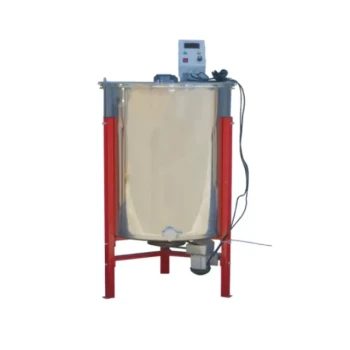
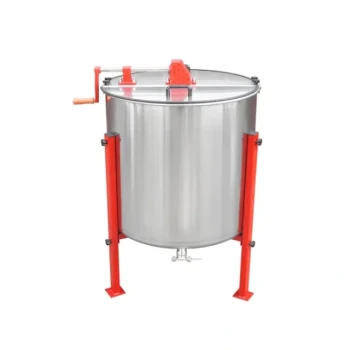
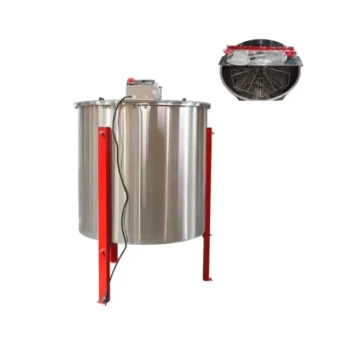
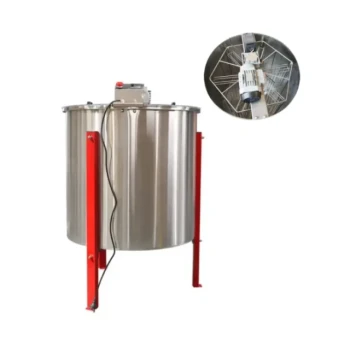
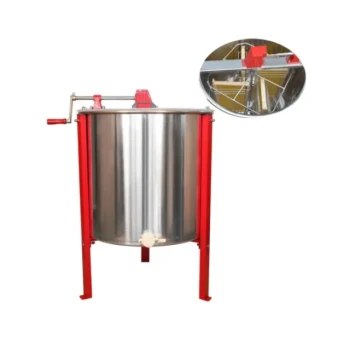
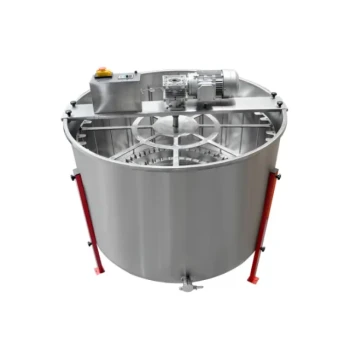
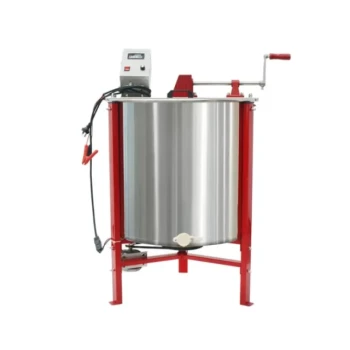
Centrifugal honey extractors utilize high-speed rotation to separate liquid honey from the comb through purely mechanical means. By spinning uncapped frames at speeds reaching up to 300 rpm, the machine generates sufficient centrifugal force to pull honey out of the cells while leaving the delicate wax structure physically untouched.
The definitive advantage of centrifugal extraction is not just speed, but the preservation of the comb for immediate reuse. By eliminating the need for bees to rebuild wax, apiaries significantly reduce energy expenditure and shorten the production cycle between harvests.
The Mechanics of Preservation and Efficiency
Generating Controlled Centrifugal Force
The core mechanism relies on rotational physics rather than direct pressure. As the extractor spins the frames, centrifugal force pushes the honey outward, overcoming the surface tension holding it inside the comb cells.
Because the force is applied evenly across the frame, the liquid is expelled without crushing the cell walls. High-precision industrial models often feature rotational balance control to maintain stability, ensuring the force is strong enough to extract mature honey but gentle enough to prevent frame breakage.
Avoiding Thermal and Physical Damage
Unlike traditional methods such as pressing or sun-melting, centrifugal extraction operates without destroying the wax matrix. Pressing involves crushing the comb, which inherently ruins the structure bees worked to build.
Furthermore, this method avoids the use of heat. High temperatures can degrade the honey’s active ingredients and natural flavor profile. By relying solely on mechanical force, the extractor maintains the specific physicochemical indicators of the honey.
The Operational Impact on the Hive
Accelerating Production Cycles
The most critical efficiency gain occurs after the extraction is finished. Because the wax combs remain intact, they can be returned immediately to the hive.
This bypasses the time-consuming process where bees must secrete new wax to rebuild the comb structure. Consequently, the colony can shift its focus back to foraging and storing nectar, significantly shortening the overall honey production cycle.
Energy Conservation for the Colony
Building wax is an energy-intensive task for bees. It requires the consumption of large amounts of honey and calories that could otherwise be stored.
By preserving the comb, you are effectively conserving the hive's energy resources. This allows the bees to utilize existing infrastructure, maximizing their productivity for the current season.
Understanding the Trade-offs
The Necessity of Post-Processing
While centrifugal extraction is efficient, it does not produce bottled-ready honey immediately. The mechanical force may dislodge small wax particles or debris alongside the honey.
To ensure clarity, the extracted honey must be strained through a fine mesh to remove these solids. It is not a "zero-step" solution; it requires this secondary filtration to meet commercial standards.
The Requirement for Settling
The high-speed rotation introduces air into the liquid. Following filtration, the honey requires a settling period, typically one to two days.
This allows air bubbles and fine impurities to rise to the surface for removal. While the extraction is fast, the total time-to-market must account for this necessary settling phase to achieve high purity.
Making the Right Choice for Your Goal
Centrifugal extraction is the industry standard for a reason, but understanding your specific objectives will help you maximize its utility.
- If your primary focus is Production Volume: Prioritize the immediate return of wet, empty combs to the hive to minimize the "downtime" between honey flows.
- If your primary focus is Honey Quality: Utilize the adjustable force settings to extract without heat, preserving the unique flavor compounds and enzymatic activity of the honey.
By treating the honeycomb as a reusable asset rather than a disposable resource, you transform the extraction process from a destructive harvest into a sustainable cycle.
Summary Table:
| Feature | Centrifugal Extraction | Traditional Pressing |
|---|---|---|
| Mechanism | Centrifugal Force (Mechanical) | Physical Compression |
| Comb Integrity | Preserved (Reusable) | Destroyed (Must rebuild) |
| Heat Usage | None (Preserves enzymes) | Often required (May degrade quality) |
| Processing Speed | High (Up to 300 rpm) | Low |
| Production Cycle | Shortened (Immediate return to hive) | Long (Bees must rebuild wax) |
Maximize Your Harvest Efficiency with HONESTBEE
At HONESTBEE, we specialize in empowering commercial apiaries and distributors with high-performance beekeeping technology. Our comprehensive wholesale catalog features everything from precision-engineered honey extractors and honey-filling machines to durable hive-making machinery and essential consumables.
By choosing our centrifugal extraction solutions, you protect your hive’s most valuable asset—the comb—allowing your bees to focus on production rather than rebuilding. Whether you are scaling an industrial operation or supplying the next generation of beekeepers, our professional-grade tools ensure superior honey quality and optimized energy conservation for every colony.
Ready to upgrade your extraction workflow? Contact us today to explore our full range of wholesale beekeeping equipment and industrial machinery!
References
- Md Ektarul Islam, Faruki Shabia Maraj. Foraging behavior and honey production of Apismellifera L.. DOI: 10.3329/ajmbr.v1i2.25630
This article is also based on technical information from HonestBee Knowledge Base .
Related Products
- electric honey extractor honey centrifuge 3 frame honey extractor stainless steel honey frame extractor
- Manual Hand Crank 4 Frame Honey Extractor Centrifuge for Beekeeping
- Professional 4 Frame Self Reversing Electric Honey Extractor for Beekeeping
- 24 Frame Honey Extractor Commercial Radial Honey Frame Extraction Machine
- Electric 4 Frame Tangential Honey Extractor
People Also Ask
- What are the characteristics of electric honey extractors? Boost Your Apiary Efficiency with Automated Technology
- What are the disadvantages of using an electric honey extractor? Weighing Cost, Power, and Comb Safety
- What are the advantages of an electric honey extractor? Boost Efficiency and Scale Your Honey Production
- What are the technical advantages of electric honey extractors? Maximize Yield and Protect Your Bee Colony
- How does an electric honey extractor affect the quality of honey? Preserve Flavor & Purity with Precision Extraction