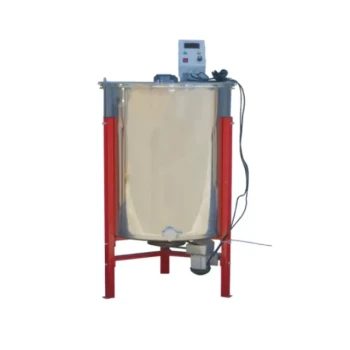
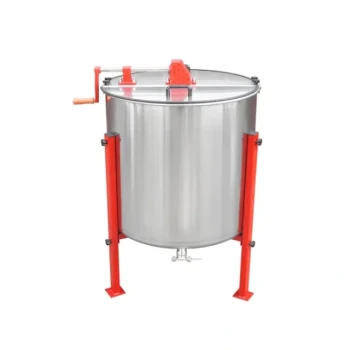
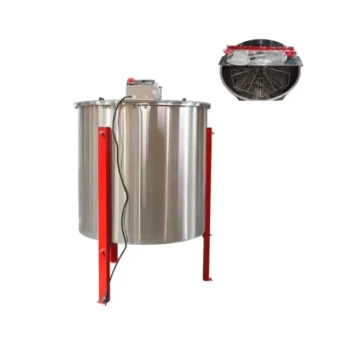
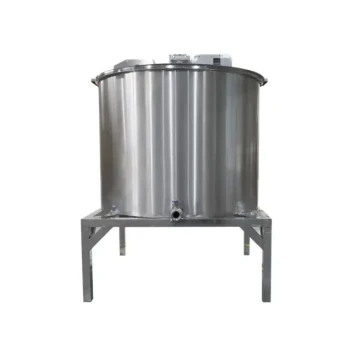
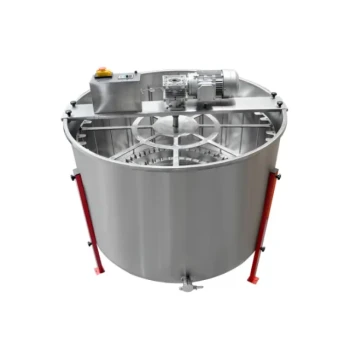
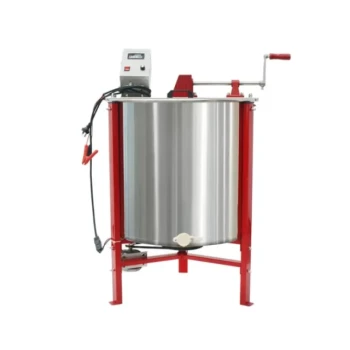
Centrifugal honey extractors leverage high-speed rotation to separate liquid honey from wax combs without damaging the structural integrity of the hive frames. By preserving the honeycomb, beekeepers can return the empty frames to the hive for immediate reuse, effectively bypassing the energy-intensive process of wax secretion and comb construction that limits colony productivity.
The primary driver of increased production is biological conservation, not just mechanical speed. By eliminating the need for bees to rebuild wax structures, the colony redirects its energy from construction to nectar collection, significantly shortening the production cycle.
The Energy Economics of the Hive
Preserving Critical Infrastructure
The most significant barrier to rapid honey production is the physical construction of the honeycomb. Bees consume significant amounts of energy and resources to secrete beeswax and build these storage structures.
Traditional harvesting methods, such as crushing or squeezing, destroy the comb, forcing the colony to start over. Centrifugal extractors remove the honey while keeping the delicate wax cells intact.
Redirecting Colony Labor
When a colony receives undamaged combs back from the extractor, they do not need to secrete new wax.
This allows the bees to immediately focus on filling the cells with nectar. This shift in labor allocation—from construction to collection—is the primary factor in substantially increasing the total annual honey yield.
Mechanical Efficiency and Cycle Speed
Acceleration of the Harvest Cycle
Centrifugal extraction drastically shortens the turnaround time between harvests.
Because the combs are returned ready for use, the preparation time for the next harvest cycle is minimized. This allows beekeepers to complete more harvest cycles within a single season.
Capitalizing on Short Flowering Periods
In commercial apiaries, nectar flows often occur during very specific, short windows of time.
High-capacity centrifugal extractors allow for rapid processing during these peak periods. By maintaining a high production turnover rate, beekeepers ensure they capture the maximum amount of honey available before the flowering season ends.
Understanding the Trade-offs
Equipment Complexity and Cost
While centrifugal extractors increase yield, they introduce a level of complexity compared to manual methods. Beekeepers must invest in professional machinery, which requires maintenance and power sources (for electric models) that traditional gravity or crush methods do not.
Operational Precision Required
The process relies on "centrifugal force," but it requires careful operation to avoid damaging the frames.
While the goal is to save the comb, incorrect speeds or imbalanced loads can still cause damage. Operators must balance the need for thorough extraction with the need to preserve the wax structure, though modern industrial-grade machines are designed to optimize this balance.
Making the Right Choice for Your Goal
To maximize the benefits of centrifugal extraction, align your approach with your specific production targets:
- If your primary focus is Maximum Annual Yield: Prioritize returning wet, intact combs to the hive immediately after extraction to stimulate rapid refilling by the colony.
- If your primary focus is Commercial Scalability: Invest in high-capacity equipment that matches the peak flow of your local flora to prevent production bottlenecks during short bloom windows.
By treating the honeycomb as a permanent asset rather than a disposable resource, you transform the biological focus of your hive from construction to pure production.
Summary Table:
| Feature | Impact on Production | Benefit for Beekeepers |
|---|---|---|
| Comb Preservation | Eliminates the need for bees to secrete new wax | Redirects colony labor to 100% nectar collection |
| High-Speed Rotation | Rapidly separates honey from frames without damage | Enables faster harvest cycles and higher turnover |
| Infrastructure Reuse | Frames are returned to hives for immediate refilling | Bypasses energy-intensive comb construction phase |
| Peak Flow Capture | Processes large volumes during short bloom windows | Maximizes yields from seasonal nectar flows |
Scale Your Honey Production with HONESTBEE Professional Equipment
To truly capitalize on peak nectar flows and maximize your annual yield, you need reliable, industrial-grade machinery. HONESTBEE specializes in supporting commercial apiaries and distributors by providing a full spectrum of beekeeping tools and advanced machinery—from high-capacity centrifugal extractors to precision honey-filling and hive-making machines.
By partnering with us, you gain access to a comprehensive wholesale portfolio of essential industry consumables and specialized hardware designed to transform your honeycomb from a disposable resource into a permanent asset.
Ready to optimize your apiary's efficiency? Contact our expert team today to discuss how our professional equipment can drive your commercial growth.
References
- Nuhfil Hanani, Mohammad Ilyas Shaleh. PEMBERDAYAAN PETANI TEMBAKAU MELALUI DIVERSIFIKASI BUDIDAYA PETERNAKAN LEBAH MADU DI KABUPATEN PROBOLINGGO JAWA TIMUR. DOI: 10.20956/jdp.v9i2.27831
This article is also based on technical information from HonestBee Knowledge Base .
Related Products
- electric honey extractor honey centrifuge 3 frame honey extractor stainless steel honey frame extractor
- Manual Hand Crank 4 Frame Honey Extractor Centrifuge for Beekeeping
- Professional 4 Frame Self Reversing Electric Honey Extractor for Beekeeping
- 24 Frame Honey Extractor Commercial Radial Honey Frame Extraction Machine
- Electric 4 Frame Tangential Honey Extractor
People Also Ask
- What are the characteristics of electric honey extractors? Boost Your Apiary Efficiency with Automated Technology
- What are the disadvantages of using an electric honey extractor? Weighing Cost, Power, and Comb Safety
- What are the advantages of an electric honey extractor? Boost Efficiency and Scale Your Honey Production
- What are the technical advantages of electric honey extractors? Maximize Yield and Protect Your Bee Colony
- How does an electric honey extractor affect the quality of honey? Preserve Flavor & Purity with Precision Extraction