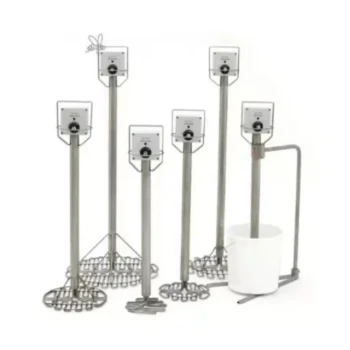
Laboratory heating and mixing devices enhance accuracy by maintaining honey and diluents at specific, controlled temperatures. This thermal regulation significantly reduces the natural viscosity of the honey, allowing for the uniform distribution of suspended particles—such as pollen grains and internal standards—during the homogenization process, thereby preventing statistical bias caused by uneven sedimentation.
The core function of these devices is to optimize the physical state of the honey before analysis begins. By dissolving crystals, eliminating air bubbles, and ensuring homogeneity, they create a representative sample that eliminates physical variables capable of skewing analytical results.
Optimizing Physical Consistency for Homogenization
Reducing Viscosity Barriers
Honey is naturally viscous, which resists flow and inhibits mixing. By maintaining samples at a specific warm temperature (typically 35-40 degrees Celsius), heating devices lower this viscosity.
This physical change is the prerequisite for all subsequent analysis. It allows the sample to behave like a fluid rather than a semi-solid, enabling mechanical mixers to function effectively.
Ensuring Representative Pollen Distribution
The primary reference highlights that high viscosity causes uneven suspension of particulate matter. Without adequate heating and mixing, pollen grains may clump or settle irregularly.
This leads to statistical bias. If the pollen is not uniformly distributed, the aliquot taken for analysis will not represent the whole, rendering microscopic counts inaccurate.
Eliminating Stratification
Sedimentation is a major threat to data integrity. Thorough mixing ensures that heavy particles do not sink to the bottom of the container.
This guarantees that every drop of the sample contains a consistent ratio of honey matrix to suspended solids.
Enhancing Optical and Analytical Clarity
Removing Physical Interferences
For optical measurements, physical imperfections in the sample act as noise. Heating the sample to 40 degrees Celsius serves to dissolve sugar crystals and drive out trapped air bubbles.
Improving Digital Imaging
When the honey is free of crystals and bubbles, its optical path is clear. This is critical for color analysis and digital image acquisition.
By removing these obstructions, the devices ensure that color data reflects the true pigmentation of the honey, rather than light refraction from air or solids.
Improving Chemical Precision
In chemical analysis, laboratories often introduce "internal standard spikes" to calibrate their instruments. High viscosity prevents these spikes from mixing evenly into the matrix.
By reducing viscosity, heating devices allow these chemical standards to be uniformly distributed, ensuring that the final chemical readout is precise and reproducible.
Understanding the Trade-offs
The Necessity of Temperature Limits
While heating is essential, the references specify a narrow range of 35-40 degrees Celsius. This is a critical operational constraint.
Avoiding Thermal Damage
Exceeding these temperatures can chemically alter the honey. The goal is to change the physical state (viscosity/clarity) without degrading the chemical composition.
Time Management
The process requires maintaining this temperature for "several minutes." Rushing this step results in incomplete homogenization, while extending it unnecessarily risks altering sensitive compounds.
Establishing a Robust Pretreatment Protocol
To maximize the accuracy of your honey analysis, tailor your heating and mixing approach to your specific analytical end-goal.
- If your primary focus is Pollen Analysis (Melissopalynology): Prioritize viscosity reduction to prevent sedimentation, ensuring the suspension remains uniform during the aliquoting process.
- If your primary focus is Color Grading: Focus on the elimination of air bubbles and the complete dissolution of sugar crystals to prevent light scattering.
- If your primary focus is Chemical/Residue Analysis: Ensure sufficient agitation time at 35-40°C so that internal standard spikes are perfectly homogenized within the matrix.
Controlled thermal pretreatment is the invisible baseline that supports the validity of every subsequent test result.
Summary Table:
| Feature | Function in Honey Pretreatment | Impact on Analytical Accuracy |
|---|---|---|
| Temperature Control | Reduces viscosity (35-40°C) | Prevents clumping and sedimentation of pollen grains |
| Homogenization | Uniformly distributes particles | Eliminates statistical bias in aliquoting and sampling |
| Crystal Dissolution | Liquefies granulated sugars | Removes optical interference for color and clarity tests |
| Degassing | Eliminates trapped air bubbles | Improves digital imaging and light path for measurements |
| Chemical Agitation | Integrates internal standards | Ensures precise calibration for chemical and residue analysis |
Elevate Your Honey Quality Standards with HONESTBEE
Precision in the lab translates to value in the market. At HONESTBEE, we specialize in empowering commercial apiaries and distributors with the tools needed for excellence. From specialized honey-filling and hive-making machinery to a full spectrum of beekeeping equipment and consumables, we provide the comprehensive wholesale solutions your business demands.
Whether you are scaling up production or refining your quality control, our industry-leading hardware and honey-themed cultural merchandise are designed to enhance your brand's authority. Contact us today to discover how our tailored equipment solutions can streamline your operations and deliver superior results to your customers.
References
- Reynaldo González-Sandoval, Francisco Alberto Palemón. ANÁLISIS PALINOLÓGICO DE LOS RECURSOS FLORALES UTILIZADOS POR Apis mellifera L. (HYMENOPTERA:APIDAE) EN CUATRO MUNICIPIOS DEL ESTADO DE GUERRERO, MÉXICO. DOI: 10.56369/tsaes.1837
This article is also based on technical information from HonestBee Knowledge Base .
Related Products
- Double Wall Honey Heating Stirring Homogenizer Mixing Machine with Various Capacity
- Honey Concentrating Vacuum Heating Thickening Machine Dehumidifier for Honey
- Professional Thermostatic Conical Honey Melter
- Stainless Steel Heated Honey Tank Warming Heating Tank
- Economy Honey Homogenizer Mixer and Melting Machine for Beekeeping
People Also Ask
- What impact do homogenizers or oscillating equipment have on honey microbial detection? Ensure Testing Accuracy
- Why is thorough mechanical stirring and homogenization emphasized in honey processing? Ensure Sample Accuracy
- How do heating equipment and homogenizers liquefy crystallized honey? Expert Guide to Professional Honey Processing
- How does the honey mixer handle different types of honey? Master Viscosity for Perfect Blends
- What are the main components of the honey mixer? Engineered for Gentle, Efficient Honey Processing