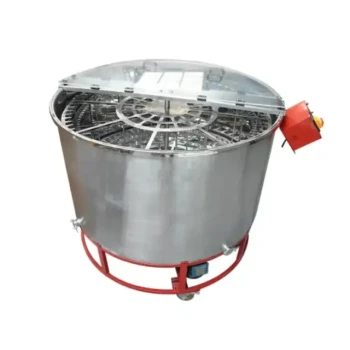
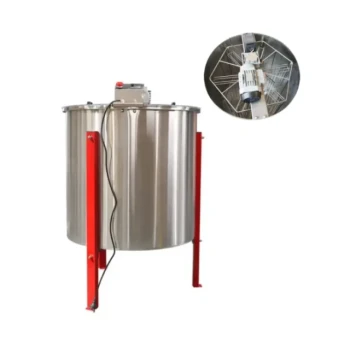
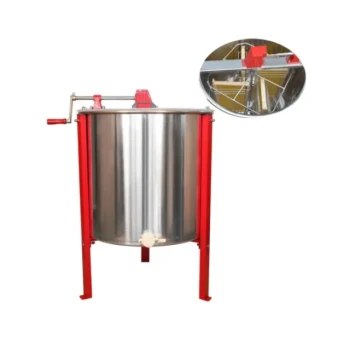
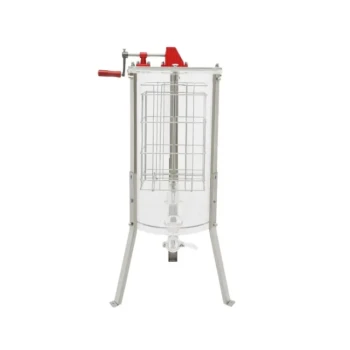
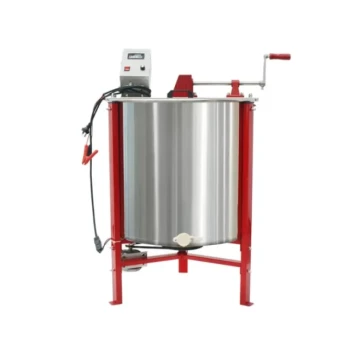
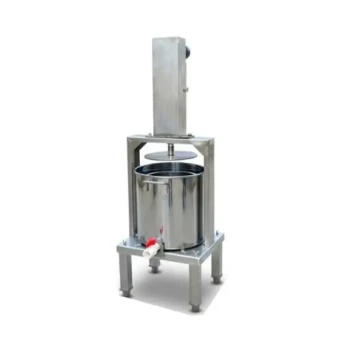
Manual and automatic honey extractors use the same basic principle: they spin honey-filled frames so centrifugal force removes honey without destroying the wax comb. A manual extractor is turned by hand and suits small apiaries, while an automatic extractor uses an electric motor to reduce labor and increase throughput for larger operations.
The right choice depends less on the extractor’s basic function than on the apiary’s harvest volume, available labor, budget, and growth plans. Manual equipment minimizes purchase cost and mechanical complexity; automatic equipment saves substantial time when many frames must be processed.
How Honey Extractors Work
The role of centrifugal force
After honey frames are placed inside the extractor, the basket rotates around a central axis. Centrifugal force draws honey out of the cells and onto the extractor’s interior wall.
The honey then flows downward and can be collected through the outlet. Because the wax comb remains largely intact, frames can be returned to the hive instead of being rebuilt by the bees.
Why comb preservation matters
Bees spend considerable time and energy producing new wax. Reusing drawn comb allows them to direct more resources toward colony development and honey production.
This benefit depends on correct handling. Excessive speed, unsuitable frame positioning, or damaged comb can still cause breakage, regardless of whether the extractor is manual or automatic.
How Manual Honey Extractors Function
Hand-powered operation
A manual extractor uses a handle or hand crank connected to the frame basket. The beekeeper turns the crank, causing the frames to rotate and release honey through centrifugal force.
The operator controls the rotation speed and typically adjusts the process according to the frame condition and extraction progress.
Where manual equipment fits best
Manual extractors are generally appropriate for small apiaries, hobbyists, and beginner beekeepers. They offer a straightforward operating principle without a motor, electronic controls, or motor-related maintenance.
They are also useful where harvesting is occasional and the beekeeper does not need to process large batches quickly.
The labor requirement
The main limitation is physical effort. The operator must continue cranking during extraction, and processing a larger number of frames can become tiring and time-consuming.
For a beekeeper with limited labor or a narrow harvesting window, the lower purchase price may not compensate for the additional work.
How Automatic Honey Extractors Function
Motor-driven extraction
An automatic extractor uses an electric motor to rotate the frame basket. Once the frames are loaded and the machine is started, the motor performs the spinning process with minimal manual intervention.
Many automatic models provide speed control, helping the operator use a more consistent extraction cycle.
Where automatic equipment fits best
Automatic extractors are designed for higher-volume harvesting and professional operations. They reduce repetitive labor and allow workers to process more frames in less time.
This makes them particularly valuable for commercial apiaries, honey-processing businesses, and operations expecting production to increase.
Consistency and workflow
Motorized operation can provide more consistent rotation than hand cranking. It also makes the extraction stage easier to integrate into a broader workflow involving multiple workers or other processing equipment.
Automation does not eliminate the need for supervision. Frames still need to be loaded correctly, inspected, and handled carefully to protect the comb and maintain hygienic operation.
The Decision Factors That Matter Most
Harvest volume
The amount of honey and number of frames processed per harvest should be the starting point. A few hives may be manageable with manual equipment, while larger batches can quickly make manual extraction inefficient.
The “more than ten hives” guideline can be a useful initial reference, but it is not a universal cutoff. Frame count, harvest frequency, available labor, and target processing time are more meaningful than hive count alone.
Labor and time
Manual equipment is suitable when the beekeeper is comfortable doing hands-on work and has sufficient time for extraction. It can also support a traditional, involved harvesting process.
Automatic equipment becomes more attractive when labor is limited, harvesting must be completed quickly, or the operation has staff whose time is better allocated elsewhere.
Initial cost and operating complexity
Manual extractors generally have a lower purchase cost and simpler mechanical construction. Their straightforward design can also make operation and basic troubleshooting easier.
Automatic extractors require a larger initial investment and include motorized components that need appropriate care. Their value comes from labor savings and higher processing capacity, not simply from owning more advanced equipment.
Future growth
An extractor should be selected for the apiary’s likely workload over its useful planning horizon, not only for the current season. Buying equipment that is too small may create bottlenecks as colony numbers or customer demand increase.
For distributors and resellers, offering both categories is often more practical than promoting one as universally superior. Customers have materially different needs based on scale, budget, labor availability, and expansion plans.
Understanding the Trade-offs
Manual extractors: lower cost, higher effort
The main advantages of manual extractors are affordability, simplicity, and direct operator control. They are often the sensible choice for small-scale beekeeping where extraction speed is not a priority.
The trade-off is slower processing and greater physical effort. As volume rises, the operator may spend substantially more time on a task that an automatic machine can perform with limited intervention.
Automatic extractors: higher productivity, higher investment
Automatic extractors reduce repetitive labor and support faster, more consistent processing. For commercial users, these benefits can justify the higher purchase price.
However, automatic models are more mechanically complex. They require suitable electrical operation, regular maintenance, and attention to motor and control components.
Durability depends on care
Manual designs may have fewer components that can fail, but simplicity does not guarantee indefinite service. Corrosion, poor cleaning, overloading, and rough handling can shorten the life of any extractor.
Automatic equipment can also provide many years of service when properly maintained. Durability should therefore be evaluated alongside material quality, construction, maintenance support, replacement parts, and supplier responsiveness.
Avoid choosing by price alone
The cheapest extractor may become expensive if it creates labor bottlenecks or must be replaced when the apiary expands. Conversely, the most automated model may be unnecessary for a small operation that harvests only occasionally.
A sound comparison should consider total operating value: purchase cost, labor demand, expected throughput, maintenance requirements, and the cost of delayed processing.
How to Apply This to Your Apiary
Compare the following factors before selecting a model: expected frame volume, harvest frequency, available labor, required processing speed, budget, cleaning and maintenance capability, and anticipated growth.
- If your primary focus is low-cost, small-scale extraction: Choose a manual extractor that matches your frame format and expected batch size, provided you are comfortable with the additional time and physical effort.
- If your primary focus is productivity and reduced labor: Choose an automatic extractor with suitable capacity and speed control for your expected harvest volume.
- If your primary focus is future expansion: Evaluate equipment against projected frame volume rather than current hive numbers, and prioritize a model that will not become an immediate processing bottleneck.
- If your primary focus is product sourcing or resale: Maintain a portfolio of manual and automatic options, supported by reliable technical guidance, responsive service, available parts, and efficient order fulfillment.
The best extractor is the one whose capacity, labor profile, and total cost align with the apiary’s real operating goals.
Summary Table:
| Feature | Manual Extractor | Automatic Extractor |
|---|---|---|
| Power Source | Hand crank | Electric motor |
| Best For | Small apiaries, hobbyists | Large operations, commercial |
| Labor | High (continuous cranking) | Low (minimal intervention) |
| Throughput | Low | High |
| Cost | Lower initial investment | Higher initial investment |
| Maintenance | Simpler | More complex (motor/electronics) |
Whether you run a small apiary or a large commercial operation, HONESTBEE offers a full range of manual and automatic honey extractors to match your needs. As a trusted wholesale supplier for beekeepers, distributors, and resellers, we provide competitive pricing, OEM/ODM support, certified quality, and fast order fulfillment to keep your business thriving. Contact our team today to find the perfect extractor for your apiary and boost your honey production efficiency. Get in touch with us now!
Related Products
- HONESTBEE 72 Frame Industrial Electric Honey Extractor for Beekeeping
- Commercial Electric 12 Frame Honey Extractor Spinner Motorized Honey Extractor
- HONESTBEE 3-Frame Manual Acrylic Honey Extractor
- electric honey extractor honey centrifuge 3 frame honey extractor stainless steel honey frame extractor
- HONESTBEE 6 Frame Self Reversing Electric Honey Extractor for Beekeeping
People Also Ask
- What is the importance of balancing honeycomb frames within a honey extractor? Ensure Stability and Protect Machinery
- How is honey separated from the frames after they are uncapped? Efficient Extraction Methods for High Yields
- What are the main benefits of using a honey extractor? Maximize Yields and Protect Your Honeycomb
- What are the recommended methods for removing honey from the honeycomb? Top Extraction Techniques for Maximum Efficiency
- How do manual honey extractors compare to electric honey extractors? Choosing the Right Tool for Your Apiary Growth