Standardized beehive frames function as precise spatial benchmarks that allow beekeepers and researchers to convert visual observations into quantifiable data. By estimating the percentage of adult bee coverage and counting specific brood cells on these uniform structures, technicians can objectively calculate a colony's reproductive capacity and total population size.
By providing a fixed, uniform surface area, standardized frames transform the chaotic biology of a bee colony into measurable indices. This allows for the objective tracking of population growth and the identification of health impacts caused by pathogens.
The Mechanics of Frame-Based Assessment
Quantifying Population Density
The primary method for evaluating colony strength involves estimating adult bee coverage. Because the surface area of a standardized frame is constant, technicians can assess what percentage of the frame is covered by bees.
This visual data allows for the calculation of the total adult population size. It provides an immediate snapshot of the workforce available for foraging and hive maintenance.
Measuring Reproductive Potential
Frames act as a canvas for analyzing the colony's future growth. Technicians count or estimate the number of capped and uncapped brood cells present on the frame surface.
High ratios of healthy brood indicate a strong reproductive capacity. Conversely, spotting gaps or irregularities in the brood pattern allows assessors to quantify the negative impacts of pathogens, such as Nosema microsporidians, on colony productivity.
Applying the Liebefeld Method
To increase precision, experts often employ the Liebefeld assessment method. This technique conceptually subdivides each frame into four equal units.
Inspectors visually estimate the density of bees, brood, honey, and pollen within these quadrants. This semi-subjective approach uses the frame as a standard unit to convert complex, organic colony dynamics into comparable numerical data.
The Critical Role of Standardization
Eliminating Environmental Variables
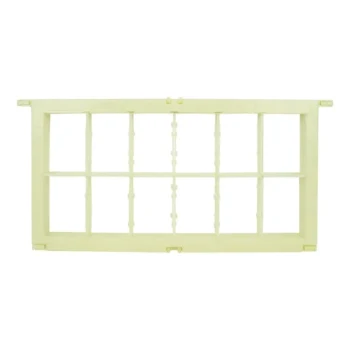
The use of fixed-dimension frames (such as the standard 366 x 222 mm or modified Langstroth sizes) ensures a uniform physical environment.
When all colonies have the same capacity and spatial constraints, researchers can confirm that differences in survival or growth are due to biological fitness and genetic traits. This rules out the possibility that variations are caused simply by having more or less room to grow.
Enabling Cross-Regional Comparison
Manufacturing technologies, such as CNC machining, ensure that frames and hive components maintain extreme uniformity across different batches and locations.
This hardware standardization is a prerequisite for broad-scale research. It allows institutions in different regions to generate comparable health indices, ensuring that a "strong colony" in one location is measured against the exact same spatial standards as one in another.
Understanding the Trade-offs
The Limit of "Snapshot" Data
While frame inspections provide excellent data on population and brood, they represent a single point in time. They do not capture dynamic daily fluctuations in foraging capacity or feed consumption.
For real-time monitoring of resource flow or immediate alarms (such as theft or winter starvation), beehive scales measuring weight fluctuations are superior to visual frame inspections.
Subjectivity in Visual Estimation
Although the frame provides a standard grid, the act of estimating coverage (e.g., "75% covered") retains an element of human subjectivity.
Methods like Liebefeld reduce this error by subdividing the frame, but consistency requires training. Technicians must be skilled in distinguishing between healthy brood and disease symptoms, such as the sunken cappings of American Foulbrood (AFB) or larval discoloration from European Foulbrood (EFB).
How to Apply This to Your Project
When establishing protocols for colony health assessment, select your metrics based on your specific end goal:
- If your primary focus is quantification of colony strength: Prioritize measuring the percentage of adult bee coverage and the ratio of capped to uncapped brood to calculate reproductive capacity.
- If your primary focus is comparative research: Ensure all hardware is CNC-machined to standard dimensions to eliminate spatial volume as a variable in your fitness data.
- If your primary focus is disease management: Use frame inspections to identify specific brood pattern anomalies (like sunken cappings) that indicate pathogen pressure.
Standardization turns the frame into a scientific instrument, allowing you to measure biological success against a fixed physical constant.
Summary Table:
| Assessment Metric | Method of Measurement | Key Insight Provided |
|---|---|---|
| Adult Bee Coverage | Percentage of frame surface covered | Total workforce population and foraging capacity |
| Brood Cell Count | Counting capped/uncapped cells | Reproductive potential and future growth trends |
| Liebefeld Method | Quadrant-based visual estimation | High-precision numerical data on hive dynamics |
| Hardware Uniformity | Standardized (CNC) dimensions | Elimination of environmental variables in research |
| Health Indicators | Identifying irregular brood patterns | Early detection of pathogens like AFB, EFB, or Nosema |
Scale Your Apiary Operations with HONESTBEE Precision Equipment
At HONESTBEE, we understand that for commercial apiaries and distributors, standardized hardware is the foundation of scientific colony management. Our comprehensive wholesale catalog provides the extreme uniformity required for professional health assessments and high-yield production.
Our value to your business includes:
- Industrial Machinery: Precision hive-making and honey-filling machines for seamless operations.
- Wholesale Supplies: A full spectrum of beekeeping tools, specialized hardware, and essential consumables.
- Retail-Ready Merchandise: Honey-themed cultural products to diversify your market reach.
Whether you are managing thousands of colonies or supplying the next generation of beekeepers, we deliver the tools that turn chaotic biology into measurable success.
Contact HONESTBEE Today for a Wholesale Quote
References
- Cristina Botías, Mariano Higes. Nosema spp. infection and its negative effects on honey bees (Apis mellifera iberiensis) at the colony level. DOI: 10.1186/1297-9716-44-25
This article is also based on technical information from HonestBee Knowledge Base .
Related Products
- Professional Galvanized Steel Frame Rest for Beehives
- HONESTBEE Wired and Assembled Wooden Bee Frames Foundation for a Thriving Hive
- Wooden Bee Hive Frames for Beekeeping and Wholesale
- Assembled Wooden Bee Frames with Plastic Foundation for Durability and Convenience by HONESTBEE
- Plastic Bee Frame Beekeeping Hive Frames for Wholesale
People Also Ask
- What are the standard dimensions for frame rests in a beehive? Essential Guide for Perfect Bee Space
- How does balancing the number of frames impact hive productivity? Optimize Your Apiary's Biological Output
- What are the main considerations when choosing between wooden and plastic bee hive frames? Optimize Your Apiary's Efficiency
- How do wooden and plastic hive frames compare in terms of durability? Wood vs. Plastic Longevity & Repairability
- What are the main types of beehive frames used in modern beekeeping? Find the Perfect Fit for Your Apiary